
Serving Generation CX: Leveraging Industry Trends to Transform Your Customer Experience

P.J. Leslie

|

May 22, 2024

|

Read time: 3 min

As the auto repair industry continues to evolve, adaptability to changing customer needs is crucial to delivering a top-notch customer experience. When it comes to choosing an auto repair shop, customers are more likely to prefer a shop that is easy to do business with over the nearest shop. For the modern customer – an increasingly digital generation sometimes called Generation CX – the customer experience is paramount. One of the ways to curate an invaluable customer experience is to leverage the trends of today’s customers. Using these trends alongside the knowledge gained from your shop’s data, you can create an experience that is transparent, convenient and efficient.

Tekmetric’s Industry Index Report, pinpoints key trends around customer needs and expectations. In a recent webinar with Ratchet and Wrench, we discussed how you can use these trends to propel your business. By leveraging the trends within the report in conjunction with your shop’s performance metrics, you can tailor your approach to enhance your customer experience, drive revenue and ultimately boost your bottom line.  

Efficient operations drive revenue

Efficient shops create more revenue opportunities by completing repairs quickly and effectively. When you streamline your processes, you enable your team to accomplish more in less time, without sacrificing quality. Efficiency creates smoother customer interactions and reduced wait times. This translates to a seamless customer experience – a key driver of satisfaction and repeat business that drives profits and increases your bottom line. 

Several tools are available that can improve your efficiency, thereby helping you repair more vehicles in less time. For instance, Tekmetric’s Smart Jobs feature allows service writers to create jobs in just one click depending on the customer’s vehicle type by automatically pulling the correct labor time, sourcing the parts and applying relevant matrices based on the job selected. By reducing the number of clicks, your service advisors save time on creating repair orders (ROs). Instead, they can focus on answering customer questions and delivering an exceptional customer experience.

Convenient communication increases customer trust

Today, there are over 250 million vehicles on the road that are more than 12 years old and will inevitably need repairs. On average, shops see customers twice a year – and the majority will seek a shop they trust. Transparency and communication build strong levels of trust, resulting in a significant impact on the shop’s overall performance. Clear and convenient communication with the customer about repairs can streamline the approval process in the short term, as well as increase your average repair order (ARO) in the long term.   

Customers expect clear communication and visibility in the repair process. One tool that supports these expectations is a digital vehicle inspection (DVI). DVIs allow your shop to send visual reports of inspection findings directly to your customers, keeping them informed and engaged throughout the repair process. DVIs can be shared via email or text, so your customer can conveniently access them and approve the work even when they are not physically at your shop. Through DVIs, a shop can share data in the form of photos and videos, encouraging customers to make informed, data-driven decisions. This digital tool goes a long way in building trust as vehicle owners can gain a deeper understanding of the repairs you recommend. Vehicle owners can prioritize the immediate repairs while also having a record of additional work, like a tire rotation, that needs to be done in three months.

Another way to build trust through clear communication is through two-way texting. This feature facilitates instant communication, enabling your customers to authorize repairs, ask questions or provide feedback in real time. For example, shops using Tekmetric can communicate directly with vehicle owners through two-way texts, even creating a repair order or appointment based solely on a text – no calls necessary! Customers know they can reach your shop anytime, from anywhere, and their needs will be met. 

Together, two-way convenient communication and DVIs significantly increase the likelihood of customers accepting your shop’s recommended repairs, increasing your ARO and ultimately driving revenue growth. 

Personalized customer experiences promote loyalty

Personalized customer experiences are another revenue driver. By adding a personal touch to the customer’s experience, you can go beyond the standard service offerings to create tailored experiences that bring customers back time and time again. 

One key aspect of personalized experiences is the integration of digital payment options, such as “buy now, pay later” or text-to-pay. According to the Tekmetric’s Industry Index, only 16% of shops have tapped into the potential of text-to-pay options – but these options have tremendous potential in building customer relationships. Tekmetric’s solution enables your shop to offer customers the convenience of digital payment methods such as Apple Pay, Google Pay or text-to-pay. This not only streamlines the payment process but also caters to modern consumer preferences, making transactions faster and more convenient. 

Additionally, “buy now, pay later” options powered by Affirm or Klarna allow your customers to get the repairs they need and pay over time, supporting their financial needs without negatively impacting your shop’s revenue. By alleviating some of the financial burden of repairs with “buy now, pay later,” you can better empower the vehicle owner to make an informed decision on repairs without breaking their bank. Tekmetric has witnessed the power of digital payment solutions: in the past year, 60% of customers at our partner shops were approved for financing, with 62% of them utilizing this option. The average transaction amount is $567 for card payments and $1,883 for "buy now, pay later" purchases on our platform.

Tying it all together to transform your customer experience

Efficiency, personalization and convenience are all traits that you can prioritize to maximize profit and create a noteworthy customer experience. Technology can do so much for businesses at its foundation, but taking it to the next level within the customer experience makes a significant difference. By leveraging technology to create a strong experience, you can set your shop up for success far into the future and measure up, by every measure.  

For more information, check out our recent webinar with Ratchet + Wrench, or reach out to our team to talk to a shop advisor.
👉 Ready to grow your automotive business? [Book a personalized Tekmetric Demo Here]

FAQ

More articles

As a shop owner, you aren't just selling a car repair; you are selling expertise, specialized equipment, and peace of mind. If your rates are too low, you’ll struggle to keep the lights on. If they’re too high without the value to back them up, customers may opt for a competitor.

In this guide, we’ll walk through exactly how to find that "sweet spot" for your labor rate so you can build a sustainable, profitable shop.

How much should a mechanic charge per hour?

Mechanic shops should charge a labor rate that is competitive in their area, covers their overhead costs (rent, utilities, employees, etc.), and allows them to maintain a healthy profit margin (40-70%) to run the shop. Whether you are an independent shop or a large dealership, your labor rate and parts markup are your primary vehicles for maintaining profitability.

Key terms to know

Before we dive into the math, we need to understand these concepts.

  • Loaded labor rate: is the true cost of an employee, including their hourly wage, taxes, benefits, and insurance.
  • Hourly labor rate pricing: is the "posted" rate—the number your customers see on the repair estimate. It is the flat dollar amount you charge per billable hour.
  • Flat-Rate pricing: is a system where a specific repair is assigned a predetermined amount of time (e.g., a water pump replacement is "booked" at 3.4 hours). The customer pays for 3.4 hours regardless of whether the auto mechanic finishes in two hours or five.
  • Effective labor rate (ELR): is the real-world number that matters. It’s calculated by taking your total labor sales and dividing them by the actual hours your technicians worked.

How to set your automotive shop labor rate (step by step)

Setting your rate shouldn't be a guessing game based on what the guy down the street is charging. It should be a data-driven decision. Here is a step-by-step approach to finding your labor rate.

How to set your mechanic labor rate.

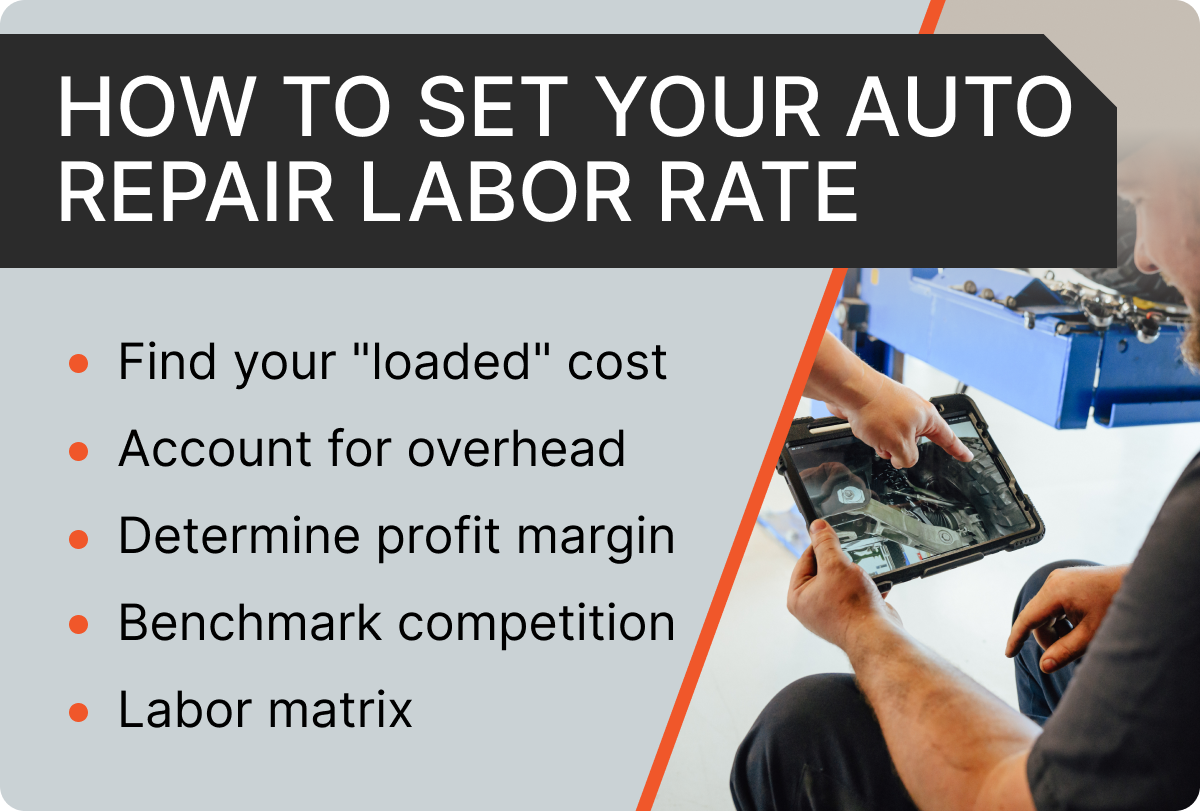
Step 1: Calculate your "loaded" labor cost

First, determine exactly what it costs you to pay an employee. This isn't just their hourly wage. You should include:

  • Wages and overtime.
  • Payroll taxes.
  • Benefits (Health insurance, 401k).
  • Workers' comp and liability insurance.
  • Training and certifications.
  • Any other benefits you provide employees.

Divide this total annual cost by the number of billable hours that the employee produces in a year. This is your "loaded" cost and does not include any profit margin.

Step 2: Account for overhead

Your labor revenue needs to cover more than just the employee. It must also cover the overhead costs of running an auto repair business:

  • Rent.
  • Utilities and shop supplies.

Step 3: Determine your desired profit margin

In the automotive industry, labor profit margins vary greatly, but most shops aim for 40-70%. If your loaded cost for a technician is $45 per hour and you want a 65% profit margin, your base mechanic labor rate should be at least $128 per hour.

Step 4: Benchmark against your competition

While your internal numbers should be your primary focus, you shouldn’t ignore the local market. If your labor rate is $128 per hour but every other independent shop in your town is at $100, you need to either justify your value through superior service or find ways to reduce your overhead. Make sure you benchmark against competitors of similar size, services offered, and geographically nearby.

Step 5: Implement a labor matrix

Not every repair order is the same. Many successful shops use a labor guide combined with a labor matrix that slightly increases the rate for more complex jobs or diagnostic work. Shops that perform more specialized repairs or focus on specialty vehicles should heavily consider implementing a labor matrix.

Which factors impact labor rates?

Your rate shouldn't be static. Several external and internal factors will influence how much you can—and should—charge for car repair services.

  • Location: A higher cost of living in cities like California or New York necessitates higher labor rates compared to rural towns. Your technicians need to earn enough to live nearby.
  • Shop type: A general auto repair shop usually has lower rates than a specialty Euro shop or a heavy-duty diesel facility. Specialization requires more expensive tools and higher-paid talent.
  • Certifications: If your team holds advanced ASE certifications or factory training, you provide more value. Customers are often willing to pay more for a repair estimate from a shop they trust to do it right the first time.
  • Warranty: If you offer a service warranty, you are taking on more risk and can charge more for the peace of mind.

5 Ways Tekmetric can help your shop be more profitable

Tekmetric can help you be more profitable by providing the features and reporting you need to make better business decisions. Tekmetric shops average a 65% labor profit margin by utilizing modern features that help you build trust with your customers and keep them coming back year after year.

  1. Custom labor matrix: Tekmetric allows you to set up labor matrices that automatically adjust your mechanic labor rate. This ensures you don’t undercharge for difficult work.
  2. Real-Time reports: Stop waiting until the end of the month to see if you made money. Tekmetric gives shop owners a real-time look at their gross profit, plus many other helpful metrics.
  3. Measuring effective labor rate: As we discussed, your posted rate isn't always what you take home. Tekmetric tracks your ELR automatically, showing you exactly where "leaks" (like excessive discounting or slow techs) are happening.
  4. Digital Vehicle Inspections (DVI): Higher rates are easier to justify when you can show the customer exactly why they need the work. Tekmetric’s DVIs build trust and increase customer satisfaction, making the price conversation much smoother.
  5. Technician efficiency: By tracking technician efficiency and productivity within the platform, you can see which members of your team are hitting their goals and which employees might need more coaching.

Final thoughts

Setting your labor rate requires constant attention to your local market, your internal costs, and the evolving complexity of car repair. By following these steps, you’ll ensure that your shop doesn't just keep cars running—it keeps your business thriving. If you have questions about Tekmetric or how we can help your shop be more profitable, book your free demo today.

Setting Your Automotive Repair Labor Rate (5-Step Guide)

March 19, 2026

Read time: 3 min

read more

When it comes to starting a business, you have a lot to consider.

How are you going to make sales?

Are your operations in order?

How will you approach legal, HR, and marketing?

But it’s important to not forget about one key part to getting your business off the ground: funding.

You’ll want to be well-versed in what to look for in a potential partnership whether you’re in the startup phase, the expansion phase, or even in a plateau phase.

By better preparing now, you’ll set your company up for future success.‍

Recently, Prasanth shared his thoughts about different kinds of funding with Texas CEO Magazine. You can read the full piece here, or check out some of the highlights below.

Determine The Right Equity Path For Your Business

The first step for any business owner should always consist of researching and selecting the right method of funding for your company. Once you’re confident in your company’s business model, your company’s current state, and any future aspirations for your company, you’ll want to determine the right equity path that can take your company where you want it to go.

1. Venture Capital

Venture capital is a more traditional route and is optimal for new entrepreneurs. If you have an idea for a potential business venture but aren’t sure exactly what to do with it just yet, venture capital could help you secure funding so that you can bring your ideas to fruition.

With venture capital, your partner will purchase a significant portion of the company, and in turn will offer support and guidance to nurture your company’s growth

2. Growth Equity

If your company has already excelled in the starting phases and needs another boost to continue expanding, you’ll want to consider growth equity—otherwise known as “rocket fuel.” Growth equity tends to be founder-centric and offers more autonomy and room to remain true to your company’s original core values and business model.

3. Private Equity

Companies that have reached the later stages of their business’ lifecycle may opt for private equity.

This route can be a good contender for companies that are at risk of going under due to lack of profits. Private equity can give your company the boost needed to prevent it from closing up shop.

Whoever you choose to partner with will take a large portion of your company’s ownership and will make significant changes to the company. However, the private equity route tends to yield bigger checks.

What Did Tekmetric Do For Funding?

Prasanth knows how important the right funding for your company is.

Prior to 2021, Tekmetric was in the startup and the small business stage, so the initial funding from friends and family was an avenue that worked out really well at the time

After 2021, Tekmetric started to expand exponentially. Tekmetric’s Co-CEOs and Co-Founders Prasanth and Sunil Patel realized that more growth could be possible if they changed from their personal network funding to the growth equity route.

Growth equity provided funding for additional initiatives, such as marketing, product research, and hiring. In turn, Tekmetric was able to pursue the vision that Prasanth and Sunil had outlined during the company’s beginning stage.

Find The Right Partner

You’ll want to be intentional about choosing any of your partnerships as a business owner, especially when it comes to finding the right funding partnerships.

The partner you decide to go with will help determine what your business’ tone and future will be like.

As you’re determining the right partnerships for you, ask yourself 5 questions:

  • Is the partner aligned with my business goals?
  • Do I trust this partner with my team and my business?
  • What will my relationship with this partner look like?
  • How much day-to-day involvement in my company does this partner expect?
  • Does this partner provide a reasonable amount of funding to support my goals?

No matter what equity direction you take, you’ll want to find a partnership dynamic that works for you, your business, and your team. As you’re choosing the right partner, remain transparent about any goals and expectations you have in mind for your company.

You won’t want to choose a partner solely based on numbers. The partnership will be a long-term business relationship—a marriage of sorts—and you should treat the partnership with thoughtfulness and respect.

What Did Tekmetric Do For Funding Partnerships?

At Tekmetric, Prasanth and Sunil knew whichever partner they selected to provide funding would play a significant role in the company’s future, and would have a strong impact on Tekmetric’s overall tone, goals, and growth.

At the time Prasanth and Sunil started looking for partners, Tekmetric was a well-established name throughout the auto repair industry, so they wanted a partner that would work alongside them, not just someone who would give them money and stay at a distance.

Eventually, Tekmetric found the right partner—one who is not only sensitive to the company’s needs but also the needs of Tekmetric’s customers.

Tek-Tip: Always ensure your partnerships are a two-way street.

As an auto repair shop management system, Tekmetric has long realized the importance of mutually beneficial partnerships. We’ve established partnerships along the way with companies like Mechanic Advisor and Advance Auto Parts Pro Solutions to help us better meet our customers’ needs.  In fact, Tekmetric has more than 30 industry partners (and counting) to ensure the most seamless possible experience.

Want to assess your general partnerships beyond funding? Find out what you should consider as a shop owner before entering into an auto repair shop partnership here.

Remain True To Your Business Yourself

No matter the equity path you choose to go or the partnerships you choose to take, you’ll want to stay true to your business’ core values and who you are as a business owner.

Rather than cutting corners, you can opt for the best possible solutions.

Prasanth said it best: financial support and equity can be confusing, and it’s easy to get lost in the numbers and forget why you started your business in the first place. However, the right partner will make all the difference.

After all, if you are putting significant time and effort into your idea, your company, and your team, you should expect a partner who supports your continued success long into the future.

→ Check out our latest blog on 12 marketing strategies to help you bring in more customers, or learn how you can become the ultimate leader for your team

A special thanks to Texas CEO Magazine for providing space for Prasanth to share his knowledge.

With a complete view of how all your shops are performing and access to the tools needed to make changes quickly, shop management systems help run your shop with smooth and agile business operations, provide a consistent experience for customers, and ultimately maximize revenue and support your shop's growth.

Features such as unified reporting across all your shops and shared customer history work to create seamless processes for managing your business as a centralized organization.