Tekmetric Multi-Shop is designed to give owners everything they need to manage multiple shops in one place. Our goal is to help your team gain back time, make more informed decisions, and maximize your shops’ margins!
Our latest update for Tekmetric Multi-Shop, Shared Customer History, does just that! With stronger cohesion between different locations, multi-shop owners and service advisors can simplify their workflow and provide a more seamless customer experience.
What is Shared Customer History?
Tekmetric Multi-Shop Shared Customer History allows users to connect customers across shops and view history for those customers across all locations within their organization in Tekmetric. With just a few clicks, shop owners and general managers can quickly add customers from one shop location to another without actually typing out all their information again. This means shops can provide a seamless customer experience across all locations and easily maintain customer information without worrying about duplicating entries.
Gain a better handle on your customer information and provide a better experience at the same time.
By linking customer data so that service writers have access to all past information -- digital vehicle inspections, estimates generated, approved or declined work, and completed repairs -- you can save your shop time while enabling a more personalized experience for the customer.
Remind customers of that declined brake job from your other location, or check up on the status of the leaky oil line to see if it's finally time for replacement. To the customer, this will feel like the truly modern experience they've grown accustomed to in this new digital age.
And they'll be impressed with how on-top-of-things your shop is!
How Shared Customer History Benefits Your Shops
Fewer clicks on your end means a more cohesive and streamlined process, which results in a smooth, frictionless experience for the customer:
Save time finding the information you need, and gain greater visibility into all shops
Build a seamless, personalized customer experience across all shops
Easily maintain data and ensure consistency across all locations
Grow your shops with increased customer retention thanks to a modern experience
Overall, Shared Customer History enables your shop to provide your customers with the same experience, no matter what location they visit. It’ll be like they're visiting the exact same business, with the same care and support they’ve already come to expect.
So, if that customer is on vacation or a business trip and has to stop by a different location for the first time, your shop will immediately have visibility into the history of everything they've done at your other locations, and you can pick up from where they left off like it’s the exact same shop.
And the benefits really don't stop there. There's so many ways to fuel your business's growth with the right multi-shop platform.
As a shop owner, you aren't just selling a car repair; you are selling expertise, specialized equipment, and peace of mind. If your rates are too low, you’ll struggle to keep the lights on. If they’re too high without the value to back them up, customers may opt for a competitor.
In this guide, we’ll walk through exactly how to find that "sweet spot" for your labor rate so you can build a sustainable, profitable shop.
How much should a mechanic charge per hour?
Mechanic shops should charge a labor rate that is competitive in their area, covers their overhead costs (rent, utilities, employees, etc.), and allows them to maintain a healthy profit margin (40-70%) to run the shop. Whether you are an independent shop or a large dealership, your labor rate and parts markup are your primary vehicles for maintaining profitability.
Key terms to know
Before we dive into the math, we need to understand these concepts.
Loaded labor rate: is the true cost of an employee, including their hourly wage, taxes, benefits, and insurance.
Hourly labor rate pricing: is the "posted" rate—the number your customers see on the repair estimate. It is the flat dollar amount you charge per billable hour.
Flat-Rate pricing: is a system where a specific repair is assigned a predetermined amount of time (e.g., a water pump replacement is "booked" at 3.4 hours). The customer pays for 3.4 hours regardless of whether the auto mechanic finishes in two hours or five.
Effective labor rate (ELR): is the real-world number that matters. It’s calculated by taking your total labor sales and dividing them by the actual hours your technicians worked.
How to set your automotive shop labor rate (step by step)
Setting your rate shouldn't be a guessing game based on what the guy down the street is charging. It should be a data-driven decision. Here is a step-by-step approach to finding your labor rate.
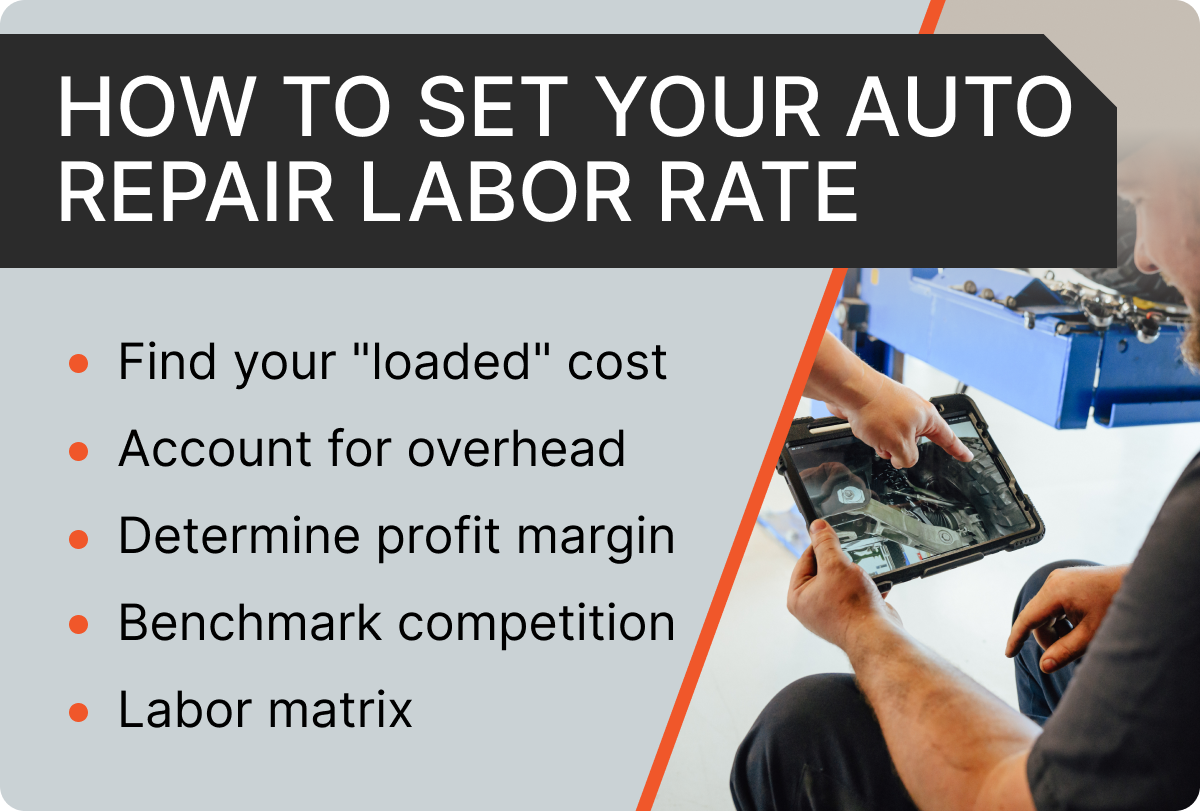
Step 1: Calculate your "loaded" labor cost
First, determine exactly what it costs you to pay an employee. This isn't just their hourly wage. You should include:
Wages and overtime.
Payroll taxes.
Benefits (Health insurance, 401k).
Workers' comp and liability insurance.
Training and certifications.
Any other benefits you provide employees.
Divide this total annual cost by the number of billable hours that the employee produces in a year. This is your "loaded" cost and does not include any profit margin.
Step 2: Account for overhead
Your labor revenue needs to cover more than just the employee. It must also cover the overhead costs of running an auto repair business:
In the automotive industry, labor profit margins vary greatly, but most shops aim for 40-70%. If your loaded cost for a technician is $45 per hour and you want a 65% profit margin, your base mechanic labor rate should be at least $128 per hour.
Step 4: Benchmark against your competition
While your internal numbers should be your primary focus, you shouldn’t ignore the local market. If your labor rate is $128 per hour but every other independent shop in your town is at $100, you need to either justify your value through superior service or find ways to reduce your overhead. Make sure you benchmark against competitors of similar size, services offered, and geographically nearby.
Step 5: Implement a labor matrix
Not every repair order is the same. Many successful shops use a labor guide combined with a labor matrix that slightly increases the rate for more complex jobs or diagnostic work. Shops that perform more specialized repairs or focus on specialty vehicles should heavily consider implementing a labor matrix.
Which factors impact labor rates?
Your rate shouldn't be static. Several external and internal factors will influence how much you can—and should—charge for car repair services.
Location: A higher cost of living in cities like California or New York necessitates higher labor rates compared to rural towns. Your technicians need to earn enough to live nearby.
Shop type: A general auto repair shop usually has lower rates than a specialty Euro shop or a heavy-duty diesel facility. Specialization requires more expensive tools and higher-paid talent.
Certifications: If your team holds advanced ASE certifications or factory training, you provide more value. Customers are often willing to pay more for a repair estimate from a shop they trust to do it right the first time.
Warranty: If you offer a service warranty, you are taking on more risk and can charge more for the peace of mind.
5 Ways Tekmetric can help your shop be more profitable
Tekmetric can help you be more profitable by providing the features and reporting you need to make better business decisions. Tekmetric shops average a 65% labor profit margin by utilizing modern features that help you build trust with your customers and keep them coming back year after year.
Custom labor matrix: Tekmetric allows you to set up labor matrices that automatically adjust your mechanic labor rate. This ensures you don’t undercharge for difficult work.
Real-Time reports: Stop waiting until the end of the month to see if you made money. Tekmetric gives shop owners a real-time look at their gross profit, plus many other helpful metrics.
Measuring effective labor rate: As we discussed, your posted rate isn't always what you take home. Tekmetric tracks your ELR automatically, showing you exactly where "leaks" (like excessive discounting or slow techs) are happening.
Digital Vehicle Inspections (DVI): Higher rates are easier to justify when you can show the customer exactly why they need the work. Tekmetric’s DVIs build trust and increase customer satisfaction, making the price conversation much smoother.
Technician efficiency: By tracking technician efficiency and productivity within the platform, you can see which members of your team are hitting their goals and which employees might need more coaching.
Final thoughts
Setting your labor rate requires constant attention to your local market, your internal costs, and the evolving complexity of car repair. By following these steps, you’ll ensure that your shop doesn't just keep cars running—it keeps your business thriving. If you have questions about Tekmetric or how we can help your shop be more profitable, book your free demo today.
More than anything, partnerships should be mutually beneficial to everyone involved. When good partnerships are formed, the whole should be worth more than the sum of its parts.
Why Should Your Auto Business Partner with Other Brands?
For example, McDonald’s burgers make you thirsty enough to want a Coca-Cola, and sodas have a high margin. By partnering up, McDonald’s can lock in their costs on soda and improve their profit margins for the long term.
On the other hand, not all partnerships are beneficial. Partnerships can expand your opportunities but can also force you into making decisions you never intended to make. When McDonald’s decided to partner with Coca-Cola, they had to exclude other soda brands from their locations.
This exclusivity may have been worth it, but it meant removing options from customers, such as Dr. Pepper and Pepsi products. What may have made the partnership intriguing for McDonald’s is the fact that Coca-Cola owns a variety of beverages, including Diet Coke, Fanta, Sprite, Powerade, Minute Maid and Pibb Xtra.
Thanks to a variety of options, McDonald’s is able to satisfy most customers who ask for a Dr. Pepper by saying, “Will Pibb Xtra be okay?”
Partnerships in the Auto Repair Industry
In the auto repair industry, we face similar challenges when it comes to partnering with other businesses and brands.
Potential partnerships may include teaming up with parts suppliers, software companies, marketing and trade show affiliates, and any other service, resource or tool that could potentially improve your shop. In some cases, these partnerships will help shop owners enhance performance, save costs and drive revenue.
Other times, auto partnerships may bind you to an agreement that doesn’t pay off.
Here are some questions you can ask yourself to determine whether a partnership is mutually beneficial or if they’re asking you for more than you’re getting in return.
1. Are You Free to Choose the Tools and Solutions You Want?
One sign of a bad partnership is being forced to do something you don’t want to do. If partnering with another company means taking valuable options off the table, then you may be at a disadvantage.
If your partner implies or directs you not to do business with their competitors because they would like for you to instead use their services or their partner’s services, think it through.
Before officially entering a partnership, imagine your shop one year, five years and ten years down the road. Where will it be then? What will happen if your shop grows? What if innovation has slowed down with your partner? Will you be allowed to innovate your business by using new tools and solutions that become available in the future?
If you’re restricted in a way that prevents you from innovating or adapting to market conditions by testing other products, tools, solutions, and software, you may be handcuffed and unable to compete with other shops.
One of the most challenging parts of being a service advisor is building trust with drivers. Many drivers already feel apprehensive about spending money on repairs, but you’re still tasked with letting them know exactly what’s wrong with their car. And sometimes, that means identifying more issues than they were expecting.
At Tekmetric, we’ve heard a lot of great tricks of the trade from service advisors like you. And we’ve designed Tekmetric with many of these insights in mind. By leveraging Tekmetric’s capabilities, you can more effectively upsell, cross-sell, and reach more customers—and see your shop’s ARO and gross profits rise.
Here are the best auto repair shop software features within Tekmetric to help you flourish in your role.





.svg)



.svg)

.svg)
.svg)
.svg)
.svg)
.svg)
.svg)