Setting Your Automotive Repair Labor Rate (5-Step Guide)

Benjamin Johnson

|

March 19, 2026

|

Read time: 3 min

As a shop owner, you aren't just selling a car repair; you are selling expertise, specialized equipment, and peace of mind. If your rates are too low, you’ll struggle to keep the lights on. If they’re too high without the value to back them up, customers may opt for a competitor.

In this guide, we’ll walk through exactly how to find that "sweet spot" for your labor rate so you can build a sustainable, profitable shop.

How much should a mechanic charge per hour?

Mechanic shops should charge a labor rate that is competitive in their area, covers their overhead costs (rent, utilities, employees, etc.), and allows them to maintain a healthy profit margin (40-70%) to run the shop. Whether you are an independent shop or a large dealership, your labor rate and parts markup are your primary vehicles for maintaining profitability.

Key terms to know

Before we dive into the math, we need to understand these concepts.

  • Loaded labor rate: is the true cost of an employee, including their hourly wage, taxes, benefits, and insurance.
  • Hourly labor rate pricing: is the "posted" rate—the number your customers see on the repair estimate. It is the flat dollar amount you charge per billable hour.
  • Flat-Rate pricing: is a system where a specific repair is assigned a predetermined amount of time (e.g., a water pump replacement is "booked" at 3.4 hours). The customer pays for 3.4 hours regardless of whether the auto mechanic finishes in two hours or five.
  • Effective labor rate (ELR): is the real-world number that matters. It’s calculated by taking your total labor sales and dividing them by the actual hours your technicians worked.

How to set your automotive shop labor rate (step by step)

Setting your rate shouldn't be a guessing game based on what the guy down the street is charging. It should be a data-driven decision. Here is a step-by-step approach to finding your labor rate.
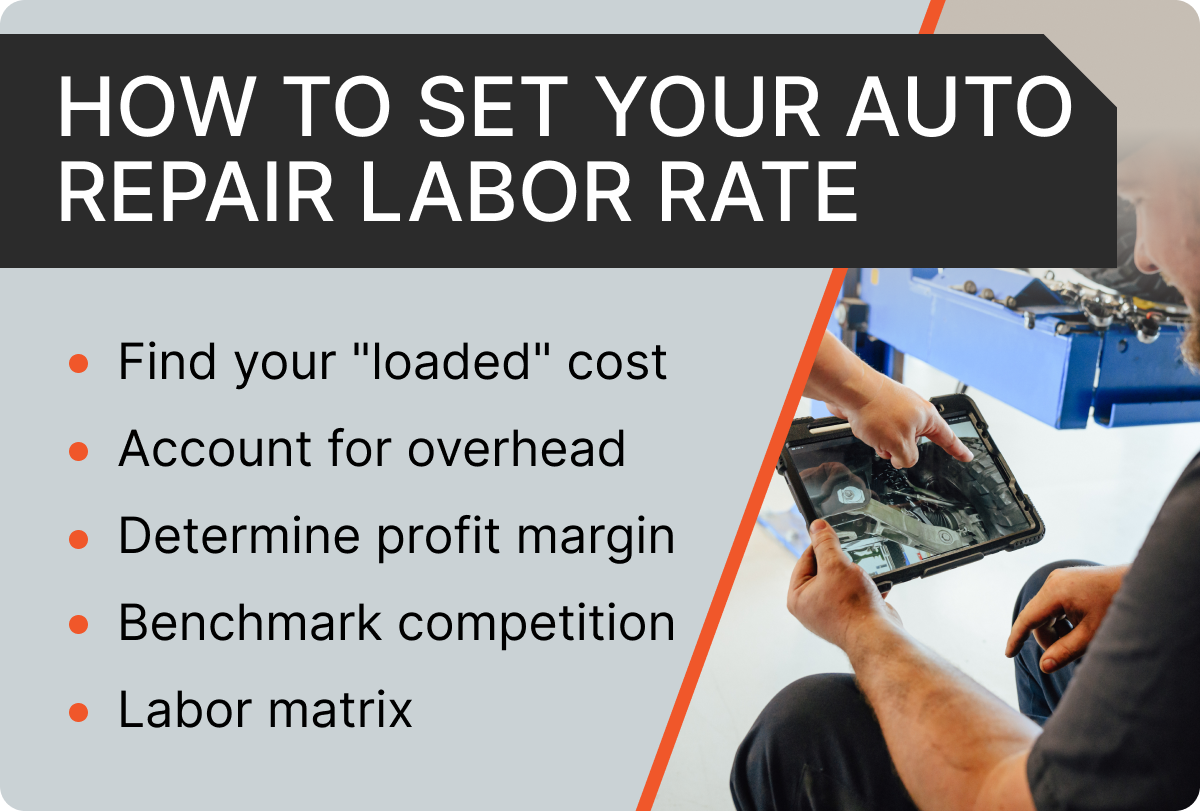
How to set your mechanic labor rate.

Step 1: Calculate your "loaded" labor cost

First, determine exactly what it costs you to pay an employee. This isn't just their hourly wage. You should include:

  • Wages and overtime.
  • Payroll taxes.
  • Benefits (Health insurance, 401k).
  • Workers' comp and liability insurance.
  • Training and certifications.
  • Any other benefits you provide employees.

Divide this total annual cost by the number of billable hours that the employee produces in a year. This is your "loaded" cost and does not include any profit margin.

Step 2: Account for overhead

Your labor revenue needs to cover more than just the employee. It must also cover the overhead costs of running an auto repair business:

  • Rent.
  • Utilities and shop supplies.

Step 3: Determine your desired profit margin

In the automotive industry, labor profit margins vary greatly, but most shops aim for 40-70%. If your loaded cost for a technician is $45 per hour and you want a 65% profit margin, your base mechanic labor rate should be at least $128 per hour.

Step 4: Benchmark against your competition

While your internal numbers should be your primary focus, you shouldn’t ignore the local market. If your labor rate is $128 per hour but every other independent shop in your town is at $100, you need to either justify your value through superior service or find ways to reduce your overhead. Make sure you benchmark against competitors of similar size, services offered, and geographically nearby.

Step 5: Implement a labor matrix

Not every repair order is the same. Many successful shops use a labor guide combined with a labor matrix that slightly increases the rate for more complex jobs or diagnostic work. Shops that perform more specialized repairs or focus on specialty vehicles should heavily consider implementing a labor matrix.

Which factors impact labor rates?

Your rate shouldn't be static. Several external and internal factors will influence how much you can—and should—charge for car repair services.

  • Location: A higher cost of living in cities like California or New York necessitates higher labor rates compared to rural towns. Your technicians need to earn enough to live nearby.
  • Shop type: A general auto repair shop usually has lower rates than a specialty Euro shop or a heavy-duty diesel facility. Specialization requires more expensive tools and higher-paid talent.
  • Certifications: If your team holds advanced ASE certifications or factory training, you provide more value. Customers are often willing to pay more for a repair estimate from a shop they trust to do it right the first time.
  • Warranty: If you offer a service warranty, you are taking on more risk and can charge more for the peace of mind.

5 Ways Tekmetric can help your shop be more profitable

Tekmetric can help you be more profitable by providing the features and reporting you need to make better business decisions. Tekmetric shops average a 65% labor profit margin by utilizing modern features that help you build trust with your customers and keep them coming back year after year.

  1. Custom labor matrix: Tekmetric allows you to set up labor matrices that automatically adjust your mechanic labor rate. This ensures you don’t undercharge for difficult work.
  2. Real-Time reports: Stop waiting until the end of the month to see if you made money. Tekmetric gives shop owners a real-time look at their gross profit, plus many other helpful metrics.
  3. Measuring effective labor rate: As we discussed, your posted rate isn't always what you take home. Tekmetric tracks your ELR automatically, showing you exactly where "leaks" (like excessive discounting or slow techs) are happening.
  4. Digital Vehicle Inspections (DVI): Higher rates are easier to justify when you can show the customer exactly why they need the work. Tekmetric’s DVIs build trust and increase customer satisfaction, making the price conversation much smoother.
  5. Technician efficiency: By tracking technician efficiency and productivity within the platform, you can see which members of your team are hitting their goals and which employees might need more coaching.

Final thoughts

Setting your labor rate requires constant attention to your local market, your internal costs, and the evolving complexity of car repair. By following these steps, you’ll ensure that your shop doesn't just keep cars running—it keeps your business thriving. If you have questions about Tekmetric or how we can help your shop be more profitable, book your free demo today.

👉 Ready to grow your automotive business? [Book a personalized Tekmetric Demo Here]

FAQ

More articles

We can't deny it, we're customer obsessed. That's why we went out of our way to visit shop owners who rely on Tekmetric every day! And part of why we're so customer-obsessed is because of how much our customers love Tekmetric, and its ability to empower shops.

That's why we’re celebrating another season as the leaders in the industry for shop management software!

Once again, for the third time in a row this year, G2 users have chosen Tekmetric as the leading solution for managing and revolutionizing their independent auto repair shop.

Tekmetric Chosen as the Clear Industry Leader

For their latest round of awards, Tekmetric was chosen as a clear industry leader for auto shop management software for the third time this year.

‍

‍

We've said it before, and we'll say it again, this is all because of shops like yours!

All the amazing independent shops that do great work every day with Tekmetric, the shops that keep people's vehicles safe and reliable. The heroes that get their customers back on the road every single day!

We were just chosen because you all love us so much!

There’s Always More to Come!

Thank you! Thank you for partnering with us, and thank you for helping us create the best possible solution for running an independent auto repair shop!

We're excited to be awarded and regarded so highly, and we strive to keep that level of excellence and support at every step in your shop.

Tekmetric is always being updated, and we’ll never stop working with and supporting shops to help them run efficiently and with fewer headaches, so you can focus on doing what you love!

If you're running an auto repair shop, investing in a car lift is essential. A high-quality vehicle lift makes it easier to work on cars, increases efficiency, and ensures safety. But how much does it actually cost to install a car lift? That depends on the type of lift, installation costs, and other factors such as weight capacity and safety features. Let’s break it all down so you can pick the best automotive lift for your needs.

Do you need a car lift?

Car lifts are essential in auto repair shops because they provide mechanics with better access to a vehicle’s undercarriage, making inspections, repairs, and maintenance tasks safer, more efficient, and more comfortable. Unlike floor jacks, lifts offer a stable and elevated workspace, reducing the risk of injuries and improving workflow.

With a car lift, technicians can quickly perform tasks such as oil changes, brake repairs, exhaust system work, and suspension adjustments without having to crawl under the vehicle. This efficiency leads to faster turnaround times and higher shop productivity.

Additionally, lifts help maximize shop space by allowing vertical storage for vehicles, which is especially useful in high-volume repair shops. Overall, car hoists are a fundamental investment for any auto repair shop looking to enhance efficiency, safety, and the quality of service provided to customers.

Types of car lifts and their costs

Each type of lift has its pros and cons. Some lifts are better for oil change shops and some are better for tire or repair shops. In general, car lifts can cost between $1,000 and $20,000 depending on brand, lift capacity, lift height, and features. Here’s a comprehensive look at the most common lift options for your shop.

An image comparing the cost of car lift types.

Two-Post car lifts

A two-post car lift is one of the most popular choices for auto repair shops. They are popular because they take up less space and can be affordable depending on features. Make sure to plan out your shop layout as these lifts are permanent and cannot be easily moved. These hoists come in asymmetric and symmetric configurations, allowing flexibility based on vehicle type.

  • Price: $3,000 - $10,000
  • Best For: General repair shops working on SUVs and smaller cars.
  • Lift capacity: 5,000 - 10,000 lbs.
  • Popular brands: BendPak, Rotary, Tuxedo.
  • Advantages: High lifting capacity while saving space for smaller shops.

Four-Post lifts

A four-post lift provides greater stability and weight capacity, making it ideal for heavier vehicles. If your shop works on a lot of trucks or heavy-duty vehicles, the four-post lift might be the best lift for you. Tire and brake shops should avoid these lifts as the tires sit on the lift making it difficult to work on these areas.

  • Price: $5,000 - $25,000
  • Best For: Dealerships and professional shops.
  • Lift capacity: 7,000 - 14,000 lbs.
  • Popular brands: BendPak, Titan, Tuxedo, Rotary.
  • Advantages: Heavier lifting capacity for larger vehicles.

Scissor lifts

If saving space is your top priority, the scissor lift may be your best option. They are almost invisible when not in use and lie flat on the ground to optimize garage space. Double check the lift capacity and height to make sure it can accommodate the types of vehicles you work on.

  • Price: $1,500 - $10,000
  • Best For: Quick repair shops where space is limited.
  • Lift capacity: 5,000 - 15,000 lbs.
  • Brands: QuickJack, BendPak, MaxJax
  • Advantages: Compact and cheaper.

In-Ground lifts

In-ground car lifts are a great choice for shops that work on heavier vehicles and want to save space. These lifts are the perfect balance of the space saving capabilities of a scissor lift while also providing optimal strength for large vehicles.

  • Price: $10,000 - $25,000
  • Best For: Repair shops and dealerships.
  • Lift capacity: 5,000 - 20,000 lbs.
  • Brands: BendPak, Rotary, Atlas
  • Advantages: Compact while also offering enough muscle.

Portable car lifts

If your shop layout frequently changes or you are a mobile mechanic, a portable lift may be the best option. These lifts can be easily moved around a garage or taken to a job site and are often the cheapest option. However, they can be less reliable and don’t provide the same level of strength as a stationary lift.

  • Price: $500 - $5,000
  • Best For: Home garages, mobile mechanics, DIY enthusiasts.
  • Lift capacity: 5,000 - 10,000 lbs.
  • Brands: QuickJack, MaxJax
  • Advantages: Affordable, compact, mobile.

Installation prices for car lifts

Installing a vehicle lift is not just about purchasing the unit. You also need to consider the installation costs, which can vary depending on the type of lift and garage setup. Here are the main factors affecting installation costs:

1. Concrete requirements

Most lifts, especially two-post car lifts and four-post lifts, require a thick concrete base. If your floor isn’t thick enough, you may need reinforcement, which adds to the cost.

2. Electrical setup

Lifts need power, and if your garage isn’t wired for it, you’ll need an electrician.

3. Air compressors & accessories

Some lifts require compressors and additional balancer tools for operation.

4. Professional installation

Hiring a pro ensures the lift is ALI-certified and meets safety regulations.

Choosing the right car lift for your auto repair shop

Each type of lift comes with its own advantages, making it important to choose the right one based on your needs. Here are some things to consider when making your decision:

  • How big is your shop?
  • Which repair services do you offer?
  • What is your budget?
  • Does the lift offer a warranty?
  • Will you garage layout change over time?
  • How important is a car lift warranty to you?
  • How heavy will the vehicles you work on be?
  • What is the average review rating of the lift?
  • How easy or hard is the lift to install?
  • How much will the maintenance cost?

Final thoughts

Installing a vehicle lift in your auto repair shop is a smart investment. Whether you choose a two-post car lift, scissor lifts, or portable lift, knowing the lift cost and installation costs upfront can help you budget wisely. Whatever you choose, ensure it’s ALI-certified for safety and performance. Lastly, don’t forget about regular maintenance and safety inspections to ensure your lift continues to run for many years.

How Much Does a Car Lift Cost + Installation Prices

March 21, 2025

Read time: 3 min

read more

What is a mobile mechanic?

Unlike traditional auto shops, mobile mechanics travel to their customers to provide automotive repairs and services at the clients home. This service is attractive to older clients who may not want to travel as much or for young professionals who are to busy to wait for their car at a shop. Another major perk is that mobile mechanics can often perform services at a cheaper price because of having lower overhead costs.

Mobile mechanics are not able to perform every repair that a brick-and-mortar shop can as they have to transport all of their tools and supplies with them. However, they can still provide these common repair services:

  • Oil changes
  • Diagnostics
  • Tire rotations/replacements
  • Filter replacements
  • Batteries
  • Spark plugs
  • Alternators
  • Brake service and more.

How profitable is a mobile mechanic business?

Mechanics can charge whatever they would like but most repairs fall in the $20 - $125 per hour range. Like any business, you have to consider your startup costs, advertising expenses, number of expected clients, and how much your services are worth before determining if your business will be profitable. Overwhelmed yet? Dont worry, we will explain everything in detail below.

6 Steps to become a mobile mechanic

While you may not need a college degree to be a quality mechanic, you will still have to invest in tools, licensing, marketing and other business needs. We have outlined everything you need to start your business below.

Six steps to become a mobile mechanic.

Develop a Business plan

Starting with a quality business plan for your business is the first step in making sure you start off on the right foot. Outlining who your competitors are, setting goals and solidifying your financials may seem outdated but they are the foundations of your business. Here are nine steps to creating your business plan:

  1. Write an executive summary
  2. Describe your shop
  3. State your business goals
  4. Describe your products and services
  5. Do your market research
  6. Outline your marketing and sales plan
  7. Perform a business financial analysis
  8. Make financial projections
  9. Create a plan for growth and expansion

Tek-Tip: If you want to jump start your business, consider joining a mobile mechanic business like Wrench.

Gather necessary licenses and certifications

Once you have created your business plan, it is time to start working on your business license. Not every state requires you to acquire a license but some do. Do your research for the state you plan to work in and make sure you are legally ready to open your auto repair shop.

The most common certifications include:

  • ASE certification: Also known as the National Institute for Automotive Service Excellence. Being one of the largest accreditation organizations, ASE is commonly recognized throughout the auto industry.
  • Manufacturer certification: Mechanics may elect to gain additional certifications from specific manufacturers (Honda, Toyota, etc.) to add to their credibility. These certifications are also recommended if you only work on certain types of cars.
  • Refrigerant certification: If you plan to work on MVAC (motor vehicle air conditioners), the EPA requires you to obtain certification in proper refrigerant handling according to Section 609 regulations from the Clean Air Act.

Also, don’t forget to register your business and form the appropriate legal entity (partnership, sole proprietorship, limited liability, or corporation). Each entity has pros and cons, so consult with a legal professional to make sure you are ready to file taxes with the IRS and open your own business.

Set your pricing structure

Your cost per hour or per repair should be reflective of your years of experience, geographical location, types of services performed and competition. Doing some competitor research will help you determine how much clients are willing to pay in your area.

Some mobile mechanics can charge more if they offer premium services or more complicated repairs. If you are new to the area, it may be beneficial to keep your costs low until you have a solid client base. Don’t forget that you can also make money off of part markups.

Lastly, remember to account for inflation, sales tax, parts, and gas for your vehicle. Depending on your payment options, you will also need to account for credit card processing fees. Auto repair can be a seasonal industry (especially in certain states), so make sure to stow away some revenue for slower months.

Insurance coverage

If you are going make an investment in your mobile auto repair business, you need to protect it with the proper insurance coverage. Some of the common insurance plans you should consider include:

  • Liability insurance
  • Comprehensive coverage
  • Fire and theft insurance
  • Road risks insurance

Lastly, decide if you will be offering any warranties on your services/parts and how that will impact your bottom line.

Invest in quality equipment

  • Tools: A reliable power source, jack or portable car lift, drain pans, safety equipment, scanners, cleaning sprays, diagnostic equipment and gloves are all important to have on hand. Also, don’t forget a proper lighting source.
  • Parts: Having commonly needed auto parts in your inventory will save you time rather than waiting for parts to be delivered to you. However, you should also determine how much inventory space you have and how to maximize it.
  • Software: A cheat code for mobile mechanics is adding cloud-based auto repair software that can help you keep track of inventory, invoices, billing, inspections, marketing, and more all in one place.
  • Vehicle: Reliable transportation is critical for mobile mechanics. Select a vehicle that has enough storage to accommodate large parts and good fuel economy for longer trips. Lastly, don’t forget to bring shelter in case of inclement weather so you can continue to work in the elements.

Tek-Tip: If you need help coming up with a mobile mechanic business name, we have developed a guide to the best auto repair business names. In addition, we developed an AI-powered name generator tool that can also help with logo creation.

Marketing and advertising

You can offer the best mobile mechanic service in your state but without a proper marketing strategy, customers may struggle to find you. Here are some common marketing efforts that will help you build a strong customer base.

  • Website: A strong website is the glue that holds all of your marketing efforts together by providing a central location to find prices, services, phone number, and more. Make sure your website reflects what makes you better than your competition. SEO (search engine optimization) is another important factor to include in your website to ensure you are visible to those searching online for your services.

Tek-Tip: Not tech savvy? Tekmetric Marketing can help by offering website building, online scheduling, review management, and more.

  • Paid advertising: Strategize where your target audience is located and how you can leverage paid advertisements to attract more customers. Possible opportunities include Google ads, social media ads, local event sponsorship and more.
  • Social media: Social media is a great place to highlight customer testimonials and engage with your audience. Experiment with varying content types until you find what resonates with your customers.
  • Traditional marketing: Mailers, business cards, flyers, billboards and direct mail can all be impactful marketing tactics for local businesses. Considering adding a QR code pointing users to your website or adding coupons to incentivize customers.
  • Referral program: Testimonials go a long way for word-of-mouth marketing. Consider offering a discount on future services for each new customer they refer to your business.
  • Email: Email marketing is a great way to retain existing customers by offering incentives or coupons to ensure your car repair business stays top of mind. Another impactful email marketing tactic is to send oil change reminders to existing clients.

Closing Thoughts

Starting a mobile mechanic business can be intimidating but the flexible working hours, independence and profitability make it worthwhile. Being a small business owner is not for everyone, consider starting out as part time and move into full time as your profitability grows. Don’t forget to utilize your network to learn industry trends and new tactics to grow your business.

How to Start a Mobile Mechanic Business (6 Step Guide)

October 31, 2024

Read time: 3 min

read more