How to Start a Mobile Mechanic Business (6 Step Guide)

Benjamin Johnson

|

October 31, 2024

|

Read time: 3 min

What is a mobile mechanic?

Unlike traditional auto shops, mobile mechanics travel to their customers to provide automotive repairs and services at the clients home. This service is attractive to older clients who may not want to travel as much or for young professionals who are to busy to wait for their car at a shop. Another major perk is that mobile mechanics can often perform services at a cheaper price because of having lower overhead costs.

Mobile mechanics are not able to perform every repair that a brick-and-mortar shop can as they have to transport all of their tools and supplies with them. However, they can still provide these common repair services:

  • Oil changes
  • Diagnostics
  • Tire rotations/replacements
  • Filter replacements
  • Batteries
  • Spark plugs
  • Alternators
  • Brake service and more.

How profitable is a mobile mechanic business?

Mechanics can charge whatever they would like but most repairs fall in the $20 - $125 per hour range. Like any business, you have to consider your startup costs, advertising expenses, number of expected clients, and how much your services are worth before determining if your business will be profitable. Overwhelmed yet? Dont worry, we will explain everything in detail below.

6 Steps to become a mobile mechanic

While you may not need a college degree to be a quality mechanic, you will still have to invest in tools, licensing, marketing and other business needs. We have outlined everything you need to start your business below.

Six steps to become a mobile mechanic.

Develop a Business plan

Starting with a quality business plan for your business is the first step in making sure you start off on the right foot. Outlining who your competitors are, setting goals and solidifying your financials may seem outdated but they are the foundations of your business. Here are nine steps to creating your business plan:

  1. Write an executive summary
  2. Describe your shop
  3. State your business goals
  4. Describe your products and services
  5. Do your market research
  6. Outline your marketing and sales plan
  7. Perform a business financial analysis
  8. Make financial projections
  9. Create a plan for growth and expansion

Tek-Tip: If you want to jump start your business, consider joining a mobile mechanic business like Wrench.

Gather necessary licenses and certifications

Once you have created your business plan, it is time to start working on your business license. Not every state requires you to acquire a license but some do. Do your research for the state you plan to work in and make sure you are legally ready to open your auto repair shop.

The most common certifications include:

  • ASE certification: Also known as the National Institute for Automotive Service Excellence. Being one of the largest accreditation organizations, ASE is commonly recognized throughout the auto industry.
  • Manufacturer certification: Mechanics may elect to gain additional certifications from specific manufacturers (Honda, Toyota, etc.) to add to their credibility. These certifications are also recommended if you only work on certain types of cars.
  • Refrigerant certification: If you plan to work on MVAC (motor vehicle air conditioners), the EPA requires you to obtain certification in proper refrigerant handling according to Section 609 regulations from the Clean Air Act.

Also, don’t forget to register your business and form the appropriate legal entity (partnership, sole proprietorship, limited liability, or corporation). Each entity has pros and cons, so consult with a legal professional to make sure you are ready to file taxes with the IRS and open your own business.

Set your pricing structure

Your cost per hour or per repair should be reflective of your years of experience, geographical location, types of services performed and competition. Doing some competitor research will help you determine how much clients are willing to pay in your area.

Some mobile mechanics can charge more if they offer premium services or more complicated repairs. If you are new to the area, it may be beneficial to keep your costs low until you have a solid client base. Don’t forget that you can also make money off of part markups.

Lastly, remember to account for inflation, sales tax, parts, and gas for your vehicle. Depending on your payment options, you will also need to account for credit card processing fees. Auto repair can be a seasonal industry (especially in certain states), so make sure to stow away some revenue for slower months.

Insurance coverage

If you are going make an investment in your mobile auto repair business, you need to protect it with the proper insurance coverage. Some of the common insurance plans you should consider include:

  • Liability insurance
  • Comprehensive coverage
  • Fire and theft insurance
  • Road risks insurance

Lastly, decide if you will be offering any warranties on your services/parts and how that will impact your bottom line.

Invest in quality equipment

  • Tools: A reliable power source, jack or portable car lift, drain pans, safety equipment, scanners, cleaning sprays, diagnostic equipment and gloves are all important to have on hand. Also, don’t forget a proper lighting source.
  • Parts: Having commonly needed auto parts in your inventory will save you time rather than waiting for parts to be delivered to you. However, you should also determine how much inventory space you have and how to maximize it.
  • Software: A cheat code for mobile mechanics is adding cloud-based auto repair software that can help you keep track of inventory, invoices, billing, inspections, marketing, and more all in one place.
  • Vehicle: Reliable transportation is critical for mobile mechanics. Select a vehicle that has enough storage to accommodate large parts and good fuel economy for longer trips. Lastly, don’t forget to bring shelter in case of inclement weather so you can continue to work in the elements.

Tek-Tip: If you need help coming up with a mobile mechanic business name, we have developed a guide to the best auto repair business names. In addition, we developed an AI-powered name generator tool that can also help with logo creation.

Marketing and advertising

You can offer the best mobile mechanic service in your state but without a proper marketing strategy, customers may struggle to find you. Here are some common marketing efforts that will help you build a strong customer base.

  • Website: A strong website is the glue that holds all of your marketing efforts together by providing a central location to find prices, services, phone number, and more. Make sure your website reflects what makes you better than your competition. SEO (search engine optimization) is another important factor to include in your website to ensure you are visible to those searching online for your services.

Tek-Tip: Not tech savvy? Tekmetric Marketing can help by offering website building, online scheduling, review management, and more.

  • Paid advertising: Strategize where your target audience is located and how you can leverage paid advertisements to attract more customers. Possible opportunities include Google ads, social media ads, local event sponsorship and more.
  • Social media: Social media is a great place to highlight customer testimonials and engage with your audience. Experiment with varying content types until you find what resonates with your customers.
  • Traditional marketing: Mailers, business cards, flyers, billboards and direct mail can all be impactful marketing tactics for local businesses. Considering adding a QR code pointing users to your website or adding coupons to incentivize customers.
  • Referral program: Testimonials go a long way for word-of-mouth marketing. Consider offering a discount on future services for each new customer they refer to your business.
  • Email: Email marketing is a great way to retain existing customers by offering incentives or coupons to ensure your car repair business stays top of mind. Another impactful email marketing tactic is to send oil change reminders to existing clients.

Closing Thoughts

Starting a mobile mechanic business can be intimidating but the flexible working hours, independence and profitability make it worthwhile. Being a small business owner is not for everyone, consider starting out as part time and move into full time as your profitability grows. Don’t forget to utilize your network to learn industry trends and new tactics to grow your business.

👉 Ready to grow your automotive business? [Book a personalized Tekmetric Demo Here]

FAQ

More articles

He and Sunil Patel started Tekmetric in 2016, and today, it’s become the preferred auto tech software in the auto repair industry.

Prasanth’s success prompted Authority Magazine to contact him for an interview on the formula for scaling success.

Below are just a few excerpts of Prasanth’s interview with Ken Babcock (CEO of Tango), along with bonus content for any entrepreneur seeking to scale their business.

Scaling with People

Let’s look at each component.

The Right People.

First, you have to have the team that serves your company the best.

At Tekmetric, we learned this the hard way. We had a phenomenal idea — but our first team wasn’t comprised of exactly all the people we needed.

And that meant we failed in the first round. It was disappointing, but we learned a valuable lesson, and the next round, we hired people based on the talents we knew we needed. It was the right move, and it set us in the right direction toward success. In fact, many of the team members from this second group are still with us today.

Tekmetric’s People Today: The Best Support in the Industry

Today, Tekmetric has a growing team of people working in various departments, such as customer support, sales, product development, and human resources.

Walk into our Houston headquarters, and you’ll see people from all backgrounds catching up on their week, discussing the next product update, or talking about the future of our company over a cup of coffee.

A large portion of our team works remotely. We have employees across the United States, including: </p><ul>

  • Cleveland, OH
  • Washington, DC
  • Denver, CO
  • San Diego, CA

But no matter where our team members are, one of the big things they have in common is that they’re passionate about providing Tekmetric’s customers with the best experience and support possible.

Our support team in particular is easy to get in touch with.

Customers don’t have to spend hours listening to annoying “waiting” music on the phone or anxiously sitting in front of their computers for a response to a support ticket.

The Tekmetric support team acts to get questions answered quickly and any issues resolved fast.

After all, auto tech software needs to move at the pace of the auto repair industry—fast—and support is an important part of that process.

Sound like you would fit in? Join us!

Scaling with Direction

You also have to know the direction you’re going.

Having the idea is great; getting it right as you grow is vital. You may not have the details fully fleshed out, but you must know what you want to do and the tools you need to get there.

I’ve always said, if you have a goal in mind, and you don’t know how to get there, then you’re doing something right.

If you do know how to get there, you’re not thinking big enough. Think long and hard about what you want your business to look like.

Once you figure out those initial steps and orient yourself in the right direction, you can think ahead to challenges like growing and scaling.

Tekmetric’s Direction Today: Driving the Auto Repair Industry Into the Future

The Tekmetric team keeps a close eye on what’s happening in the auto repair industry so that we can stay one step ahead when it comes to driving the auto repair industry into the future.

For example, Tekmetric listened to its customers’ desires for a true two-way texting feature, which enables shops and their customers to communicate more seamlessly than ever before.

Tekmetric also frequently adds to its list of integrations with industry-leading tools so that shop owners can set up workflows that work best for them.

And Tekmetric listens to what shop owners, technicians, and service advisors are saying, taking their feedback and suggestions into account.

We know that we cannot do this on our own, and respect the contributions of people throughout the industry.

The Successful Auto Tech Software Scaling Formula

May 25, 2022

Read time: 3 min

read more

"Innovation is the ability to see change as an opportunity—not a threat.” - Steve Jobs

Like any business owner, auto repair shop owners must consider all aspects of their business: operations, marketing, collections, bookkeeping, payroll, profitability, and customer service.

But how do you track, monitor, and gain control over these various business functions and analyze the relationship between them? Many shop owners turn to automotive computer programs as a solution, but there are a lot of options to consider. As you research automotive computer programs, you may be asking yourself:

Is it better to have one program for each business function, or one system that covers various aspects? What is the right mix of programs?

Tekmetric is a cloud-based shop management system; but that doesn’t mean all other software and systems out there align with what our software can do. Some automotive computer programs cover diagnostics, some focus on marketing, some focus on digital inspections, and there are some systems out there that check off most—if not all—the boxes.

There is a lot to consider when determining which automotive computer programs are right for your business, and we want to make sure your shop’s needs are met.

How Automotive Computer Programs Fuels Business Innovation

May 22, 2023

Read time: 3 min

read more

Every vehicle that rolls into your shop is an opportunity to protect a customer's family, uncover real problems before they become roadside emergencies, and build the kind of trust that earns repeat business—but only if your team catches what matters every time.

A consistent inspection process is how shops do that. And when you pair it with the right tools, it pays off: Tekmetric shops using Digital Vehicle Inspections (DVIs) average $741 per repair order, compared to $612 without them.

Below, you'll find a downloadable 100-point vehicle inspection checklist, a breakdown of what every technician should check, and an overview of how digital vehicle inspections can sharpen your workflow.

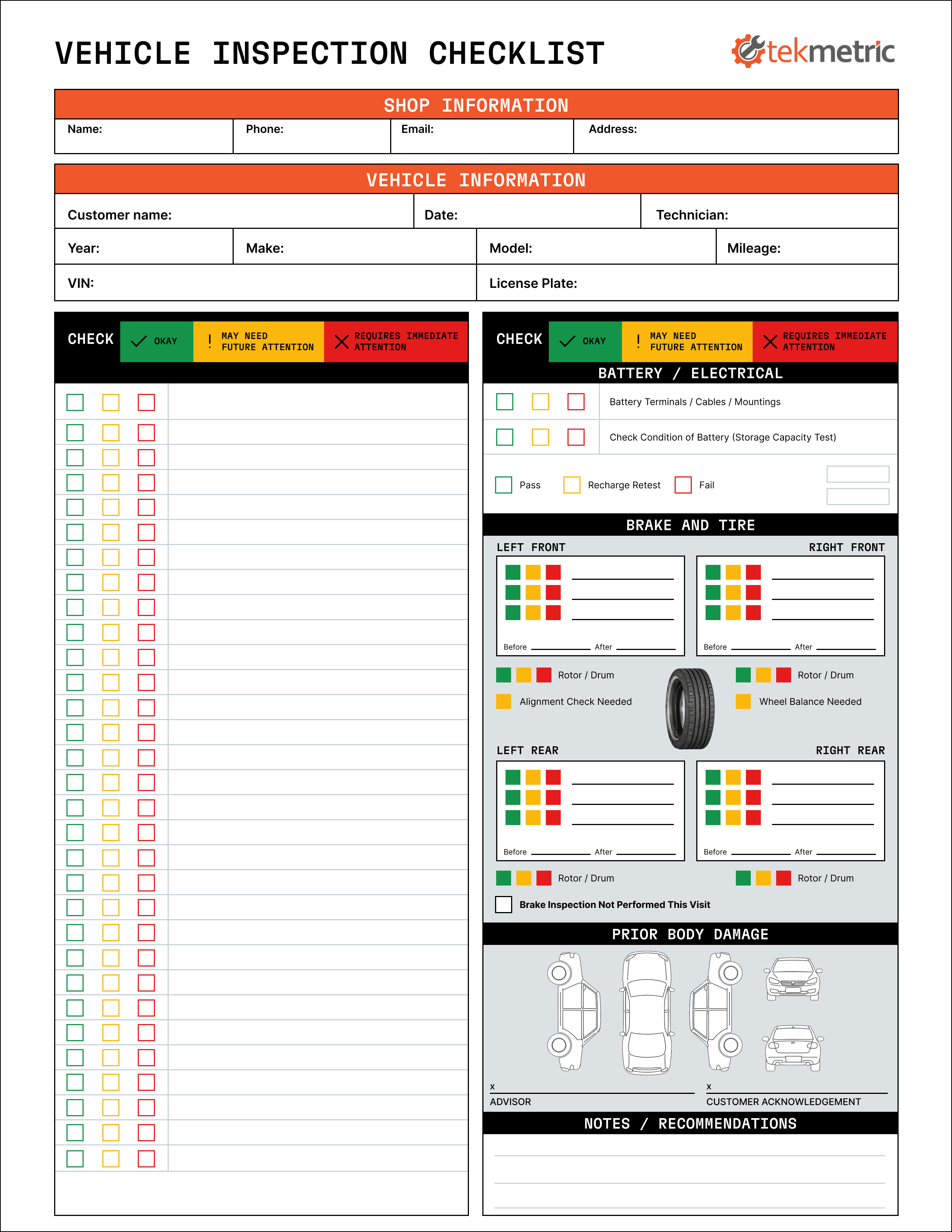
Printable vehicle inspection checklist (PDF)

Free Download: Download our comprehensive vehicle inspection checklist (PDF) to use in your shop.

Vehicle inspection checklist template.

100-Point vehicle inspection checklist

A full inspection covers every system that affects safety, drivability, and reliability. The comprehensive 100-point checklist below gives your technicians a strong baseline they can follow on every repair order.

Vehicle intake

  1. Log the VIN and license plate to confirm the vehicle's identity and match past service records.
  2. Record odometer reading in and out.
  3. Note customer-reported concerns and the reason for the visit.
  4. Document the fuel level at drop-off.
  5. Check for open safety recalls tied to the VIN.
  6. Gather customer contact information.

Do you like free resources? Download our free automotive repair work order template to use in your shop.

Exterior condition

  1. Check the body for dents, scratches, and any signs of damage.
  2. Inspect the bumpers front and rear for cracks, loose mounts, or impact marks.
  3. Confirm the license plate is secure, legible, and properly mounted.
  4. Note any rust, paint issues, or trim damage.
  5. Inspect fenders, rocker panels, and body panel alignment.
  6. Inspect glass, windshield, and mirrors for chips, cracks, or pitting.
  7. Check door handles, hinges, and weather stripping.
  8. Inspect child safety locks.
  9. Inspect the trailer hitch.

Lights and electrical

  1. Headlights on low and high beam.
  2. Taillights and brake lights.
  3. Turn signals front and rear.
  4. Hazard flashers.
  5. License plate lights and dashboard illumination.
  6. Reverse lights, fog lights, and daytime running lights.
  7. Interior dome, map, and courtesy lights.
  8. Any warning light that's illuminated on the dashboard. A check engine light, ABS warning, or airbag indicator tells you where to focus diagnostic time.
  9. Battery voltage, terminals, and charge/discharge load test.
  10. Alternator output and starter draw.
  11. Ignition switch and accelerator pedal function.
  12. Horn operation.

Tires and wheels

  1. Check tire pressure on all four tires plus the spare.
  2. Measure tire tread depth.
  3. Check for uneven wear patterns that can point to alignment or suspension issues.
  4. Inspect sidewalls for cracks, bulges, or embedded objects.
  5. Check valve stems and caps for leaks or damage.
  6. Review the tire DOT date code for age.
  7. Verify wheel condition, lug nut torque, and hub cap security.
  8. Check the spare tire, jack, lug wrench, and locking wheel lock key.
  9. Confirm the tire pressure monitoring system (TPMS) is functioning.

Brake system

  1. Check brake pads for thickness and wear patterns.
  2. Inspect rotors for scoring, warping, or excessive wear.
  3. Examine brake drums and shoes, if equipped.
  4. Check brake calipers for sticking, leaks, or damaged boots.
  5. Check brake fluid level and condition at the master cylinder.
  6. Examine brake lines and hoses for cracks or leaks.
  7. Test parking brake function and adjustment.
  8. Evaluate overall brake pedal feel, travel, and pulsation.
  9. Verify ABS sensors, wiring, and warning light operation.

Steering and suspension

  1. Inspect the steering wheel for play and responsiveness.
  2. Check steering column and intermediate shaft for looseness.
  3. Check power steering fluid level and condition.
  4. Examine tie rods and ball joints for wear.
  5. Check struts for leaks or damage.
  6. Inspect shock absorbers for proper dampening and leaks.
  7. Check CV boots and axle shafts.
  8. Inspect wheel bearings for noise or excessive play.
  9. Inspect sway bar links, bushings, and control arms.
  10. Look for uneven ride height or sagging that can indicate a failing spring.

Under the hood

  1. Check the battery capacity.
  1. Check engine oil level and condition.
  2. Check the oil filter for leaks and proper seating.
  3. Inspect transmission fluid.
  4. Check coolant level, condition, and the cooling system for leaks.
  5. Inspect brake fluid, power steering fluid, and washer fluid reservoirs.
  6. Inspect the battery, cables, and hold-down hardware.
  7. Examine the serpentine belt and any drive belts for cracks, glazing, or fraying.
  8. Check all hoses for soft spots, swelling, bulges, or leaks.
  9. Inspect the engine air filter and cabin air filter.
  10. Check the fuel filter, if serviceable.
  11. Inspect the PCV valve and evaporative emissions components.
  12. Check the radiator and condenser fins for debris or damage.
  13. Check engine and transmission mounts.
  14. Look for oil leaks at the valve cover, oil pan, and gaskets.
  15. Test the spark plugs and ignition components.
  16. Inspect air intake.
  17. Inspect fuses.

Under the car

  1. Check the exhaust system for leaks, rust, and damaged hangers.
  2. Inspect the muffler, resonator, and heat shields.
  3. Inspect fuel system components, lines, and the fuel tank for leaks or corrosion.
  4. Look at the transmission and differential housings for leaks.
  5. Check the oil pan and drain plug for seepage or stripped threads.
  6. Examine the frame, subframe, and undercarriage for rust or impact damage.
  7. Check emissions-related components like the catalytic converter and oxygen sensors.
  8. Inspect the driveshaft, U-joints, and center support bearings.
  9. Verify skid plates and underbody shielding are secure.
  10. Scan the ground under the vehicle for any fluid drips or leaks.

Interior and safety equipment

  1. Test seat belts for retraction, fraying, and buckle function.
  2. Confirm airbag and supplemental restraint indicators clear properly.
  3. Inspect windshield wipers and wiper blades for streaking or splitting.
  4. Test washer fluid spray on the windshield and rear glass, if equipped.
  5. Inspect interior warning lights.
  6. Check AC, heat, and all fan speeds.
  7. Test front and rear defrosters.
  8. Inspect infotainment displays and systems.
  9. Test door locks, power windows, and the key fob.
  10. Inspect driver-assist systems, backup camera, and parking sensors.
  11. Inspect lane departure systems.

Road test

  1. Confirm smooth engine start and stable idle.
  2. Evaluate transmission shift quality and clutch engagement, if manual.
  3. Test braking response, pedal feel, and stopping distance.
  4. Listen and feel for suspension noise, vibration, or harshness.
  5. Check cruise control and driver-assist system operation.
  6. Note any dashboard warning indicator, abnormal smoke from the exhaust, or unusual vibration that appears during the drive.

What are digital vehicle inspections (DVIs)?

Paper inspection checklists worked for decades, but they come with real costs: illegible handwriting, lost sheets, no documentation, and frustrating back-and-forth among the technician, service advisor, and customer.

Digital Vehicle Inspections change that. With Tekmetric, your technicians perform the inspection on a tablet or phone, attach photos and videos of anything that needs attention, and send a vehicle health report straight to the customer's phone.

Here's what that looks like in practice: A technician notices worn brake pads on a 2019 Toyota Highlander. Instead of writing a note the customer may not understand, the technician snaps a photo of the worn pad next to a new one, records a short video, and marks the task red for immediate attention. The service advisor builds the estimate and texts it to the customer. Whether they're an in-store customer in the waiting room or at work across town, the customer approves the job with a digital signature.

Tired of piles of paper inspections? Upgrade your shop with digital vehicle inspections. Send inspections to the customer for approval with the visual proof needed to close the deal.

Why car inspections matter

Every car owner is counting on your team to catch what they can't see. A consistent inspection process gives your technicians a repeatable way to do exactly that on every repair order, every time.

Inspections also drive revenue. When you document a vehicle's condition clearly with photos and notes, customers understand exactly what their car needs and why. They approve more of the work they genuinely need when they can see the evidence.

Build customer trust with digital vehicle inspections

A great inspection process isn't about checking boxes. It's about giving every vehicle owner a clear, honest picture of their car's condition so they can make informed decisions about their safety and their budget. When your shop pairs a thorough inspection process with a digital tool like Tekmetric's DVI, you give your team the speed and consistency they need and your customers the transparency they want.

Your next inspection starts with the right checklist. Download the free 100-point vehicle inspection checklist or upgrade to digital vehicle inspections.

Free Vehicle Inspection Checklist (Printable PDF)

April 22, 2026

Read time: 3 min

read more