
Free Vehicle Inspection Checklist (Printable PDF)

Benjamin Johnson

|

April 22, 2026

|

Read time: 3 min

Every vehicle that rolls into your shop is an opportunity to protect a customer's family, uncover real problems before they become roadside emergencies, and build the kind of trust that earns repeat business—but only if your team catches what matters every time.

A consistent inspection process is how shops do that. And when you pair it with the right tools, it pays off: Tekmetric shops using Digital Vehicle Inspections (DVIs) average $741 per repair order, compared to $612 without them.

Below, you'll find a downloadable 100-point vehicle inspection checklist, a breakdown of what every technician should check, and an overview of how digital vehicle inspections can sharpen your workflow.

Printable vehicle inspection checklist (PDF)
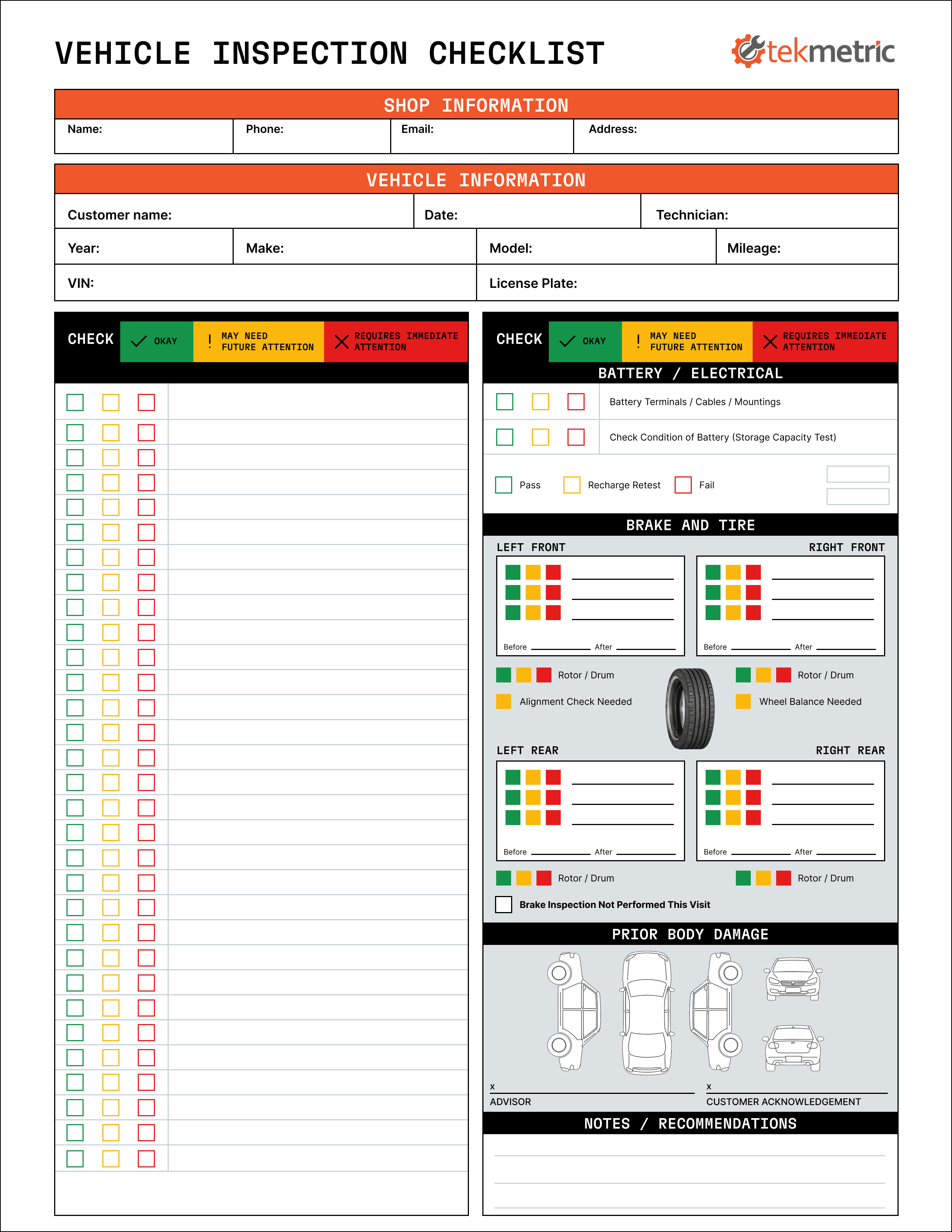
Free Download: Download our comprehensive vehicle inspection checklist (PDF) to use in your shop.

Vehicle inspection checklist template.

100-Point vehicle inspection checklist

A full inspection covers every system that affects safety, drivability, and reliability. The comprehensive 100-point checklist below gives your technicians a strong baseline they can follow on every repair order.

Vehicle intake

  1. Log the VIN and license plate to confirm the vehicle's identity and match past service records.
  2. Record odometer reading in and out.
  3. Note customer-reported concerns and the reason for the visit.
  4. Document the fuel level at drop-off.
  5. Check for open safety recalls tied to the VIN.
  6. Gather customer contact information.

Do you like free resources? Download our free automotive repair work order template to use in your shop.

Exterior condition

  1. Check the body for dents, scratches, and any signs of damage.
  2. Inspect the bumpers front and rear for cracks, loose mounts, or impact marks.
  3. Confirm the license plate is secure, legible, and properly mounted.
  4. Note any rust, paint issues, or trim damage.
  5. Inspect fenders, rocker panels, and body panel alignment.
  6. Inspect glass, windshield, and mirrors for chips, cracks, or pitting.
  7. Check door handles, hinges, and weather stripping.
  8. Inspect child safety locks.
  9. Inspect the trailer hitch.

Lights and electrical

  1. Headlights on low and high beam.
  2. Taillights and brake lights.
  3. Turn signals front and rear.
  4. Hazard flashers.
  5. License plate lights and dashboard illumination.
  6. Reverse lights, fog lights, and daytime running lights.
  7. Interior dome, map, and courtesy lights.
  8. Any warning light that's illuminated on the dashboard. A check engine light, ABS warning, or airbag indicator tells you where to focus diagnostic time.
  9. Battery voltage, terminals, and charge/discharge load test.
  10. Alternator output and starter draw.
  11. Ignition switch and accelerator pedal function.
  12. Horn operation.

Tires and wheels

  1. Check tire pressure on all four tires plus the spare.
  2. Measure tire tread depth.
  3. Check for uneven wear patterns that can point to alignment or suspension issues.
  4. Inspect sidewalls for cracks, bulges, or embedded objects.
  5. Check valve stems and caps for leaks or damage.
  6. Review the tire DOT date code for age.
  7. Verify wheel condition, lug nut torque, and hub cap security.
  8. Check the spare tire, jack, lug wrench, and locking wheel lock key.
  9. Confirm the tire pressure monitoring system (TPMS) is functioning.

Brake system

  1. Check brake pads for thickness and wear patterns.
  2. Inspect rotors for scoring, warping, or excessive wear.
  3. Examine brake drums and shoes, if equipped.
  4. Check brake calipers for sticking, leaks, or damaged boots.
  5. Check brake fluid level and condition at the master cylinder.
  6. Examine brake lines and hoses for cracks or leaks.
  7. Test parking brake function and adjustment.
  8. Evaluate overall brake pedal feel, travel, and pulsation.
  9. Verify ABS sensors, wiring, and warning light operation.

Steering and suspension

  1. Inspect the steering wheel for play and responsiveness.
  2. Check steering column and intermediate shaft for looseness.
  3. Check power steering fluid level and condition.
  4. Examine tie rods and ball joints for wear.
  5. Check struts for leaks or damage.
  6. Inspect shock absorbers for proper dampening and leaks.
  7. Check CV boots and axle shafts.
  8. Inspect wheel bearings for noise or excessive play.
  9. Inspect sway bar links, bushings, and control arms.
  10. Look for uneven ride height or sagging that can indicate a failing spring.

Under the hood

  1. Check the battery capacity.
  1. Check engine oil level and condition.
  2. Check the oil filter for leaks and proper seating.
  3. Inspect transmission fluid.
  4. Check coolant level, condition, and the cooling system for leaks.
  5. Inspect brake fluid, power steering fluid, and washer fluid reservoirs.
  6. Inspect the battery, cables, and hold-down hardware.
  7. Examine the serpentine belt and any drive belts for cracks, glazing, or fraying.
  8. Check all hoses for soft spots, swelling, bulges, or leaks.
  9. Inspect the engine air filter and cabin air filter.
  10. Check the fuel filter, if serviceable.
  11. Inspect the PCV valve and evaporative emissions components.
  12. Check the radiator and condenser fins for debris or damage.
  13. Check engine and transmission mounts.
  14. Look for oil leaks at the valve cover, oil pan, and gaskets.
  15. Test the spark plugs and ignition components.
  16. Inspect air intake.
  17. Inspect fuses.

Under the car

  1. Check the exhaust system for leaks, rust, and damaged hangers.
  2. Inspect the muffler, resonator, and heat shields.
  3. Inspect fuel system components, lines, and the fuel tank for leaks or corrosion.
  4. Look at the transmission and differential housings for leaks.
  5. Check the oil pan and drain plug for seepage or stripped threads.
  6. Examine the frame, subframe, and undercarriage for rust or impact damage.
  7. Check emissions-related components like the catalytic converter and oxygen sensors.
  8. Inspect the driveshaft, U-joints, and center support bearings.
  9. Verify skid plates and underbody shielding are secure.
  10. Scan the ground under the vehicle for any fluid drips or leaks.

Interior and safety equipment

  1. Test seat belts for retraction, fraying, and buckle function.
  2. Confirm airbag and supplemental restraint indicators clear properly.
  3. Inspect windshield wipers and wiper blades for streaking or splitting.
  4. Test washer fluid spray on the windshield and rear glass, if equipped.
  5. Inspect interior warning lights.
  6. Check AC, heat, and all fan speeds.
  7. Test front and rear defrosters.
  8. Inspect infotainment displays and systems.
  9. Test door locks, power windows, and the key fob.
  10. Inspect driver-assist systems, backup camera, and parking sensors.
  11. Inspect lane departure systems.

Road test

  1. Confirm smooth engine start and stable idle.
  2. Evaluate transmission shift quality and clutch engagement, if manual.
  3. Test braking response, pedal feel, and stopping distance.
  4. Listen and feel for suspension noise, vibration, or harshness.
  5. Check cruise control and driver-assist system operation.
  6. Note any dashboard warning indicator, abnormal smoke from the exhaust, or unusual vibration that appears during the drive.

What are digital vehicle inspections (DVIs)?

Paper inspection checklists worked for decades, but they come with real costs: illegible handwriting, lost sheets, no documentation, and frustrating back-and-forth among the technician, service advisor, and customer.

Digital Vehicle Inspections change that. With Tekmetric, your technicians perform the inspection on a tablet or phone, attach photos and videos of anything that needs attention, and send a vehicle health report straight to the customer's phone.

Here's what that looks like in practice: A technician notices worn brake pads on a 2019 Toyota Highlander. Instead of writing a note the customer may not understand, the technician snaps a photo of the worn pad next to a new one, records a short video, and marks the task red for immediate attention. The service advisor builds the estimate and texts it to the customer. Whether they're an in-store customer in the waiting room or at work across town, the customer approves the job with a digital signature.

Tired of piles of paper inspections? Upgrade your shop with digital vehicle inspections. Send inspections to the customer for approval with the visual proof needed to close the deal.

Why car inspections matter

Every car owner is counting on your team to catch what they can't see. A consistent inspection process gives your technicians a repeatable way to do exactly that on every repair order, every time.

Inspections also drive revenue. When you document a vehicle's condition clearly with photos and notes, customers understand exactly what their car needs and why. They approve more of the work they genuinely need when they can see the evidence.

Build customer trust with digital vehicle inspections

A great inspection process isn't about checking boxes. It's about giving every vehicle owner a clear, honest picture of their car's condition so they can make informed decisions about their safety and their budget. When your shop pairs a thorough inspection process with a digital tool like Tekmetric's DVI, you give your team the speed and consistency they need and your customers the transparency they want.

Your next inspection starts with the right checklist. Download the free 100-point vehicle inspection checklist or upgrade to digital vehicle inspections.

👉 Ready to grow your automotive business? [Book a personalized Tekmetric Demo Here]

FAQ

How often should a vehicle be inspected?

What should a basic vehicle inspection always include?

Can digital inspections really help a shop make more money?

Does my shop need to change its process to use digital inspections?

More articles

The truth is that estimates tie into professionalism. When the first oral surgeon gave you an estimate for your wisdom tooth removal surgery, they helped you:

  • Manage your expectations: You knew what kind of procedure to expect, and how much you could expect to pay for it.
  • See that the office cared about your wellbeing: The oral surgeon and their staff wanted you to make the best choice possible and gave you a resource to accomplish that.
  • Have a reference point for the future if any issues come up: For example, if you got charged a couple of hundred dollars more after your procedure, you’d have documentation to show that the extra cost wasn’t part of the plan.

Wisdom tooth removal surgery isn’t cheap. Neither is auto repair work.

Just like a professional oral surgeon’s office explains to patients what their options are and how much they should expect to pay for procedures, a professional auto repair shop shows drivers what their repair work options are and how much they should expect to pay for repairs.

That professionalism is what helps you win over and retain more customers. If your customers are deciding between different auto repair shops, they’ll likely stick with the business that shows the most professionalism.

Retain More Customers With Auto Repair Estimating Software

May 22, 2023

Read time: 3 min

read more

Tekmetric has remained committed to 2024 as a year filled with product innovation, providing updates that included feedback from our customers to demonstrate our commitment to a customer-centric approach as we continue to grow. From product updates and attending industry events to elevating our approach to data security, the second quarter has built on the first quarter’s momentum, leading to a vibrant first half of 2024.

Supporting Shops by Enhancing Efficiency

Tekmetric is systematically seeking opportunities to better understand the needs of shop owners and how our product can help shops run more efficiently. Building on our commitment to enhancing shop effectiveness, we focused Q2 on implementing updates that significantly bolster operational efficiency across the board.

Having the right technical team is essential, and with our latest update, shops can now assign multiple technicians to a single job, ensuring greater collaboration and efficiency. This update allows more experienced technicians to supervise staff technicians regarding more complex jobs, giving staff technicians an opportunity to experience hands-on learning. Overall, having multiple technicians on a single job improves efficiency by allowing you to align and prioritize your technician resources.

In addition to the multiple technician updates, we also released the Inventory Activity Feed. To ensure smooth operations and profitability, it's crucial to understand the flow of money. Inventory plays a necessary role in this process and with this update, shop owners now have an extra eye to spot inconsistencies in pricing and quantity. This new feature allows shops to monitor key changes made to parts inventory, identify and rectify errors and enhance operational efficiency and employee training initiatives.

As we move into Q3, we continue to strive for further updates that increase productivity within internal operations or streamline the customer experience from the first touchpoint until repair completion and beyond.

Commitment to Education and Learning Opportunities in the Industry

In an industry as complex as auto repair, there is no shortage of learning opportunities to improve your shop or learn how to incorporate customer feedback into our ongoing improvements.

At Tekmetric, we value a commitment to growing our knowledge base and sharing that with our peers at various events, whether it be in-person conferences or through webinars. Our dynamic duo John Phelps and P.J. Leslie attended WorldPac STX in Nashville, Tennessee in late April to share with repair shops key strategies to boost profits through enhanced customer experiences. Their presentation included leveraging digital tools and enhancing the digital buying experience, transforming buyer trends into revenue drivers and customer retention through excellent experiences.

From there, P.J. had two additional speaking opportunities at Thoroughbred Diesel in Winchester, Kentucky and AASPA Tools in Harrisburg, Pennsylvania in the month of May where he presented on How Customer Experience Can Change An Industry. At both events, he shared his expertise regarding digital purchasing experiences, leveraging trends for revenue growth, mastering customer retention strategies, and surpassing expectations of the CX generation. Additionally, John Phelps, made an appearance on the Changing the Industry podcast where he discussed Career Shifts and Setting Industry Standards. At Tekmetric, we believe that the desire to give and improve the lives of our customers is ultimately what will drive your business to reach its full potential.

We participated in the ASI & ASTA Summer Social in Apex, North Carolina which provided an opportunity to network and connect with shop owners and tire dealers from the area. Our participation at these events helps us better understand your needs, fueling our commitment to product innovation and excellence in customer experience.

Tekmetric also aims to support our shop owners in sharing their own insights and lessons about measuring up in today’s industry through the webinars that we host. This quarter, we hosted a webinar entitled “Confessions of A Shop Owner,” which included Travis Troy, owner of Honest Wrenches, along with Ward Myers, VP of Training and eServices at Advance Auto Parts, Gregg Rainville, SVP at Steer, and Ian Miller, Partner Manager at Tekmetric. The key points were all about defining and developing shop culture and leveraging technology to be more efficient in the auto repair space.

Prioritizing Data Security

We recently increased our benchmark in data security by earning SOC 2 Type II compliance. Tekmetric meets the five principles that are required which include: security, availability, processing integrity, confidentiality and privacy. With SOC 2 Type II compliance, we are able to keep any information that you put into Tekmetric secure, from your shop’s data to your customers’ information. This gives us more confidence that as we continue to improve the quality of Tekmetric, we are also ensuring the security of everything that is entrusted to us.

Keeping Our Foot on the Gas

As we close out the first half of the year, Tekmetric aims to use our customer-centric approach as the fuel that ignites our product innovation. Through our commitment to attending industry events and listening to customer feedback, Tekmetric meets its customers where they are, with constant plans to keep innovating and improving. We head into Q3 with our customer-obsessed mentality to continue improving and streamlining shop operations with Tekmetric.

In the Driver’s Seat: Steering Our Way to Q2 Success

August 16, 2024

Read time: 3 min

read more

Payment methods aren’t simply about an exchange of money. They're personal. And in the ecommerce environment, offering the right payment methods is like extending an invitation — it lets your customers know they're welcome here and they can expect a seamless experience.

Buy now, pay later (BNPL) methods provide even more convenience and flexibility, allowing customers to break their purchases into smaller payments. When you add BNPL to your menu of payment options, you open the door to even more customers and to higher-value sales. In fact, a recent survey found that more than 70% of businesses using BNPL report higher conversions, average order value, and customer acquisitions.

We've partnered with Stripe to make Affirm’s BNPL payment methods available to your customers. Businesses that offer BNPL through Stripe on average see a 24.5% increase in sales. Adding Affirm to your mix of payment methods can help your business:

1. Boost Conversion

A $400 price tag, for example, might discourage some customers from clicking buy, but when they can split that cost into four $100 payments, the transaction may be more appealing. That's how BNPL methods can help motivate your customers to make an order, driving up your conversion rate.

2. Increase Your Average Order Value

 BNPL methods may encourage your customers to order more lower-value goods at one time, increasing your average cart size. It may also encourage them to purchase high-value goods, such as luxury items or furniture. In either case, your customers have greater ability to place higher-value orders, which can help drive revenue.

3. Reach More Customers 

BNPL methods can help you tap into new market segments by making a purchase easier on a customer's budget through a series of smaller payments. These payment methods are especially attractive to younger customers who may not have a credit card or the ability to pay for large purchases in a single payment.

The flexibility of buy now, pay later is a huge benefit to your customers—one that can inspire them to make a purchase. And—maybe the best part—this all happens without extra work on your part, and Affirm takes on any potential risk.

With Affirm, you get paid in full immediately, while your customer owes only a portion or nothing up front. Affirm handles underwriting the customer and collecting payments, and assumes liability if a customer files a fraud-related dispute, so you can focus on growing your business.

Click here to learn more about how Tekmetric and Stripe can help you optimize your checkout