Automotive Mechanic Certifications: The Complete Guide

Zack Wade

|

April 8, 2025

|

Read time: 3 min

In the ever-evolving automotive industry, staying ahead of the curve means constantly learning and growing. For automotive service technicians, certifications aren’t just credentials—they’re powerful tools that open doors to better job opportunities, increased pay, and credibility with customers and employers alike.

Whether you're just starting out or already working in auto repair, understanding the most common types of mechanic certification can help you create a successful, long-lasting career. This guide will break down the most recognized certifications, how to attain them, and why they matter for every auto mechanic who wants to stand out.
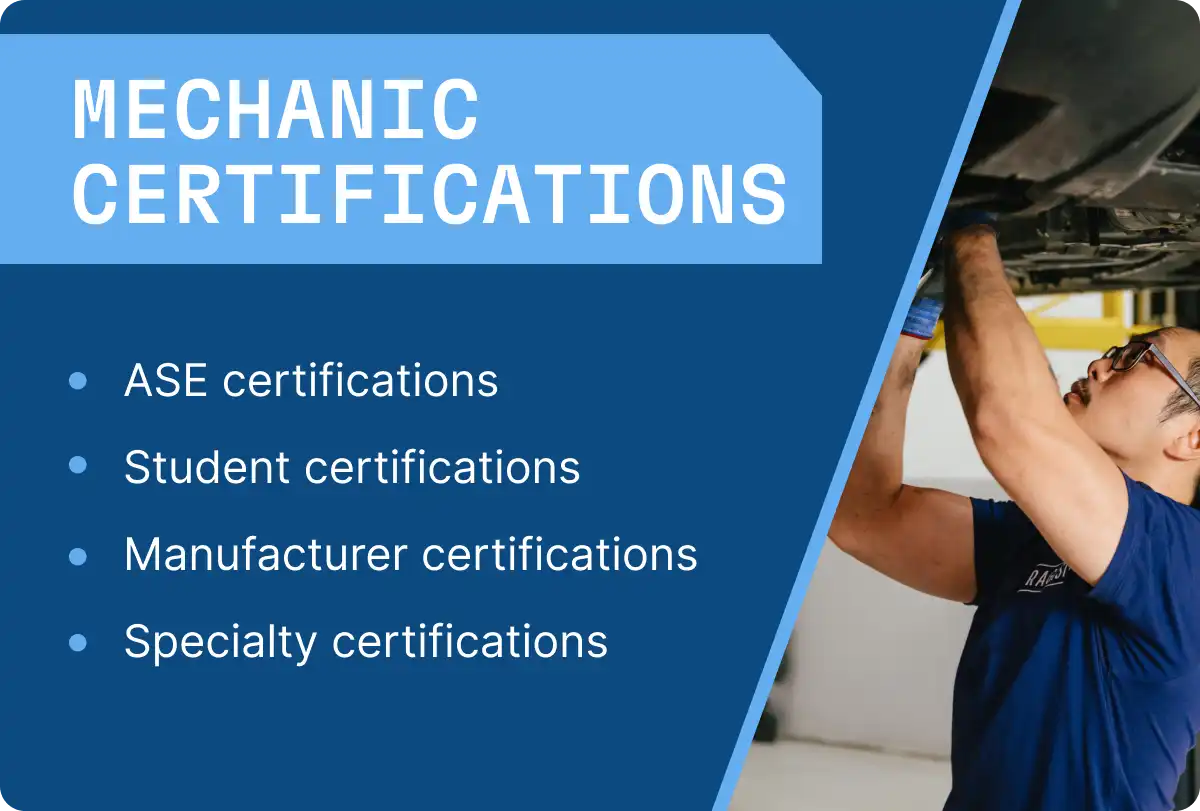
Image showing the various type of mechanic certifications.

Types of mechanic certifications

Mechanic certifications come in many forms, each tailored to different specializations and career goals. The most common types include:

1. ASE Certifications

Issued by the National Institute for Automotive Service Excellence (ASE), these certifications are the gold standard for automotive mechanics. They cover a wide range of specialties, from engine repair to electronic systems and air conditioning.

ASE certification is considered the most prestigious and widely accepted credential in the automotive world.

More about ASE

Founded in 1972, the National Institute for Automotive Service Excellence sets the benchmark for automotive service technicians. ASE offers over 50 different certification tests in categories like:

  • Engine Repair
  • Brake Systems
  • Air Conditioning and Heating
  • Suspension and Steering
  • Electrical/Electronic Systems
  • Engine Performance
  • Manual and Automatic Transmission/Transaxle
  • Light Truck and Diesel Engines

Master technicians

There’s also a separate path for master technician status, which is achieved by passing all certifications in the required testing areas for that series. For example, technicians certified in tests A1 through A8 are Master automobile technicians.

Master technician status is not for life. You must keep each one of those certifications current to maintain master technician status. If you lose master technician status due to the lapse of one or more required certifications, it can be reinstated by taking and passing the recertification tests.

How long does it take to become ASE certified?

To become ASE certified, expect to spend anywhere from 1–3 years, depending on your work experience and whether you’re currently enrolled in training programs. Each certification test typically takes 1 to 2 hours to complete and can be scheduled at a local test center.

Being ASE certified shows you’ve mastered the skills needed for the job. It’s a badge of excellence recognized by employers, repair shops, and even customers looking for reliable service.

2. Student certifications

Geared toward high school and post-secondary students in automotive technology programs, these ASE certifications offer a head start in proving foundational knowledge.

What are student certifications?

Student certifications validate entry-level knowledge in core areas of vehicle repair and maintenance. These don’t require work experience and serve as a stepping stone to full ASE status.

Programs approved by the ASE Education Foundation often include student certification exams as part of their curriculum. These are excellent options for students at auto mechanic schools or in a community college training program.

Student certifications are valid for two years and help you build confidence before entering the workforce as an entry-level technician.

3. Manufacturer certifications

These certifications are specific to vehicle manufacturers and offered by companies like Ford, Toyota, GM, and others. Often, auto technicians working in dealerships will pursue these to show mastery of brand-specific systems.

For repair technicians who want to specialize in a particular brand, manufacturer certifications are essential.

Manufacturer training programs

  • Toyota T-TEN
  • Ford ASSET
  • GM ASEP
  • Honda PACT
  • BMW STEP

These accredited programs often partner with dealerships to offer real-world, hands-on experience while you earn your credential. These programs can take anywhere from 12 to 24 months and typically require completion of automotive technology coursework alongside on-the-job work experience at a brand-affiliated repair center.

Why they matter

Manufacturer-certified auto technicians often have a faster path to high-paying roles within dealership networks and brand-specific repair shops. These certifications also prepare you to service increasingly complex vehicle systems, especially as brands continue to innovate with hybrid and electric vehicles.

4. Specialty certifications

You’ll also find credentials related to diesel engines, heavy truck systems, collision repair, and even hybrid/electric vehicles.

Each of these certification types plays a unique role in an automotive technician’s career path, and in many cases, earning more than one will make you significantly more marketable in repair shops and beyond.

Depending on your interests, you may also want to pursue:

  • A/C Refrigerant Certification - Necessary if you want to be able to to buy refrigerant and work on air conditioning service.
  • Diesel Mechanics Certification – Focused on diesel engines used in commercial fleets and heavy truck applications.
  • Collision Repair Certification – Great for auto mechanics looking to work in body shops.
  • Hybrid/Electric Vehicle Certification – A growing field with high demand.

Each of these certifications typically requires completion of a specialized training course and a passing score on certification exams. These programs may be part of a broader certificate program or offered as a standalone credential.

Tek-Tip: Another way to get ahead as a young technician is to be experienced with auto repair shop software so your employer doesn't have to teach you how to use their system.

Benefits of mechanic certifications

Getting certified is one of the most direct ways to turn your hands-on experience into a long-term career asset. Mechanic certifications do more than look good on a resume—they deliver real-world advantages. Here are some of the benefits of completing automotive certifications:

  • Increased Pay: Certified mechanics typically earn higher wages. According to the Bureau of Labor Statistics (BLS), certified automotive mechanics can earn higher hourly rates, especially in competitive markets.
  • Job Security: The more certifications you have, the more valuable you are to auto repair businesses.
  • Professional Credibility: Certification demonstrates a commitment to quality and standards, building trust with customers and employers.
  • Career Advancement: Certified automotive service technicians are more likely to advance to roles such as shop foreman, master technician, or service manager.
  • Mobility: Certifications make it easier to move between different types of employers—whether that’s independent repair shops, starting a mobile mechanic business, dealerships, or specialty service centers.

What does the certification process look like?

Most mechanic certifications follow a similar pathway but always refer to the specific instructions for your program.

Step 1: Enroll

Start by enrolling in an automotive technology program. These are offered by community colleges, trade schools, and accredited auto mechanic schools. Many programs are supported by the ASE Education Foundation, ensuring alignment with real-world industry standards.

Look for certificate programs or associate degrees that offer hands-on training. Financial aid is often available for eligible students.

Step 2: Gain work experience

Work experience is critical for most certifications. For ASE certification, for example, you need at least two years of on-the-job experience—or one year plus a diploma from an accredited program. You’ll need to show that you’ve worked on everything from brake systems and axles to manual drive train repairs and electrical systems.

Step 3: Pass certification tests

Most mechanic certifications require passing written or computer-based certification exams. These are typically held at a certified test center. The exams cover a variety of topics depending on the specialty, including engine performance, electronic systems, and automatic transmission repair.

Tek-Tip: Some auto shops/employers will pay your test fees for you.

Step 4: Maintain certification

Many certifications require recertification every five years. Staying current ensures you’re up to date with the latest automotive repair techniques, tools, and systems.

Final thoughts

Becoming a certified mechanic takes dedication, but the payoff is worth it. From better job prospects to increased credibility, mechanic certifications help you build a successful, respected career in automotive repair.

Invest in your future. Get trained, get certified, and become a leader in the ever-growing world of automotive repair.


👉 Ready to grow your automotive business? [Book a personalized Tekmetric Demo Here]

FAQ

What is the best automotive certification?

Are automotive certifications worth it?

How much does ASE certification cost?

How often do you have to recertify?

Can you become ASE certified without school?

More articles

Almost 1,000 shop owners, service advisors, and technicians gathered in Houston for Tektonic 2026, Tekmetric's first industry conference. Over two days at the Marriott Marquis, attendees packed breakout rooms, traded hard-earned lessons, and heard from operators, coaches, and industry leaders who have built and scaled shops of their own.

The Question That Started It All

Tekmetric CEO and Founder Sunil Patel opened Tektonic 2026 with a question he has been asking since he was writing service tickets and mopping floors at his former Houston shop, Motorwerks of Houston: "Why does it have to be so hard? Why does it have to feel like we're fighting a war on 12 fronts?"

That question, he told the room, is the reason Tekmetric exists.

Standing in front of shop owners, service advisors, and technicians who understand that question on a cellular level, Patel walked through how much harder running a repair shop has become. Vehicles are packed with software, sensors, and calibration systems that require entirely new toolsets. Customer expectations have been shaped by on-demand everything. Technician shortages continue to press on shops across the country. And OEM data restrictions are making it harder for independent shops to do the work they were built to do.

But Patel didn't stop at the challenge. He laid out four pillars he believes the industry needs to move forward: stop celebrating burnout as a badge of honor, build genuine trust with customers and teams, invest in an ecosystem of great partners and vendors, and embrace technology that serves shops rather than extracts from them.

He closed with a simple ask for everyone in the room: be curious, be open, be generous with what you know, and be present. 

"I want you to take something away from here," he said. "Something that will get you to be 1% better than you were."

That set the tone for everything that followed.

Top Takeaways

Process Consistency Wins on the Hard Days

Busy days don't create problems. They expose them. The best shops build their standard operating process before the chaos starts.

  • Call the day before. A preappointment call to review service history and flag overdue maintenance turns intake from reactive to planned and primes customers to say yes before they walk in the door.
  • Speed is your biggest sales tool. Every hour between drop-off and delivering an estimate costs roughly 10% in approval rates. Get findings to customers fast.
  • Set the next promise, not the finish line. Never promise a completion time you can't guarantee. Promise the next specific update and deliver it on time, every time.
  • The in-store customer is the highest-priority repair order in the building. Every other car can wait. The person sitting in your lobby cannot.
  • Improve one thing at a time. Pick one process to fix, measure it, and build accountability before moving to the next. Trying to fix everything at once fixes nothing.

Speed Closes More Jobs Than Salesmanship

Closing rates drop sharply with every hour that passes between drop-off and the customer call. A customer who has been waiting since 8 a.m. has had time to read every one-star review and talk themselves out of approving the work.

  • Get inspection results to customers within 30 minutes of dispatch. That's the speed zone. Everything else in the shop is secondary until that call is made.
  • In-store customers get findings in 15 minutes or less. The customer is sitting right there. Use it.
  • Relative priority is your daily compass. At any moment, the most important thing is moving the car that's furthest behind in the process. Not the loudest customer. Not the most expensive ticket. The earliest step.
  • Two daily goals. Full stop. Every technician runs at least eight billable hours. The shop hits its gross profit target. Nail both and everything else follows.

You Don't Have a Technician Shortage. You Have a Culture Problem.

The technician pipeline isn't as broken as it seems. What's broken is how many shops make it hard to stay.

  • Rethink flat rate. Hybrid pay models that combine a solid base with performance incentives align your team's goals with the shop's goals and they're far more attractive to the next generation coming into the trade.
  • Answer two questions before you do anything else. Why would a technician work here? Why would a customer come back? If you hesitate on either, start there.
  • Recognition is the highest-ROI leadership move you have. Research cited at the conference found that team members become disengaged because they don't feel seen. Fix that before you invest in anything else.
  • AI won't replace hospitality. Technology can handle administrative weight, but the trust a service advisor builds with a customer at the counter is irreplaceable. Invest in that skill set.
    ‍
P.J. Leslie, Tekmetric's head of mid-market and enterprise sales, moderates a panel during Tektonic 2026 in which multishop owners break down the real strategies behind expansion: buying shops, building shops, systemizing operations, integrating teams, protecting culture, and planning for eventual exit or partnership.

Growing to Multiple Locations Takes More Than Money

Every multishop operator on the stage agreed: you're never fully ready, and that's fine. What matters is being profitable, having the right people, and expecting the unexpected.

  • Profitable and cash-positive before you move. When you make a mistake at location two—and you will—you need a healthy location to cover it.
  • You're ready when your shop doesn't need you. Build your bench before you open the next door. The manager for location two should already be in your building today.
  • Start your exit plan on day one. Almost no one in the room at one of Tektonic’s breakout sessions had a clear exit strategy. Don't leave money on the table because you never thought through how the story ends—whether that means selling, transitioning, or building for long-term cash flow.

Leadership Is the Ceiling on Everything Else

Your shop will never outperform your leadership. What you tolerate becomes your standard. How you show up on Monday morning sets the emotional temperature for everyone around you.

  • Know your triggers before they know you. Name what sets you off. Once you can spot it, you can stop it before it damages a relationship.
  • Pause for three seconds. Before you respond to anything that's gotten under your skin, stop. Three seconds is the difference between a reaction and a response.
  • Hear less. Listen more. After someone finishes speaking, let the silence sit. People almost always have more to say and the second thing is usually the real thing.
  • Walk into hard conversations knowing how you want them to end. Start with the outcome in mind, not the grievance.
    ‍
Tekmetric Chief Product Officer Jared Haleck breaks down Tekmetric's new products at Tektonic 2026. The new products include Tekmetric digital ads, Smart DVI, and Tekmetric phones.

Product Announcements at Tektonic 2026

The closing session belonged to the Tekmetric product team. Drawing on data from more than 15,000 shops on the platform, Tekmetric President and COO Lauren Langston and Chief Product Officer Jared Haleck built the roadmap around key areas where winning shops consistently outperform the rest: car count, average repair order (ARO), driver experience, and cycle time.

Here's a look at what’s coming:

Tekmetric Digital Ads: AI-powered advertising on Google Maps and Search, built for the moment a driver has a problem and is ready to act. It connects directly to Tekmetric so you can see the gross profit behind every dollar of ad spend, not just clicks.

Smart DVI: Technicians walk the vehicle, narrate what they see, and Smart DVI builds the customer-ready inspection report automatically—findings organized, images annotated, and jobs pre-suggested for the estimate. Less time typing. More time turning wrenches.

Tekmetric Phones: Customer details, open repair orders, and communication history surface the moment an inbound call rings. No more looking it up while someone's waiting. A future capability in development will transcribe calls in real time and auto-populate appointment notes.

See You in 2027

Tektonic 2026 was Tekmetric's first industry conference, and it delivered on the promise Sunil Patel made from the stage: a room full of shop owners, service advisors, and technicians who showed up to get better.

The through-line across every session was the same. The shops that win are the ones that build systems, invest in their people, and keep getting 1% better. Not all at once. One thing at a time.

Registration for Tektonic 2027 is already open. We hope to see you there.

‍

Running a repair shop takes more than turning wrenches. It’s booking appointments, reminding customers to show up, following up on declined jobs – all while keeping bays full and the front office running smoothly.

But for most shops, staying connected with customers feels like a second job. Some rely on a patchwork of booking tools, texting apps, and review platforms. Others don’t follow up at all. Either way, things slip through the cracks. The result? Missed appointments, lost revenue, and customers who never return.

That’s why we built Tekmetric Marketing.

Not another system to learn. Not another login to juggle. It’s built right into Tekmetric, the platform you already trust to run your shop. With online booking, reminders, campaigns, follow-ups, reviews, and even a professional website all in one place, Tekmetric Marketing helps you keep customers engaged and loyal automatically – without piling more work on your plate. And it’s designed so anyone on your team can use it. No marketing expertise required.

More Cars. Higher ARO. Steady Repeat Business.

Every repair order holds untapped potential. A declined brake job today can turn into tomorrow’s revenue. A routine oil change can become the start of a long-term relationship.

Tekmetric Marketing makes sure those opportunities don’t slip away. Customers can schedule online 24/7, filling bays while you sleep. Automated reminders cut down on no-shows and keep the calendar steady. Follow-ups on declined jobs and maintenance turn “not today” into approved work. Seasonal campaigns help you bring customers back when business slows.

And if your shop doesn’t have a website, Tekmetric can build one for you, giving customers one more way to find you, book online, and keep your bays full.

As Ryan Froats of Yorktown Auto Care put it:
“As an independently-owned shop, dedicating resources towards outreach and follow-up can be challenging. Tekmetric Marketing allows me to communicate with my customer base in a variety of ways, without tying up hours of my work week.”

That’s the difference between a full schedule and an empty bay. Between a one-time job and a loyal customer.

Turn Great Service Into Lasting Loyalty

Great service doesn’t stop when the car leaves the bay. Tekmetric Marketing makes it really easy to keep the relationship going. Post-visit follow-ups that check in with customers after service, showing you care and helping you catch issues early. Review requests that boost your reputation on Google, making it easier for new customers to find and trust you. Private feedback that gives you valuable insights to improve service and address concerns before they go public

Together, these touchpoints build trust, strengthen relationships, and turn satisfied customers into loyal advocates.

One Platform. No Missed Messages.

Because Tekmetric Marketing lives inside Tekmetric, all customer communication flows through one platform – from estimates and approvals to reminders, follow-ups, and promotions. No more bouncing between systems or wondering what’s been sent. Everything is tied to the customer profile, making communication clear, consistent, and professional.

Tekmetric Marketing also works in sync with your shop’s calendar, repair orders, and payments. Bookings instantly block off availability. Reminders align with scheduled work. Everything just works without syncing headaches or double entry.

And here’s the best part: Tekmetric Marketing is designed for busy shop owners and front office staff. It’s easy to set up, runs automatically in the background, and helps you grow your business without adding more to your to-do list – or requiring a marketing degree.

As Corey Hansen of Hansen Auto Repair shared:
“It’s so convenient having everything in one place, right inside Tekmetric. I already have Tekmetric open for managing the shop and invoicing, so I don’t have to switch tabs or log into something else to engage with my customers. Having it all together just makes things faster—and for me, saving time is huge.”

Auto Repair. Done Right.

Tekmetric has always been the all-in-one platform that helps shops run better — from managing repairs to taking payments. Now, with Tekmetric Marketing, it’s also the platform that helps you grow faster, keep customers loyal, and deliver a better experience at every turn.

Turn every visit into the next one. With Tekmetric Marketing, it happens automatically.

Mechanics need the best tools to perform repairs efficiently and safely. With so many brands in the automotive industry, it can be hard to sift through the noise to find the right automotive tool brand for you. Whether you are a beginner or an expert mechanic, this guide will help identify the best brands for you.

Below, we have highlighted the top automotive tool brands to help you select the best tools for your needs. We have hand-selected these brands to provide a variety of price points and quality levels. Each brand has something unique to offer and we hope this guide helps you narrow down your choices.

14 best automotive mechanic tool brands listed with logos.

Our Top-Rated Mechanic Tool Brands

While every mechanic tool brand has something unique to offer, these high-quality brands stood out to us based on value, reviews, durability, and performance. Tekmetric reviewed these brands without any affiliate commission to remove bias.

Matco Tools: Premium tools for everyone

Matco is a prominent brand in the automotive tool space because of its reputation for durable and reliable products. Featuring a wide variety of hand tools (and apparel) at reasonable prices, Matco has become a leading brand. Products include wrenches, sockets, ratchets, screwdrivers and more. This brand is a great option for mechanics looking for quality tools that are built to last.

Kobalt: Budget-friendly tools

Kobalt has become a popular choice for mechanics looking for professional-grade tools without breaking the bank. They have found the perfect balance of quality and price. Plus, they are easy to find and readily available at Lowes and Amazon. However, if you are looking for highly specialized tools, Kobalt may not offer every tool you need. In addition, you may find better quality from other brands but quality comes at a cost.

Wright Tool: American-made tools

Wright is an innovative USA tool supplier that has created a reputation for quality long-lasting tools. Wright features an extensive product range including wrenches, sockets, hammers, tool storage, screwdrivers, and more. Wright is a great option for those looking for innovation and American-made tools.

Snap-On Tools: Professional-grade hand tools

Snap-On has become synonymous with exceptional quality, precision, and durability, making it a preferred choice among professional automotive mechanics. The premium pricing will be easily justified by professional mechanics and those looking to make an investment but may not be the best choice for casual or DIYers. Snap-On is a great choice for those looking for top-notch quality and performance.

Craftsman Tools: Reliable and budget-friendly

Craftsman is another popular choice for mechanics looking for quality tools without the premium price tag. Craftsman offers a wide variety of tools including sockets, torque wrenches, and ergonomic power tools. Craftsman is a great choice for those looking to find a balance between price and quality. Craftsman is available at most of the large retailers including Amazon, Lowes, and Home Depot.

OTC: Diagnostic and specialty tools

OTC is a reputable brand offering specialty equipment for mechanics. OTC specializes in jacks, diagnostics and speciality equipment. They do not offer every tool you will need but they have select specialized tools that can be hard to find elsewhere. OTC is a great choice for mechanics looking for technical products or needing specialized equipment.

Tek-Tip: Don't forget to look at warranties when comparing the best mechanic tool brands.

Husky: Affordable quality tools

Husky is a big name in the automotive tool space because they have found the right balance of quality and price. They have a large selection of tools and back them up with a lifetime warranty. Products include mechanic tools sets, wrenches, sockets, and more. Husky is easy to find at Home Depot, Amazon, and other large retailers. Most users will like Husky but if you want to make a larger financial investment, you can find higher-quality brands elsewhere.

Proto: Durable and innovative tools

Proto is a reputable brand in the automotive tool industry, offering durable, high-quality tools that are often favorably compared to other brands. Products include adjustable wrenches, combination wrenches, screwdrivers, and more. They offer innovative designs and competitive pricing which make them a viable option for professional mechanics.

Blackhawk: Specialty shop equipment

Blackhawk is another specialty brand offering jacks, stands, ramps, creepers, and shop equipment. While they do not sell every product mechanics need, they specialize in a few key products and have made a good name for themselves. Blackhawk is available at some major retailers including Amazon and Northern Tool.

Milwaukee Tool: Cordless power tools

Milwaukee is a big name in the tool space in general and has been building its presence in the automotive space. Milwaukee offers a wide variety of tools including power tools, lighting, safety equipment, mechanic tool sets, wrenches, and more. They specialize in innovative cordless power tools and can be found at Amazon, Ace Hardware and Home Depot.

DeWalt: Reputable retail supplier

DeWalt is a large supplier of automotive tools and typically caters to both DIY and professional mechanics alike. They offer a comprehensive product line featuring wrenches, power tools, tool kits, storage, hand tools, and more. DeWalt is a great option for those looking for a reputable brand that is easy to find at Amazon, Lowes and Ace Hardware.

Mac Tools: Premium-grade tools

Mac Tools is a leading brand in the automotive space and is recognized for durability and quality. They offer almost every tool a mechanic will need but they are not available at most retailers (buy from a franchise or their website). Despite being harder to locate, Mac Tools is included in this list for a reason and has a lot to offer mechanics looking for professional-grade tools.

Makita: Automotive power tools and batteries

Makita is a reputable automotive tool company specializing in power tools and batteries. If you stay within the Makita ecosystem, their batteries can power over 325 different tools. Power tool products include drive impact wrenches, grinders, lighting, and more. Makita is a top choice for mechanics looking for cordless power tools at a good price.

SK Tools: Renowned quality

With over 100 years of experience, SK has created a reputation for delivering quality tools that last. SK offers mechanic tool sets, sockets, ratchets, wrenches, screwdrivers, tool storage, and more. You can purchase SK Tools on their website, Amazon, and other popular retailers. SK is a great choice for those looking for quality tools at an affordable price point.

How to Pick the Best Tool Brand for You

Price, durability, warranty, and brand reputation are some of the biggest factors when looking for the best tool brand for you. When selecting your brand, make sure it meets your specific needs, budget, and has a strong reputation.

Price

Price is an important factor to consider when looking for the best mechanic tool brand. Consider if it is worth it to purchase a higher quality brand to ensure your tools last longer and need to be replaced less frequently. Lastly, consider additional costs such as batteries, electricity, and storage.

Durability

When selecting your brand, durability is an important factor to consider. Some brands are cheaper but will cost you more over a lifetime if you have to replace them regularly. If the tool has an active lifetime warranty, then this factor holds less importance. Lastly, consider how much you use your tools. Every day? Once a month? If you use tools every day, the extra expense of quality tools may be justified.

Warranty

When looking for the best mechanic tool brands, warranties can be one of the most important factors to consider. Some brands offer lifetime warranties, others offer limited warranties or no warranty at all. Replacement costs can be substantial so make sure you research beforehand.

Reviews

Reviews offer first-hand perspectives of how the tool performed for others. Research each tool and also research the brand as a whole and see how other mechanics are liking the tool/brand.

Essential Tools for Mechanics

Every automotive mechanic should have these hand tools to assist with common repairs and streamline their workflow. While not exhaustive, this list will handle the majority of common car repairs.

  • OBD Scanner
  • Lighting
  • Shop stool
  • Ratchet wrenches
  • Socket set
  • Screwdriver
  • Power tools
  • Creeper
  • Car lift or jack
  • Fluid funnels
  • Pry bar
  • Pliers
  • Hammer
  • Toolbox/storage

Tek-Tip: Don't forget to pair your favorite tools with the best shop management software in the industry.

Closing thoughts

Choosing the right mechanic tool brand is essential for maximizing performance and efficiency in your work. You can make an informed decision by considering your specific needs, researching brand reviews, and finding the right warranty. Our top brands mentioned in this blog have earned the trust of professionals for their reliability and durability, so invest wisely in the one that best suits your needs.

14 Best Mechanic Tools Brands (2026 Guide)

January 7, 2025

Read time: 3 min

read more