
Free Auto Repair Receipt Template & What You Need To Include

Benjamin Johnson

|

April 15, 2025

|

Read time: 3 min

For every auto repair business, creating a clear and professional receipt isn’t just good practice—it’s essential. Whether you're working on a major vehicle repair or a routine oil change, a detailed receipt serves as a proof of payment for the customer and a legal record for your shop. It helps you maintain transparency, build trust, and protect both parties in case of disputes or warranty claims.

If you’re building your own auto repair invoice template or refining your existing process, this guide walks you through every element your auto repair receipt template should include. From contact information to labor costs, here’s what a comprehensive auto repair receipt looks like.

Auto repair shop receipt example template

We designed an auto repair shop receipt template for you to download and use in your shop. The template can be used for auto body repair shops, mobile mechanics, general repair shops, and tire shops.
Download the free template below and modify it as needed to utilize in your shop.

AUTO SHOP RECEIPT TEMPLATE DOWNLOAD

What Should Be Included in an auto repair shop receipt?

1. Shop contact information

The first thing on your receipt should be your auto repair shop’s full contact information. This builds credibility and ensures customers know how to reach you if follow-up is needed.

What to include:

  • Shop name
  • Address
  • Phone number
  • Email address
  • Website (if applicable)
  • Business logo for branding

A well-organized template with your logo and contact information at the top makes your documents look professional and trustworthy.

2. Customer Information

Next, capture the customer’s name and their contact information. This ensures the receipt is tied to the correct individual and helps with record-keeping for recurring car repair clients.

What to include:

  • Customer's name
  • Address
  • Phone number or email

This section ensures your auto repair business can easily identify who the repair services were for and reach them quickly if needed.

Tek-Tip: Wouldn’t it be great if there was an estimate building software that could do this for you? Tekmetric offers auto repair estimate software among other features.

3. Date of service and invoice number

Every mechanic receipt needs to include the date of service and a unique invoice number. This creates an accurate timeline and helps organize documents chronologically for tax reporting, audits, or warranty purposes.

What to include:

  • Date the service was completed
  • Unique invoice number
  • Optional: technician’s name or initials

4. Vehicle information

For any automotive service, tying the repair order to a specific vehicle is a must. This helps with real-time service tracking, vehicle history reporting, and future maintenance recommendations.

What to include:

  • Year, make, and model
  • Vehicle Identification Number (VIN)
  • License plate number
  • Mileage at the time of service

5. Description of services performed

This is the heart of the receipt. Clearly outline what repair work was done and what repair services were provided. The more detail, the better.

What to include:

  • Itemized list of services
  • Description of each job (e.g., “Brake pad replacement” or “Engine diagnostic”)
  • Associated labor costs for each service
  • Cost of parts

6. Parts and material breakdown

An itemized list of parts and materials used in the repair work is just as important as the labor section. This transparency helps avoid disputes and gives your customer clarity on what they’re paying for. Most auto repair shops don’t show the markup percentages on parts but you can if you want to maximize transparency.

What to include:

  • Part name and number
  • Quantity used
  • Cost per unit

7. Balance Due and Payment Summary

Now it’s time to outline the financials, from the subtotal to the total amount. This section should also include the total cost, taxes, discounts, and any payment options you accept.

What to include:

  • Subtotal (before tax)
  • Taxes (state/local)
  • Any discounts or promo codes
  • Total amount due
  • Payment methods accepted (e.g., cash, credit card, financing)
  • Amount paid and remaining balance
  • Due date for final payment, if applicable

Including this section with clear headings avoids confusion and can prevent billing issues down the line. It also ensures the receipt can function as proof of payment. Lastly, this is a great place to feature your financing options (if applicable).

8. Warranty Information

Warranty details protect both your shop and your customer in case a part fails or a job needs to be redone. If your auto repair shop offers any warranty, you need to clearly list what’s covered and for how long.

What to include:

  • Warranty length (e.g., 12 months or 12,000 miles)
  • What is and isn’t covered
  • Instructions for claiming the warranty
  • Any third-party coverage (for example, if a part manufacturer offers a separate warranty)

This section should be written in clear, non-technical language to help customers fully understand their protections. You may want to include a signature line for the customer to acknowledge receipt of the warranty.

9. Streamline receipts

Creating receipts and invoices by hand can be tedious but Tekmetric streamlines that for you. Tekmetric can help you build faster estimates and take payments digitally with our auto repair estimate software.

Some of our features include:

  • Streamlined estimate building
  • Digital approvals
  • Job history and reporting in one place
  • Financing options for customers

Final Thoughts

A well-documented auto repair receipt protects your shop, helps your customer feel confident, and sets the tone for a long-term relationship. From capturing accurate customer information to detailing every repair service, your mechanic receipt should leave nothing to guesswork.

Don’t just think of it as paperwork—think of it as part of your shop’s customer experience. With a little extra attention to your receipt process, your auto repair shop can stand out as a professional, transparent, and customer-first automotive service provider.

👉 Ready to grow your automotive business? [Book a personalized Tekmetric Demo Here]

FAQ

How do I make a car repair invoice?

More articles

Some of the minds behind Tekmetric have been exactly where you are: running a shop and trying to maintain that fine balance between success for your team, success for your customers, and success for your business.

And we know there's always that extra .001 millimeter room for improvement, which is why we set out to help shops find and make those improvements. Everything about Tekmetric is about making your shop better!

But we also know that you spend a lot of time running your shop, and that’s why we’re happy to do that heavy lifting. Part of the natural byproduct of helping great shops get better is we have a lot of data and a lot of insight into how shops can, and maybe even should, operate. 

That's the beauty of modern cloud-based shop management systems, they provide businesses like yours with a strong foundation of organization, simplicity, and functionality to run your shop, with the flexibility and freedom to run it in whatever way works best for you.

‍

‍

Looking specifically at the first half of 2023, we set out to gather a high-level view of the entire independent auto repair industry alongside unique Tekmetric shop data to understand how shops like yours can save time, improve operations, and bolster your profit margins.

The goal behind our latest industry index report was simple: we wanted to make it as easy as possible for shops like yours to take advantage of all that amazing data and industry expertise we've gathered along the way.

Keep cars on the road, customers happy, and your team supported for a successful business.

Looking for the best automotive industry conferences and events for 2026? This guide will help you navigate the most impactful automotive conferences and trade shows slated for 2026. We will dive into what makes each event unique, price, location, and more.

Key Automotive Conferences and Trade Shows

When it comes to elevating your auto repair business or career, knowing which events to prioritize is crucial. Each of these conventions offers a distinct experience, catering to different roles in the shop. Let's explore the big events you can’t miss in 2026.

1. Tektonic

What:  Tektonic is a brand new automotive conference for 2026. Whether you're leading the business, managing the front desk, or turning wrenches in the bay, Tektonic offers tailored training to elevate your skills, connect with peers, and drive your career forward in a space built for you.

Come for the shop-tested fixes. Leave with the horsepower to hit top-gear growth. Tektonic is a three-day event built for every shop, no matter your size, brand, or business model. Expect industry-first content, with Tekmetric-backed know-how.

When: April 9-11th, 2026

Where: Marriott Marquis - Houston, TX

Cost: Standard pricing starting at $1,499. Use discount code: "TEK6CONF" to save $$$.

Website: Tektonic

2. SEMA Show

What: The SEMA Show offers an attendee experience like no other automotive trade show on the planet. It's the best place to see thousands of the newest automotive performance products from new and iconic exhibitors, discover the latest product and vehicle trends, and develop essential skills by attending any one of the 99+ free education sessions – all of which are led by top industry professionals.

The SEMA Show is the premier auto show geared to help small businesses thrive and succeed. The trade-only event enables automotive specialty equipment manufacturers to display alongside automotive manufacturers to debut new, innovative products and connect with industry buyers from all over the world.

When: November 3-6th, 2026

Where: Las Vegas Convention Center - Las Vegas, NV

Cost: Early bird pricing starting at $50

Website: SEMA

3. AAPEX

What: Only AAPEX gives you the training, products, and insights to help you stay ahead today and prepare for tomorrow — all while you connect with the entire industry under one roof! Live, interactive demos. Expert-led business education. Our most robust training program yet. It’s all here to give you a jump on every new advancement and the knowledge to tackle your biggest challenges.

Where else can you come face-to-face with the world’s part suppliers showcasing innovations that give you an edge in the here and now — and global perspectives on where the industry is headed next?  Spend three days at AAPEX Las Vegas and make sure you’re ready to steer your business toward success!  

When: November 3-5th, 2026

Where: The Venetian Expo & Caesars Forum - Las Vegas, NV

Cost: Early bird pricing starting at $50

Website: AAPEX

4. NADA

What: NADA Show offers a full program of innovative products, emerging trends and networking opportunities. Four full days of outstanding education, emerging trends and networking opportunities for all areas of your dealership.

When: February 3-6th, 2026

Where: Las vegas Convention Center - Las Vegas, NV

Cost: Early bird pricing starting at $679

Website: NADA

5. ASTA

What: The ASTA Expo is an annual event that brings together professionals from the automotive aftermarket industry for training, networking, and discovering the latest innovations. Anyone is welcome, including shop owners, managers, technicians, service writers, and anyone in the automotive service and tire industry looking to grow their knowledge, network, and business.

When: September 25th, 2026

Where: Raleigh Convention Center - Raleigh, NC

Cost: Not disclosed for 2026 yet - check website.

Website: ASTA

6. Shop Hackers

What: The annual Shop Hackers seminar provides owners and staff in the independent automotive repair and collision/body industries with: Top-tier knowledge, life-changing personal connections, actionable strategies, increased motivation, one unforgettable experience.

With over a thousand attendees, a large array of vendors, and world-renowned industry leaders, this auto conference is unlike any other in the industry. You may laugh, you may cry, you will eat well, and one thing is for sure — you will walk away changed for the better.

When: July 2026

Where: Murfreesboro, TN

Cost: Not disclosed for 2026 yet - check website.

Website: Shop Hackers

7. Vision

What: VISION Hi-Tech Training & Expo, provides the opportunity for you to expand your knowledge and gain new skills, all while networking with leading automotive service industry professionals. Choose from more than 100 cutting-edge management, technical, and educator training courses. VISION also features a 60,000 square-foot exhibit hall showcasing the latest tools, equipment, and technology.

When: March 5-8th, 2026

Where: Overland Park Convention Center - Overland Park, KS

Cost: Early bird pricing starting at $435

Website: Vision

8. ATI

What: Learn how top-performing shop owners are navigating today’s economy and running more successful, profitable businesses. Our world-class speakers and informative sessions will equip you with the knowledge and tools you need to thrive.

SuperConference is not just about learning; it’s about community. Engage in interactive, team-building activities with the most supportive community of shop owners in the industry. Build relationships that will last a lifetime and grow your network with high-performing peers and professionals.

When: March 18-21, 2026

Where: Hyatt Regency Grand Cypress - Orlando, FL

Cost: Not disclosed for 2026 yet - check website.

Website: ATI

Why you should attend an automotive trade show

Now that we’ve explored some of the top 2026 events, let’s zoom out and consider the benefits of attending automotive conferences.

Networking opportunities

Imagine walking into a room filled with hundreds, even thousands, of people who share your passion, understand your challenges, and are dedicated to the same industry. That's the power of networking at automotive conferences. These aren't just casual conversations; they are opportunities for mentorship, partnerships, collaboration, and mutual growth.

Industry trends and insights

The automotive industry moves at lightning speed. What was cutting-edge last year might be standard this year, and obsolete next. Attending conferences gives you visibility into the future of auto repair. You’ll gain firsthand knowledge of the emerging trends and critical insights that will shape the industry for years to come.

Final thoughts

Finding the right automotive conference for you can be challenging but we hope this guide was helpful. Whether you are just starting your business or have spent your whole life fixing cars, there is an event for you.

More shop resources:

Top Automotive Conferences and Trade Shows in 2026

October 9, 2025

Read time: 3 min

read more

As a shop owner, you aren't just selling a car repair; you are selling expertise, specialized equipment, and peace of mind. If your rates are too low, you’ll struggle to keep the lights on. If they’re too high without the value to back them up, customers may opt for a competitor.

In this guide, we’ll walk through exactly how to find that "sweet spot" for your labor rate so you can build a sustainable, profitable shop.

How much should a mechanic charge per hour?

Mechanic shops should charge a labor rate that is competitive in their area, covers their overhead costs (rent, utilities, employees, etc.), and allows them to maintain a healthy profit margin (40-70%) to run the shop. Whether you are an independent shop or a large dealership, your labor rate and parts markup are your primary vehicles for maintaining profitability.

Key terms to know

Before we dive into the math, we need to understand these concepts.

  • Loaded labor rate: is the true cost of an employee, including their hourly wage, taxes, benefits, and insurance.
  • Hourly labor rate pricing: is the "posted" rate—the number your customers see on the repair estimate. It is the flat dollar amount you charge per billable hour.
  • Flat-Rate pricing: is a system where a specific repair is assigned a predetermined amount of time (e.g., a water pump replacement is "booked" at 3.4 hours). The customer pays for 3.4 hours regardless of whether the auto mechanic finishes in two hours or five.
  • Effective labor rate (ELR): is the real-world number that matters. It’s calculated by taking your total labor sales and dividing them by the actual hours your technicians worked.

How to set your automotive shop labor rate (step by step)

Setting your rate shouldn't be a guessing game based on what the guy down the street is charging. It should be a data-driven decision. Here is a step-by-step approach to finding your labor rate.

How to set your mechanic labor rate.

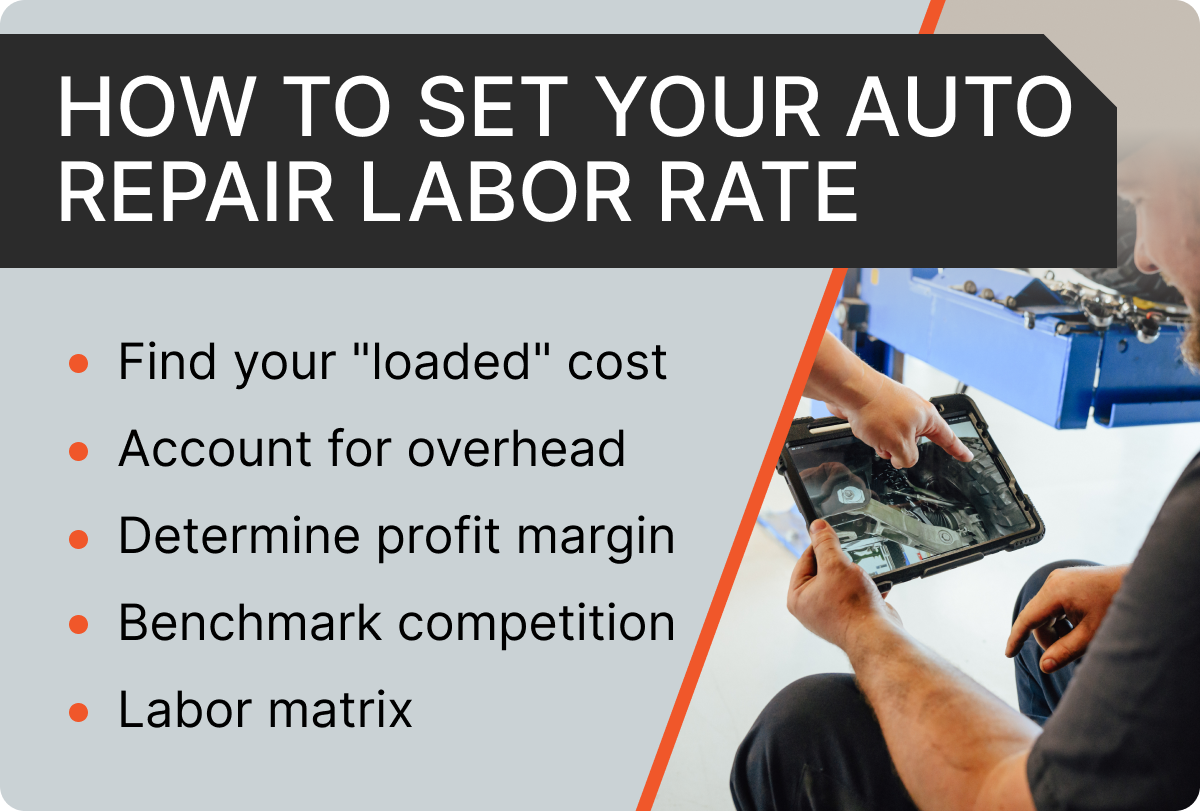
Step 1: Calculate your "loaded" labor cost

First, determine exactly what it costs you to pay an employee. This isn't just their hourly wage. You should include:

  • Wages and overtime.
  • Payroll taxes.
  • Benefits (Health insurance, 401k).
  • Workers' comp and liability insurance.
  • Training and certifications.
  • Any other benefits you provide employees.

Divide this total annual cost by the number of billable hours that the employee produces in a year. This is your "loaded" cost and does not include any profit margin.

Step 2: Account for overhead

Your labor revenue needs to cover more than just the employee. It must also cover the overhead costs of running an auto repair business:

  • Rent.
  • Utilities and shop supplies.

Step 3: Determine your desired profit margin

In the automotive industry, labor profit margins vary greatly, but most shops aim for 40-70%. If your loaded cost for a technician is $45 per hour and you want a 65% profit margin, your base mechanic labor rate should be at least $128 per hour.

Step 4: Benchmark against your competition

While your internal numbers should be your primary focus, you shouldn’t ignore the local market. If your labor rate is $128 per hour but every other independent shop in your town is at $100, you need to either justify your value through superior service or find ways to reduce your overhead. Make sure you benchmark against competitors of similar size, services offered, and geographically nearby.

Step 5: Implement a labor matrix

Not every repair order is the same. Many successful shops use a labor guide combined with a labor matrix that slightly increases the rate for more complex jobs or diagnostic work. Shops that perform more specialized repairs or focus on specialty vehicles should heavily consider implementing a labor matrix.

Which factors impact labor rates?

Your rate shouldn't be static. Several external and internal factors will influence how much you can—and should—charge for car repair services.

  • Location: A higher cost of living in cities like California or New York necessitates higher labor rates compared to rural towns. Your technicians need to earn enough to live nearby.
  • Shop type: A general auto repair shop usually has lower rates than a specialty Euro shop or a heavy-duty diesel facility. Specialization requires more expensive tools and higher-paid talent.
  • Certifications: If your team holds advanced ASE certifications or factory training, you provide more value. Customers are often willing to pay more for a repair estimate from a shop they trust to do it right the first time.
  • Warranty: If you offer a service warranty, you are taking on more risk and can charge more for the peace of mind.

5 Ways Tekmetric can help your shop be more profitable

Tekmetric can help you be more profitable by providing the features and reporting you need to make better business decisions. Tekmetric shops average a 65% labor profit margin by utilizing modern features that help you build trust with your customers and keep them coming back year after year.

  1. Custom labor matrix: Tekmetric allows you to set up labor matrices that automatically adjust your mechanic labor rate. This ensures you don’t undercharge for difficult work.
  2. Real-Time reports: Stop waiting until the end of the month to see if you made money. Tekmetric gives shop owners a real-time look at their gross profit, plus many other helpful metrics.
  3. Measuring effective labor rate: As we discussed, your posted rate isn't always what you take home. Tekmetric tracks your ELR automatically, showing you exactly where "leaks" (like excessive discounting or slow techs) are happening.
  4. Digital Vehicle Inspections (DVI): Higher rates are easier to justify when you can show the customer exactly why they need the work. Tekmetric’s DVIs build trust and increase customer satisfaction, making the price conversation much smoother.
  5. Technician efficiency: By tracking technician efficiency and productivity within the platform, you can see which members of your team are hitting their goals and which employees might need more coaching.

Final thoughts

Setting your labor rate requires constant attention to your local market, your internal costs, and the evolving complexity of car repair. By following these steps, you’ll ensure that your shop doesn't just keep cars running—it keeps your business thriving. If you have questions about Tekmetric or how we can help your shop be more profitable, book your free demo today.

Setting Your Automotive Repair Labor Rate (5-Step Guide)

March 19, 2026

Read time: 3 min

read more