Improve Your Shop's Communication With a Modern Auto Repair Estimate Template

|

March 20, 2023

|

Read time: 3 min

An auto repair estimate template, otherwise commonly referred to as a car repair estimate template, can be a great communication tool for your shop—or it can leave your team spinning their wheels in the dirt.  

While it’s easy to assume that any old auto repair estimate template will lead to a faster repair order process, unfortunately, not all templates are created equal.

The most effective templates provide a standardized framework for the estimate and repair process and lay everything out for your team and customers in a digestible format. The least effective templates cause more work for your team and eat up extra time that could (and should) be spent taking care of the customers.

A Modern Approach For Your Shop

Nowadays, there’s a whole spectrum of template options to choose from, including pen and paper forms, downloadable PDFs, and full-service shop management systems with a built-in RO program.

Finding the right fit for your shop might feel like a challenge, but the effort you put into looking for an auto repair estimate template says you care a lot about your team’s time and value their autonomy.

Upgrading your estimate process helps your team maximize its potential by giving them the power to focus on what they do best—getting customers back on the road.

It’s no secret that modern technology has changed the landscape of most industries over the past couple of decades, and the auto repair industry is no exception. Even the way we all communicate with each other has changed. Nowadays, grandparents can tune into a graduation ceremony virtually, and we can tune into a business meeting from the airport with just a smartphone. But modern technology doesn’t just affect our personal lives or bottom line; to get the full picture, we also have to consider how the customer experience has changed over the years.

Today’s customers value open communication and transparency. While pen-and-paper or PDF estimates get you on the right track to more efficiency, using a shop management system (like Tekmetric) with a built-in system for RO management can take your shop even further.

By improving both internal and external communication, and simplifying the repair and estimate process for everyone involved, you can supercharge your shop to get more customers in the door and improve customer retention.

The Types of Communication That Drive Your Shop

No matter how big or small your shop, there are two driving forces behind everyday operations: internal and external communication.

Internal Communication

Internal communication is how you communicate with your shop’s managers, technicians, and service advisors, as well as how they communicate with each other. You convey your expectations and values to your team, and your team clarifies vehicle concerns to make sure that the right work gets done in the right amount of time. Internal communication defines your business.

Without clear internal communication, your team might get confused along the repair and estimate process, compromising your shop’s workflow and the number of cars your team is able to repair during the workday.

External Communication

External communication is how you communicate with your customers. You reach customers through a variety of mediums such as marketing, scheduling appointments, and all the forms that need to be written through the estimate and repair process. External communication promotes your business.

Without clear external communication, customers may not understand what’s going on with their vehicles and grow frustrated during the estimate and repair process, compromising the trust they have in your business.

Your shop’s car repair estimate template affects both internal and external communication and can either be a handy tool or a time-consuming nuisance. Tekmetric’s car repair estimate template lets your service advisors create a professional full-service estimate in a matter of minutes, instantly improving communication and workflow, and ensuring that everyone is on the same page.

Make a Better First Impression With a Modern Auto Repair Estimate Template

First impressions are always important, but even more so in an industry surrounded by misconceptions about trustworthiness.

The estimate is part of a customer’s first impression of your shop and the first step in establishing a relationship built on trust. Templates should be designed with the customer experience in mind instead of forcing service advisors to cram technical jargon into a crowded space. The simpler a template is, the less likely it is to confuse the customer when they receive it.  

While a PDF auto repair estimate template might offer a standardized element to your repair and estimate process, a shop management system with built-in RO management features offers customers the most polished and professional experience. Modern shop management systems like Tekmetric eliminate the need for a paper trail that can often create confusion or unnecessary hiccups in the communication process. And as an added bonus, Tekmetric’s digital vehicle inspections make it possible for technicians to easily share pictures or videos that support their findings and how long the repairs are expected to take, reassuring customers that they’re not being upsold on any unnecessary repairs.

Additionally, Tekmetric gives customers the freedom to view the estimate on their own time from any location on any device. Customers need to be able to ask questions, and with just a couple of clicks, service advisors can notify customers of any unexpected delays or when their vehicle is ready for pickup.

By using a modern auto repair estimate template to clarify the repair process, customers feel more confident and empowered to make better-informed decisions. And in the end, feeling less pressure and more in control leads to higher satisfaction with your shop’s service. By paying greater attention to your external communications, you can make sure a customer’s first impression won’t be their last.

With a Modern Auto Repair Estimate Template, You Can Transform Your Team Into a Well-Oiled Machine

An auto repair estimate template isn’t just a communication tool for your customers; it’s also a tool for you and your team. If your technicians need to consult with each other before making recommendations on repairs, it might be challenging when they’re working with different software systems or different pen-and-paper forms across multiple bays. With Tekmetric, all team members have access to the same information at their fingertips and can plainly communicate any vehicle concerns through text as well as photos and videos.

Unlike a more manual auto repair estimate template, a shop management system that handles the RO process makes it easy to adjust estimates. If a technician uncovers a new vehicle concern and needs to pivot, they can easily edit the RO instead of starting over from scratch. And if they need to add additional comments or concerns, they won’t be limited by space either. Tekmetric also makes it easy to pull up previous repair orders and declined jobs for each customer to ensure your team is always getting the full picture.

Organized inventory management is essential to running an auto repair shop. With Tekmetric’s real-time inventory features, your shop manager can easily keep track of parts, assign tasks to technicians, track costs, and improve inventory management throughout the auto repair estimate template process.

By streamlining your team’s communication and workflow, you can begin to focus on the other aspects of your business and growing your shop.

Cultivate a More Impressive Shop Environment

The auto repair shops that thrive are the ones that weave their values of communication and transparency into the fabric of their processes. With a shop management system like Tekmetric, you can further open up the lines of communication and deliver on your promise to keep customers in the loop. Our built-in Job Board and auto repair estimate template make internal and external communication a breeze, so your team and customers can rest assured that all relevant information is captured, reported correctly, and easy to access every step of the way.

Making the jump to digital can be a little intimidating, but the good news is that anyone can do it. Getting trained on using Tekmetric’s auto repair estimate template doesn’t require any special licensing and can be accomplished in a jiffy.

If the tread on your internal and external communications has been getting low, gain more traction with your team and customers by using Tekmetric.

👉 Ready to grow your automotive business? [Book a personalized Tekmetric Demo Here]

FAQ

More articles

Introduction

Starting a tire shop is an exciting and profitable venture, but success isn’t just about getting customers through the door—you need the right tools and equipment to provide top-quality service. Whether you're performing tire repair, wheel balancing, or alignments, investing in high-quality automotive equipment ensures efficiency, safety, and customer satisfaction.

Many new shop owners make the mistake of cutting corners when purchasing tools, only to realize later that low-quality equipment leads to slower turnaround times, safety hazards, and costly mistakes.

By the end of this guide, you’ll know exactly what’s needed to run a successful, efficient, and profitable tire shop.

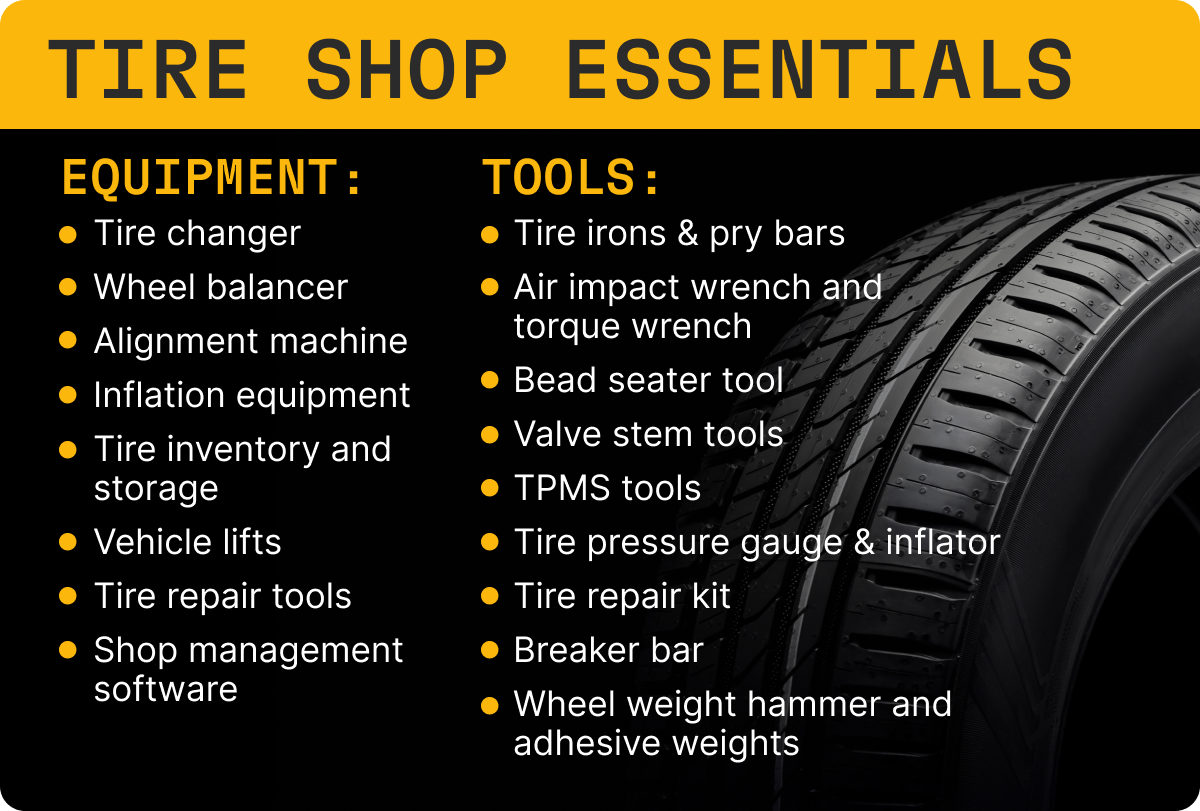
Infographic showing the tools and equipment needed to start a tire shop.

Tire shop equipment list

Beyond hand tools, your tire shop needs specialized equipment to handle tire mounting, balancing, and alignment efficiently. Here are the nine must-have machines every professional shop needs:

1. Tire changer

A tire changer is the core machine of any tire shop, allowing fast and damage-free tire mounting and removal. A high-quality automatic tire changer saves time, protects expensive alloy wheels, and enables your shop to handle a higher volume of customers efficiently.

Tire changers come in a few variations to accommodate for different tire sizes and needs. When you are ready to make a purchase, consider the price, time to train your technicians, energy usage and return on investment. Here are some of the popular choices:

  • Swing Arm: Affordable and easy to use, the swing arm tire changer is a popular choice. They are appropriate for tires up to 50 inches in diameter. The only drawback is you have to reset the head position every time you change tire sizes.
  • Tilt-Back: If you are looking for a faster option, the tilt-back may be the right choice for you. They can adjust to varying tire sizes much easier that a swing arm but they typically cost more.
  • Leverless: Leverless tire changers provide the most automated experience but also come at a premium price point. This tool can be exceptionally helpful if your technicians deal with larger truck tires or if you want to reduce the risk of employee injuries.
  • Heavy-Duty: Handling up to 90in diameter tires, this tool will be your best friend if you work on construction or heavy duty vehicles regularly. They have a high price point but it will be justifiable if you service enough large tires.

2. Wheel balancer

A wheel balancer ensures perfectly balanced tires, preventing vibrations and uneven tread wear. Investing in a wheel balancer for your auto repair shop helps you achieve precise results, improving customer satisfaction, and reducing comeback work. Wheel balancers come in a few variations:

  • Dynamic balancers: Using more advanced technology, dynamic balancers spin the tire to assess any variations in the tire. Once the tire is assessed, the technician can make any necessary adjustments to ensure a smooth and comfortable ride. These machines tend to be more precise but also come with a bigger price tag.
  • Static balancers: Static machines use a more basic measurement technology to balance tires. The basic idea is that gravity will pull the heaviest part of the tire downwards as the tire is suspended on the machine. They tend to be cheaper and take up less space but because they are stationary, the readings can be less accurate than dynamic balancers.
  • Bubble balancers: Bubble balancers are ideal for shops looking to save money or smaller operations that don’t service tires as often. They work by using a bubble level to check for imbalances in the tire. These machines are less reliable but they are also cheaper and take up less space.

3. Alignment machine

Alignment machines are critical to any tire repair shop because misaligned wheels can cause uneven tire wear and poor handling. A high-tech alignment machine allows your shop to offer wheel alignment services, a high-profit service that improves customer retention. Alignment machines are expensive, ranging from $10,000 to $40,000 but can provide years of service that often justify the upfront cost.

Proper tire alignment leads to improved handling, fuel efficiency, tire life, and safety. All of these benefits help your customers get the most out of their new tires which leads to better customer loyalty.

4. Inflation equipment

Many of your shop’s tools, including impact wrenches and bead seaters, rely on compressed air. A large-capacity air compressor ensures consistent air supply, keeping your operations running smoothly.

  • Air compressor: Air compressors provide the necessary air for many of your power tools and machines. They are also the key to proper tire inflation to make sure your tires leave the shop with the right PSI. Remember to have the right adapters needed to connect to the tire valve stem.
  • Tire inflators: If you are servicing enough tire volume, you may want to invest in dedicated tire inflators. They often include pressure gauges and make it a little easier than using a regular air compressor.

5. Tire inventory and storage

Finding the right balance between having enough tires in stock and crowding your shop layout can be challenging. To maximize efficiency, keep track of which tires you sell the most of and reduce inventory of seasonal tires that you only need once a year.

Heavy-duty tire storage racks allow you to store new and used tires efficiently. If your customers can see your inventory, make sure it is organized and professional looking. Lastly, ask your technicians for feedback and how you can help them be more efficient by adjusting your layout or inventory.

6. Vehicle lifts

A car lift makes tire rotations, inspections, and alignments easier and faster for your technicians. While they are expensive, they can be used for tire repairs as well as general automotive repairs. There are multiple types of lifts on the market so make sure to find the lift that works best for your shop. Consider price, size, lift speed, lift height, and load capacity.

Jack stands may be a cheaper alternative if you have a smaller budget to work with and don’t service a large volume of tires. However, they ares slower to use and may reduce effieiciencies in your shop workflow.

7. Tire repair tools

Some customers will just be looking for a quick patch or repair on their tire. Make sure you have patch and plug kits readily available so you can win easy business.

8. Tire shop software

Your tire shop isn’t just about changing tires—you need to track inventory, invoices, and customer records. A modern workstation with tire shop management software (like Tekmetric) keeps operations organized, efficient, and profitable.

9. Miscellaneous items

  • Waiting area: Make a good first impression by offering a comfortable waiting area with chairs, TV, and basic refreshments. Keep the climate at a comfortable temperature to make sure your customers feel at ease.
  • Marketing: Tekmetric makes it easy to market your business with modern marketing and CRM capabilities. Let us build your website and provide integrated online appointment scheduling to make it easy for customers to find you and book with you.
  • Point of sale (POS) software: Tekmetric has you covered with payment options and solutions for your customers. Provide customers with multiple ways to pay plus financing options.

Essential tools for your tire shop

Even with high-tech machinery, manual tools are essential for precise tire work. These tools allow your technicians to handle tire mounting, balancing, and repairs efficiently and safely. Here are the nine tools every tire shop needs:

1. Tire irons & pry bars

These are critical for manually mounting and demounting tires. Even with a tire changer, stubborn tires (such as off-road or low-profile tires) often require extra force. Pry bars and tire irons allow your techs to work efficiently and prevent rim damage.

2. Air impact wrench & torque wrench

Lug nut installation and removal is a daily task in any tire shop. An air impact wrench speeds up this process, while a torque wrench ensures that lug nuts are tightened to manufacturer specifications, preventing over-tightening (which can damage wheel studs) or under-tightening (which can lead to wheel detachment).

3. Bead seater tool

A bead seater blasts a strong burst of air to seat the tire bead onto the wheel, ensuring a secure and leak-free fit. This tool is especially valuable for handling low-profile, oversized, and performance tires, reducing manual effort and increasing efficiency.

4. Valve stem tools

Valve stems regulate tire pressure, and a valve stem tool kit allows for quick replacements and repairs. Properly maintaining valve stems prevents slow leaks and customer complaints, improving the overall quality of service.

5. TPMS tools

A tire pressure monitoring systems (TPMS) is an electronic system designed to monitor the air pressure inside pneumatic tires on various types of vehicles. Having the right tool can help you make sure a customers TPMS light doesn’t come on after they leave your shop. These tools can do light resets and reprogram tire positions when necessary.

6. Tire pressure gauge & inflator

Proper tire pressure improves fuel efficiency, tire lifespan, and vehicle safety. A high-quality tire pressure gauge ensures accurate readings, while an inflator allows quick and precise air adjustments, reducing customer wait times.

7. Tire repair kit

Not all punctured tires need to be replaced—some can be repaired! A tire repair kit with patches, plugs, and rubber cement lets you fix minor punctures, offering customers a cost-effective alternative to tire replacement while increasing your shop’s revenue.

8. Breaker bar

Sometimes, lug nuts are too tight for an impact wrench due to rust or excessive torque. A breaker bar provides extra leverage, making it easier to remove stuck lug nuts without damaging wheel components.

9. Wheel weight hammer & adhesive weights

Proper wheel balancing ensures a smooth ride and even tire wear. A wheel weight hammer allows your techs to install or remove clip-on weights, while adhesive weights are ideal for balancing modern alloy wheels.

Conclusion

Setting up a successful tire shop requires more than just skills—you need the right tools and equipment. If the startup cost is daunting, consider leveraging vendor/supplier relationships to help with the cost. Or, leverage a line of credit from Tekmetric Payments. By investing in high-quality tire changers, wheel balancers, and shop management software, you’ll improve efficiency, customer satisfaction, and long-term profitability. You can learn more about Tekmetric's tire shop software here.

Essential Tools & Equipment to Start a Tire Shop (Complete List)

March 7, 2025

Read time: 3 min

read more

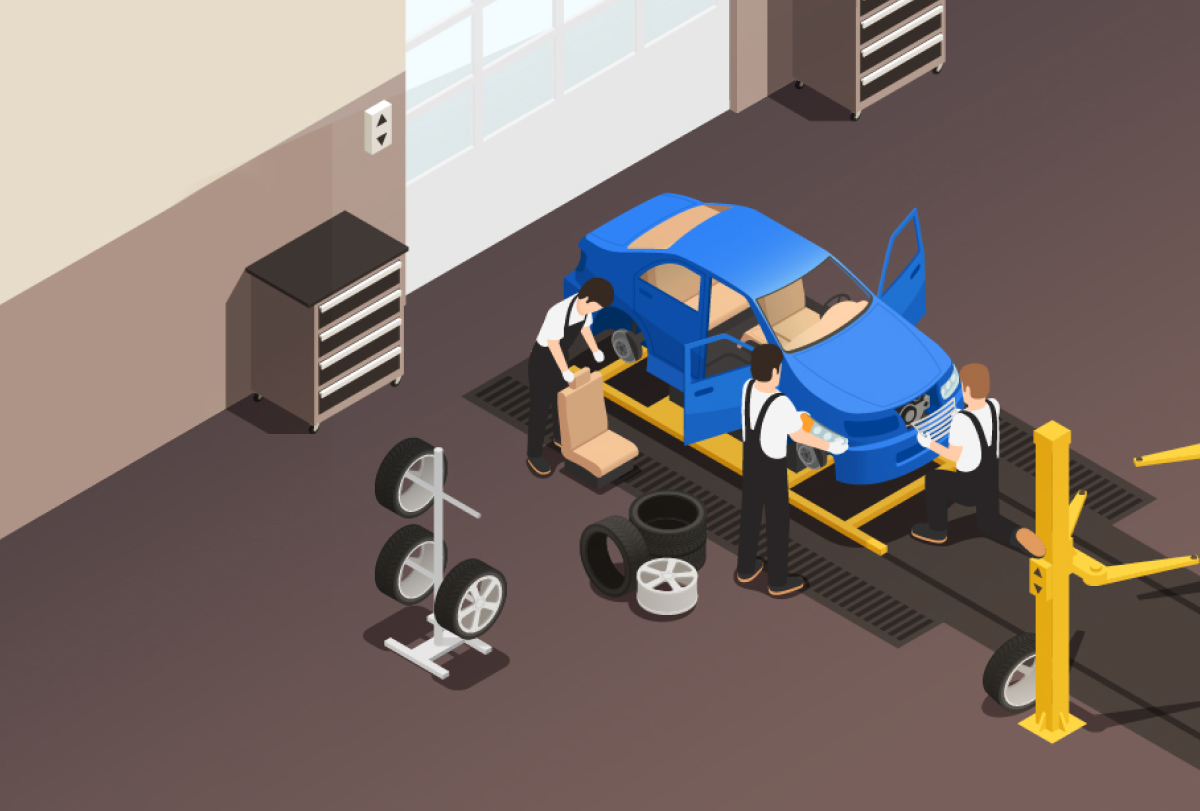
Traditionally, there are four pillars to an auto repair shop that all support one another: the shop owner, technicians, customers, and service advisors.

The integrity of the shop depends on each of these pillars in different ways. The shop owner needs to make the right calls and put the right systems in place for technicians and service advisors to do their jobs. Technicians must stay focused on repairs. And loyal customers keep the lights on.

By effectively leading your team, service advisors can support the other three pillars of the shop—and in turn, achieve balance and improve the quality of your job. Getting started in your Service Advisor career, or looking for some tips? Here’s how to lead your team with intention.

Find out what shops in your state are charging, and how to set a labor rate that keeps your shop profitable

In the automotive repair industry, your labor rate is more than just a number on an invoice — it is one of the key metrics that drives your business's profitability and overall growth. For shop owners, staying competitive while maintaining healthy margins requires a clear understanding of how labor costs fluctuate across the country. But knowing the national average is only half the picture. The more important question is: how does your shop compare?

Whether you are running a small independent shop or a high-volume operation, knowing where you stand relative to the average labor rate in your state — and against top-performing shops in your market — is essential.

This guide covers the current landscape of automotive repair labor rates across all 50 states, the factors that drive those numbers, and a step-by-step roadmap for setting a rate that supports your shop's long-term success.

Methodology and Key Terms

Tekmetric built this auto repair shop index as a community resource, backed by data from more than 10,000 shops across North America. Shops can use this tool to benchmark themselves and see how they compare state by state.

Key Terms to Know

Labor rate: The retail price per hour charged to the customer for repair services.

Flat-rate: A pricing model where a job is billed based on a predetermined number of hours from a labor guide, regardless of how long the actual repair takes.

Effective labor rate (ELR): The actual amount of labor revenue earned per billed hour after accounting for discounts, menu pricing, and unbilled time.

Understanding these terms will help you interpret the data below and apply it to your specific situation.

Mechanic Labor Rates by State

The average labor rate across the United States is $132 per hour, with the lowest state at $85 per hour and the highest at $197 per hour. Labor rates vary significantly by state, primarily driven by local cost of living and competition.

📊 See How Your Shop Compares — Free

The data below tells you what shops in your state are charging. But the labor rate is only one piece of the picture. The Tekmetric Shop Index lets you benchmark your shop across the four metrics that actually drive profitability — ARO, car count, parts margin, and effective labor rate — against thousands of real shops nationwide.

It's free, takes less than two minutes, and requires no Tekmetric account.

➡ Benchmark Your Shop Now →

Hourly Automotive Labor Rates by State

  • Alabama $124
  • Alaska $161
  • Arizona $145
  • Arkansas $116
  • California $156
  • Colorado $151
  • Connecticut $141
  • Delaware $141
  • Florida $138
  • Georgia $137
  • Hawaii $142
  • Idaho $136
  • Illinois $135
  • Indiana $123
  • Iowa $123
  • Kansas $120
  • Kentucky $126
  • Louisiana $132
  • Maine $110
  • Maryland $141
  • Massachusetts $133
  • Michigan $130
  • Minnesota $137
  • Mississippi $125
  • Missouri $120
  • Montana $135
  • Nebraska $127
  • Nevada $152
  • New Hampshire $128
  • New Jersey $140
  • New Mexico $141
  • New York $125
  • North Carolina $123
  • North Dakota $135
  • Ohio $125
  • Oklahoma $129
  • Oregon $150
  • Pennsylvania $115
  • Rhode Island $134
  • South Carolina $130
  • South Dakota $120
  • Tennessee $127
  • Texas $141
  • Utah $135
  • Vermont $110
  • Virginia $136
  • Washington $152
  • West Virginia $100
  • Wisconsin $125
  • Wyoming $134

Factors That Impact Automotive Labor Rates

Why do auto repair labor rates vary so widely from state to state? A few key factors drive the differences.

Cost of Living

In states with a higher cost of living, shop owners face higher wages to attract technicians, more expensive rent, and elevated utility and supply costs. Those overhead realities push labor rates up — not because shops are padding their margins, but because the math demands it.

Shop Type and Specialization

Dealerships typically carry the highest labor rates because of their overhead, factory-trained technicians, and reliance on OEM parts. Independent shops often have more pricing flexibility, particularly for routine services like oil changes. Specialty shops — focused on European vehicles, diesel, or performance — tend to command higher rates as well.

➡ Benchmark Your Shop Now →

Technician Expertise and Certifications

A diagnostic job requires a different skill set than a brake job. Shops that employ ASE-certified technicians or master technicians can and should charge accordingly. The rate reflects the expertise required to do the work correctly.

How to Set Your Labor Rate (Step by Step)

Setting your rate shouldn't be based on what the shop down the street is charging. It should be a data-driven decision grounded in your actual costs and performance targets.

Step 1: Calculate Your "Loaded" Labor Cost

Start with what it actually costs you to have a technician on the floor. This includes:

  • Wages and overtime
  • Payroll taxes
  • Benefits (health insurance, 401k)
  • Workers' comp and liability insurance
  • Training and certifications

Divide that total annual cost by the number of billable hours that technician produces in a year. That's your loaded cost — and it doesn't include any profit margin yet.

Step 2: Account for Overhead

Your labor revenue also needs to cover the cost of running the business:

  • Rent
  • Utilities and shop supplies
  • Marketing and software
  • Taxes

Step 3: Determine Your Target Profit Margin

Tekmetric shops average 65% labor profit margins. If your loaded cost for a technician is $45 per hour and you want a 65% margin, your base labor rate should be at least $128 per hour.

Step 4: Benchmark Against Your Market

Your internal numbers come first, but you can't ignore the local market. If your rate is $128 and every comparable independent in your area is at $100, you need to either clearly justify your value — through better inspections, faster turnaround, stronger communication — or find ways to reduce overhead. Benchmark against shops of similar size, service mix, and geography.

Step 5: Implement a Labor Matrix

Not every repair order is equal. Shops that implement a labor matrix can automatically adjust rates based on job complexity — billing more appropriately for diagnostic work or specialty repairs without manually recalculating every estimate.

➡ Benchmark Your Shop Now →

How Tekmetric Helps Your Shop Stay Profitable

Managing labor rates manually is a recipe for inconsistency and missed revenue. Here's how Tekmetric gives you the tools and data to stay ahead.

Know Where You Stand with the Tekmetric Shop Index

Before you can optimize your labor rate, you need to know how your performance compares to other shops. The Tekmetric Shop Index gives you free, instant benchmarking across four metrics: ARO, car count, parts margin, and effective labor rate. Enter your shop's numbers and see exactly where you rank against thousands of shops nationwide — no account required, no sales call, no commitment.

You can't improve what you don't measure. This is where that work starts.

➡ Benchmark Your Shop Now →

Real-Time Profitability Tracking

Tekmetric's reporting features give you live visibility into ARO, car count, revenue, and technician productivity — so you always know how your shop is performing, not just at the end of the month.

Custom Labor and Parts Matrices

Tekmetric lets you build a labor matrix that automatically adjusts rates by job type. A custom parts matrix works the same way on the parts side, protecting your margins consistently across every repair order.

Digital Inspections That Justify Your Rate

Tekmetric's digital vehicle inspections let your team send photos and videos of needed repairs directly to a customer's phone. When a customer can see the worn brake pad or the leaking gasket for themselves, they're far more likely to approve the work — and far more comfortable with the rate attached to it.

Accurate Labor Guide Integration

Tekmetric integrates with industry-standard labor guides so your estimates are based on real, accurate times — not guesswork or memory. That means technicians get credited fairly under a flat-rate system, and your service advisers spend less time on paperwork and more time with customers.

Benchmark Your Insights Now

Knowing the average labor rate in your state gives you a useful reference point. But the shops that stay profitable long-term don't stop at state averages — they benchmark continuously, track the right metrics, and make adjustments based on data instead of instinct.

Your labor rate should reflect your actual overhead, your team's capabilities, and the quality of service your customers experience. Use the state data above as a starting point, then go deeper with the Tekmetric Shop Index to see how your shop compares across every metric that drives profitability.

Ready to see where you stand? Benchmark your shop free with the Tekmetric Shop Index →

Average Auto Repair Labor Rates by State

June 30, 2026

Read time: 3 min

read more