

Introduction
Starting a tire shop is an exciting and profitable venture, but success isn’t just about getting customers through the door—you need the right tools and equipment to provide top-quality service. Whether you're performing tire repair, wheel balancing, or alignments, investing in high-quality automotive equipment ensures efficiency, safety, and customer satisfaction.
Many new shop owners make the mistake of cutting corners when purchasing tools, only to realize later that low-quality equipment leads to slower turnaround times, safety hazards, and costly mistakes.
By the end of this guide, you’ll know exactly what’s needed to run a successful, efficient, and profitable tire shop.
Tire shop equipment list
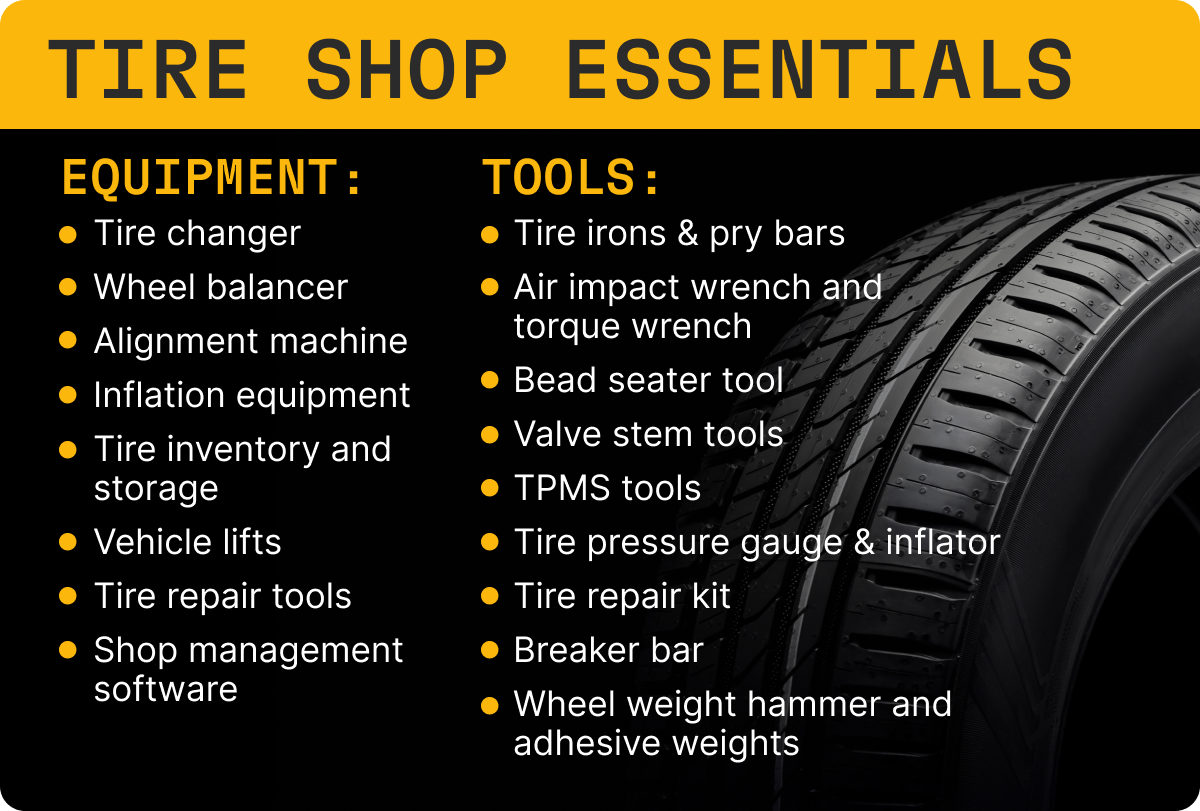
Beyond hand tools, your tire shop needs specialized equipment to handle tire mounting, balancing, and alignment efficiently. Here are the nine must-have machines every professional shop needs:
1. Tire changer
A tire changer is the core machine of any tire shop, allowing fast and damage-free tire mounting and removal. A high-quality automatic tire changer saves time, protects expensive alloy wheels, and enables your shop to handle a higher volume of customers efficiently.
Tire changers come in a few variations to accommodate for different tire sizes and needs. When you are ready to make a purchase, consider the price, time to train your technicians, energy usage and return on investment. Here are some of the popular choices:
- Swing Arm: Affordable and easy to use, the swing arm tire changer is a popular choice. They are appropriate for tires up to 50 inches in diameter. The only drawback is you have to reset the head position every time you change tire sizes.
- Tilt-Back: If you are looking for a faster option, the tilt-back may be the right choice for you. They can adjust to varying tire sizes much easier that a swing arm but they typically cost more.
- Leverless: Leverless tire changers provide the most automated experience but also come at a premium price point. This tool can be exceptionally helpful if your technicians deal with larger truck tires or if you want to reduce the risk of employee injuries.
- Heavy-Duty: Handling up to 90in diameter tires, this tool will be your best friend if you work on construction or heavy duty vehicles regularly. They have a high price point but it will be justifiable if you service enough large tires.
2. Wheel balancer
A wheel balancer ensures perfectly balanced tires, preventing vibrations and uneven tread wear. Investing in a wheel balancer for your auto repair shop helps you achieve precise results, improving customer satisfaction, and reducing comeback work. Wheel balancers come in a few variations:
- Dynamic balancers: Using more advanced technology, dynamic balancers spin the tire to assess any variations in the tire. Once the tire is assessed, the technician can make any necessary adjustments to ensure a smooth and comfortable ride. These machines tend to be more precise but also come with a bigger price tag.
- Static balancers: Static machines use a more basic measurement technology to balance tires. The basic idea is that gravity will pull the heaviest part of the tire downwards as the tire is suspended on the machine. They tend to be cheaper and take up less space but because they are stationary, the readings can be less accurate than dynamic balancers.
- Bubble balancers: Bubble balancers are ideal for shops looking to save money or smaller operations that don’t service tires as often. They work by using a bubble level to check for imbalances in the tire. These machines are less reliable but they are also cheaper and take up less space.
3. Alignment machine
Alignment machines are critical to any tire repair shop because misaligned wheels can cause uneven tire wear and poor handling. A high-tech alignment machine allows your shop to offer wheel alignment services, a high-profit service that improves customer retention. Alignment machines are expensive, ranging from $10,000 to $40,000 but can provide years of service that often justify the upfront cost.
Proper tire alignment leads to improved handling, fuel efficiency, tire life, and safety. All of these benefits help your customers get the most out of their new tires which leads to better customer loyalty.
4. Inflation equipment
Many of your shop’s tools, including impact wrenches and bead seaters, rely on compressed air. A large-capacity air compressor ensures consistent air supply, keeping your operations running smoothly.
- Air compressor: Air compressors provide the necessary air for many of your power tools and machines. They are also the key to proper tire inflation to make sure your tires leave the shop with the right PSI. Remember to have the right adapters needed to connect to the tire valve stem.
- Tire inflators: If you are servicing enough tire volume, you may want to invest in dedicated tire inflators. They often include pressure gauges and make it a little easier than using a regular air compressor.
5. Tire inventory and storage
Finding the right balance between having enough tires in stock and crowding your shop layout can be challenging. To maximize efficiency, keep track of which tires you sell the most of and reduce inventory of seasonal tires that you only need once a year.
Heavy-duty tire storage racks allow you to store new and used tires efficiently. If your customers can see your inventory, make sure it is organized and professional looking. Lastly, ask your technicians for feedback and how you can help them be more efficient by adjusting your layout or inventory.
6. Vehicle lifts
A car lift makes tire rotations, inspections, and alignments easier and faster for your technicians. While they are expensive, they can be used for tire repairs as well as general automotive repairs. There are multiple types of lifts on the market so make sure to find the lift that works best for your shop. Consider price, size, lift speed, lift height, and load capacity.
Jack stands may be a cheaper alternative if you have a smaller budget to work with and don’t service a large volume of tires. However, they ares slower to use and may reduce effieiciencies in your shop workflow.
7. Tire repair tools
Some customers will just be looking for a quick patch or repair on their tire. Make sure you have patch and plug kits readily available so you can win easy business.
8. Tire shop software
Your tire shop isn’t just about changing tires—you need to track inventory, invoices, and customer records. A modern workstation with tire shop management software (like Tekmetric) keeps operations organized, efficient, and profitable.
9. Miscellaneous items
- Waiting area: Make a good first impression by offering a comfortable waiting area with chairs, TV, and basic refreshments. Keep the climate at a comfortable temperature to make sure your customers feel at ease.
- Marketing: Tekmetric makes it easy to market your business with modern marketing and CRM capabilities. Let us build your website and provide integrated online appointment scheduling to make it easy for customers to find you and book with you.
- Point of sale (POS) software: Tekmetric has you covered with payment options and solutions for your customers. Provide customers with multiple ways to pay plus financing options.
Essential tools for your tire shop
Even with high-tech machinery, manual tools are essential for precise tire work. These tools allow your technicians to handle tire mounting, balancing, and repairs efficiently and safely. Here are the nine tools every tire shop needs:
1. Tire irons & pry bars
These are critical for manually mounting and demounting tires. Even with a tire changer, stubborn tires (such as off-road or low-profile tires) often require extra force. Pry bars and tire irons allow your techs to work efficiently and prevent rim damage.
2. Air impact wrench & torque wrench
Lug nut installation and removal is a daily task in any tire shop. An air impact wrench speeds up this process, while a torque wrench ensures that lug nuts are tightened to manufacturer specifications, preventing over-tightening (which can damage wheel studs) or under-tightening (which can lead to wheel detachment).
3. Bead seater tool
A bead seater blasts a strong burst of air to seat the tire bead onto the wheel, ensuring a secure and leak-free fit. This tool is especially valuable for handling low-profile, oversized, and performance tires, reducing manual effort and increasing efficiency.
4. Valve stem tools
Valve stems regulate tire pressure, and a valve stem tool kit allows for quick replacements and repairs. Properly maintaining valve stems prevents slow leaks and customer complaints, improving the overall quality of service.
5. TPMS tools
A tire pressure monitoring systems (TPMS) is an electronic system designed to monitor the air pressure inside pneumatic tires on various types of vehicles. Having the right tool can help you make sure a customers TPMS light doesn’t come on after they leave your shop. These tools can do light resets and reprogram tire positions when necessary.
6. Tire pressure gauge & inflator
Proper tire pressure improves fuel efficiency, tire lifespan, and vehicle safety. A high-quality tire pressure gauge ensures accurate readings, while an inflator allows quick and precise air adjustments, reducing customer wait times.
7. Tire repair kit
Not all punctured tires need to be replaced—some can be repaired! A tire repair kit with patches, plugs, and rubber cement lets you fix minor punctures, offering customers a cost-effective alternative to tire replacement while increasing your shop’s revenue.
8. Breaker bar
Sometimes, lug nuts are too tight for an impact wrench due to rust or excessive torque. A breaker bar provides extra leverage, making it easier to remove stuck lug nuts without damaging wheel components.
9. Wheel weight hammer & adhesive weights
Proper wheel balancing ensures a smooth ride and even tire wear. A wheel weight hammer allows your techs to install or remove clip-on weights, while adhesive weights are ideal for balancing modern alloy wheels.
Conclusion
Setting up a successful tire shop requires more than just skills—you need the right tools and equipment. If the startup cost is daunting, consider leveraging vendor/supplier relationships to help with the cost. Or, leverage a line of credit from Tekmetric Payments. By investing in high-quality tire changers, wheel balancers, and shop management software, you’ll improve efficiency, customer satisfaction, and long-term profitability. You can learn more about Tekmetric's tire shop software here.


.svg)



.svg)

.svg)
.svg)
.svg)
.svg)
.svg)
.svg)