Average Auto Repair Labor Rates by State

Benjamin Johnson

|

June 30, 2026

|

Read time: 3 min

Find out what shops in your state are charging, and how to set a labor rate that keeps your shop profitable

In the automotive repair industry, your labor rate is more than just a number on an invoice — it is one of the key metrics that drives your business's profitability and overall growth. For shop owners, staying competitive while maintaining healthy margins requires a clear understanding of how labor costs fluctuate across the country. But knowing the national average is only half the picture. The more important question is: how does your shop compare?

Whether you are running a small independent shop or a high-volume operation, knowing where you stand relative to the average labor rate in your state — and against top-performing shops in your market — is essential.

This guide covers the current landscape of automotive repair labor rates across all 50 states, the factors that drive those numbers, and a step-by-step roadmap for setting a rate that supports your shop's long-term success.

Methodology and Key Terms

Tekmetric built this auto repair shop index as a community resource, backed by data from more than 10,000 shops across North America. Shops can use this tool to benchmark themselves and see how they compare state by state.

Key Terms to Know

Labor rate: The retail price per hour charged to the customer for repair services.

Flat-rate: A pricing model where a job is billed based on a predetermined number of hours from a labor guide, regardless of how long the actual repair takes.

Effective labor rate (ELR): The actual amount of labor revenue earned per billed hour after accounting for discounts, menu pricing, and unbilled time.

Understanding these terms will help you interpret the data below and apply it to your specific situation.

Mechanic Labor Rates by State

The average labor rate across the United States is $132 per hour, with the lowest state at $85 per hour and the highest at $197 per hour. Labor rates vary significantly by state, primarily driven by local cost of living and competition.

📊 See How Your Shop Compares — Free

The data below tells you what shops in your state are charging. But the labor rate is only one piece of the picture. The Tekmetric Shop Index lets you benchmark your shop across the four metrics that actually drive profitability — ARO, car count, parts margin, and effective labor rate — against thousands of real shops nationwide.

It's free, takes less than two minutes, and requires no Tekmetric account.

➡ Benchmark Your Shop Now →

Hourly Automotive Labor Rates by State

  • Alabama $124
  • Alaska $161
  • Arizona $145
  • Arkansas $116
  • California $156
  • Colorado $151
  • Connecticut $141
  • Delaware $141
  • Florida $138
  • Georgia $137
  • Hawaii $142
  • Idaho $136
  • Illinois $135
  • Indiana $123
  • Iowa $123
  • Kansas $120
  • Kentucky $126
  • Louisiana $132
  • Maine $110
  • Maryland $141
  • Massachusetts $133
  • Michigan $130
  • Minnesota $137
  • Mississippi $125
  • Missouri $120
  • Montana $135
  • Nebraska $127
  • Nevada $152
  • New Hampshire $128
  • New Jersey $140
  • New Mexico $141
  • New York $125
  • North Carolina $123
  • North Dakota $135
  • Ohio $125
  • Oklahoma $129
  • Oregon $150
  • Pennsylvania $115
  • Rhode Island $134
  • South Carolina $130
  • South Dakota $120
  • Tennessee $127
  • Texas $141
  • Utah $135
  • Vermont $110
  • Virginia $136
  • Washington $152
  • West Virginia $100
  • Wisconsin $125
  • Wyoming $134

Factors That Impact Automotive Labor Rates

Why do auto repair labor rates vary so widely from state to state? A few key factors drive the differences.

Cost of Living

In states with a higher cost of living, shop owners face higher wages to attract technicians, more expensive rent, and elevated utility and supply costs. Those overhead realities push labor rates up — not because shops are padding their margins, but because the math demands it.

Shop Type and Specialization

Dealerships typically carry the highest labor rates because of their overhead, factory-trained technicians, and reliance on OEM parts. Independent shops often have more pricing flexibility, particularly for routine services like oil changes. Specialty shops — focused on European vehicles, diesel, or performance — tend to command higher rates as well.

➡ Benchmark Your Shop Now →

Technician Expertise and Certifications

A diagnostic job requires a different skill set than a brake job. Shops that employ ASE-certified technicians or master technicians can and should charge accordingly. The rate reflects the expertise required to do the work correctly.

How to Set Your Labor Rate (Step by Step)

Setting your rate shouldn't be based on what the shop down the street is charging. It should be a data-driven decision grounded in your actual costs and performance targets.

Step 1: Calculate Your "Loaded" Labor Cost

Start with what it actually costs you to have a technician on the floor. This includes:

  • Wages and overtime
  • Payroll taxes
  • Benefits (health insurance, 401k)
  • Workers' comp and liability insurance
  • Training and certifications

Divide that total annual cost by the number of billable hours that technician produces in a year. That's your loaded cost — and it doesn't include any profit margin yet.

Step 2: Account for Overhead

Your labor revenue also needs to cover the cost of running the business:

  • Rent
  • Utilities and shop supplies
  • Marketing and software
  • Taxes

Step 3: Determine Your Target Profit Margin

Tekmetric shops average 65% labor profit margins. If your loaded cost for a technician is $45 per hour and you want a 65% margin, your base labor rate should be at least $128 per hour.

Step 4: Benchmark Against Your Market

Your internal numbers come first, but you can't ignore the local market. If your rate is $128 and every comparable independent in your area is at $100, you need to either clearly justify your value — through better inspections, faster turnaround, stronger communication — or find ways to reduce overhead. Benchmark against shops of similar size, service mix, and geography.

Step 5: Implement a Labor Matrix

Not every repair order is equal. Shops that implement a labor matrix can automatically adjust rates based on job complexity — billing more appropriately for diagnostic work or specialty repairs without manually recalculating every estimate.

➡ Benchmark Your Shop Now →

How Tekmetric Helps Your Shop Stay Profitable

Managing labor rates manually is a recipe for inconsistency and missed revenue. Here's how Tekmetric gives you the tools and data to stay ahead.

Know Where You Stand with the Tekmetric Shop Index

Before you can optimize your labor rate, you need to know how your performance compares to other shops. The Tekmetric Shop Index gives you free, instant benchmarking across four metrics: ARO, car count, parts margin, and effective labor rate. Enter your shop's numbers and see exactly where you rank against thousands of shops nationwide — no account required, no sales call, no commitment.

You can't improve what you don't measure. This is where that work starts.

➡ Benchmark Your Shop Now →

Real-Time Profitability Tracking

Tekmetric's reporting features give you live visibility into ARO, car count, revenue, and technician productivity — so you always know how your shop is performing, not just at the end of the month.

Custom Labor and Parts Matrices

Tekmetric lets you build a labor matrix that automatically adjusts rates by job type. A custom parts matrix works the same way on the parts side, protecting your margins consistently across every repair order.

Digital Inspections That Justify Your Rate

Tekmetric's digital vehicle inspections let your team send photos and videos of needed repairs directly to a customer's phone. When a customer can see the worn brake pad or the leaking gasket for themselves, they're far more likely to approve the work — and far more comfortable with the rate attached to it.

Accurate Labor Guide Integration

Tekmetric integrates with industry-standard labor guides so your estimates are based on real, accurate times — not guesswork or memory. That means technicians get credited fairly under a flat-rate system, and your service advisers spend less time on paperwork and more time with customers.

Benchmark Your Insights Now

Knowing the average labor rate in your state gives you a useful reference point. But the shops that stay profitable long-term don't stop at state averages — they benchmark continuously, track the right metrics, and make adjustments based on data instead of instinct.

Your labor rate should reflect your actual overhead, your team's capabilities, and the quality of service your customers experience. Use the state data above as a starting point, then go deeper with the Tekmetric Shop Index to see how your shop compares across every metric that drives profitability.

Ready to see where you stand? Benchmark your shop free with the Tekmetric Shop Index →

👉 Ready to grow your automotive business? [Book a personalized Tekmetric Demo Here]

FAQ

More articles

Starting a tire shop can be a profitable business venture, especially if you already own an auto repair shop and want to expand your services. Today's vehicle owners are increasingly looking for one-stop shops that cater to all their automotive needs, from engine repairs to tire services. 

By adding tire services to your offerings, you can attract more customers and increase your revenue. Services typically include tire sales, installation, balancing, rotation, and repair. In this guide, we'll cover everything you need to know about how to start a tire shop, including the permits required, startup costs, profitability, and tools to help you streamline your operations.

10 Steps to Open Your Tire Shop Business

1. Market Research and Planning

  • Market Research: Assess the demand for tire services in your area, analyze the competition, and identify your target market.
  • Business Plan: Outline your business plan, target market, competition analysis, services offered, pricing strategy, and financial projections.

2. Legal Considerations and Permits

  • Business Structure: Decide whether to register as a sole proprietorship, partnership, LLC, or corporation.
  • Licenses and Permits: Obtain the necessary licenses and permits to operate a tire shop, including a business license, sales tax permit, and any environmental permits for proper tire disposal.
  • Insurance: Get appropriate insurance coverage, such as general liability, property, and worker's compensation.

3. Startup Costs and Financing

Startup costs for a tire shop can vary depending on factors such as location, size, and the range of services offered. If needed, secure funding through personal savings, investors, or loans. Typical expenses include:

  • Lease or purchase of property: Costs will vary based on location and size.
  • Equipment and tools: Tire changers, balancers, alignment machines, and hand tools.
  • Inventory: Initial stock of tires and related products.
  • Marketing: Advertising and promotional materials to attract customers.
  • Staffing: Wages for skilled technicians and support staff.

4. Choose a Location

Select a location that is easily accessible and visible to potential customers. High-traffic areas near major roads or highways can increase your shop's visibility and attract more customers. In addition, consider how close your shop will be to competitors and other auto repair shops.

5. Marketing and Branding

  • Branding: Develop a strong brand identity, including a logo, signage, and marketing materials.
  • Marketing Plan: Implement marketing strategies, such as local advertising, online marketing, and promotions. Consider offering discounts, loyalty programs, and special deals.
  • Website: A website may be your first impression to a potential customer. Make sure your website showcases your services and shop appropriately. 
  • SEO: Search engine optimization (SEO) can be a powerful tool to help shops be more visible to local customers searching for auto services.
  • Social Media: Platforms like Facebook, Instagram, and TikTok can be useful tools to help you reach new customers and promote special offers/events.
  • Local Advertising: Billboards, signage, Google ads, and direct mailers can be influential local marketing tactics to win over new customers. 

Tek-Tip: If you need help coming up with a tire shop business name, we have developed a guide to the best automotive business names. In addition, we developed an AI-powered mechanic business name generator tool that can also help with logo creation.

6. Equipment and Tools

Invest in high-quality equipment and tools to provide efficient and reliable tire services. Essential equipment needed to open a tire shop includes:

  • Tire changers
  • Wheel balancers
  • Alignment machine
  • Diagnostic tools
  • Tire inflation equipment
  • Tire repair tools
  • Jacks and car lifts

7. Inventory and Suppliers

Suppliers: Establish relationships with tire suppliers and distributors. Negotiate favorable terms and prices.

Inventory: Stock a range of tires for different vehicles and price points. Include related products like rims, tire accessories, and repair kits. Consider stocking a diverse inventory with summer, winter, performance and off-road tires.

8. Staffing and Training

Hire experienced and skilled technicians who are knowledgeable about tire services and automotive repairs. Providing ongoing training and development opportunities can help ensure your staff stays up-to-date with industry trends and best practices.

9. Tire Shop Software

To streamline your tire services and improve efficiency, consider implementing Tekmetric's Tire Suite. This powerful tool offers several features to enhance your tire shop management, including:

  • DOT# Registration: Automatically register Department of Transportation (DOT) numbers with tire manufacturers, ensuring smooth operations.
  • Easy Access Tire Specifications: Equip your Service Advisors with instant access to comprehensive tire data, facilitating accurate tire selection.
  • Add Tires from Inventory: Identify the correct sized tires directly from your inventory right on the RO, speeding up the creation of any tire job.

10. Grand Opening and Beyond

  • Grand Opening: Plan a grand opening event to attract customers and build awareness.
  • Customer Service: Focus on providing excellent customer service to build a loyal customer base.
  • Continuous Improvement: Regularly assess and improve your services, marketing efforts, and operations.

Benefits of Adding Tire Services

1. Increased Revenue Streams

Adding tire services to your auto repair shop can create new revenue streams and attract a broader customer base. Vehicle owners are more likely to choose a shop that offers comprehensive services, saving them time and effort.

2. Enhanced Customer Loyalty

Offering tire services can improve customer loyalty by providing a one-stop solution for all their automotive needs. Satisfied customers are more likely to return and recommend your store to others.

3. Competitive Advantage

By offering specialized tire services, you can differentiate your shop from competitors and position yourself as an expert in the field.

How Much Do Tire Shops Make Per Year?

The annual revenue of a tire shop can vary widely based on factors such as location, size, and the range of services offered. On average, a well-managed tire store can generate annual revenues ranging from $200,000 to $2 million. By offering high-quality services and building a loyal customer base, you can maximize your shop's profitability.

Final Thoughts

Starting a tire shop business can be a rewarding and profitable venture, especially when integrated with an existing auto repair shop. By following the steps outlined in this guide and leveraging the benefits of Tekmetric's Tire Suite, you can streamline your tire services, improve customer satisfaction, and increase your shop's profitability.

‍

How to Start a Tire Shop (10 Step Guide)

August 8, 2024

Read time: 3 min

read more

Every vehicle that rolls into your shop is an opportunity to protect a customer's family, uncover real problems before they become roadside emergencies, and build the kind of trust that earns repeat business—but only if your team catches what matters every time.

A consistent inspection process is how shops do that. And when you pair it with the right tools, it pays off: Tekmetric shops using Digital Vehicle Inspections (DVIs) average $741 per repair order, compared to $612 without them.

Below, you'll find a downloadable 100-point vehicle inspection checklist, a breakdown of what every technician should check, and an overview of how digital vehicle inspections can sharpen your workflow.

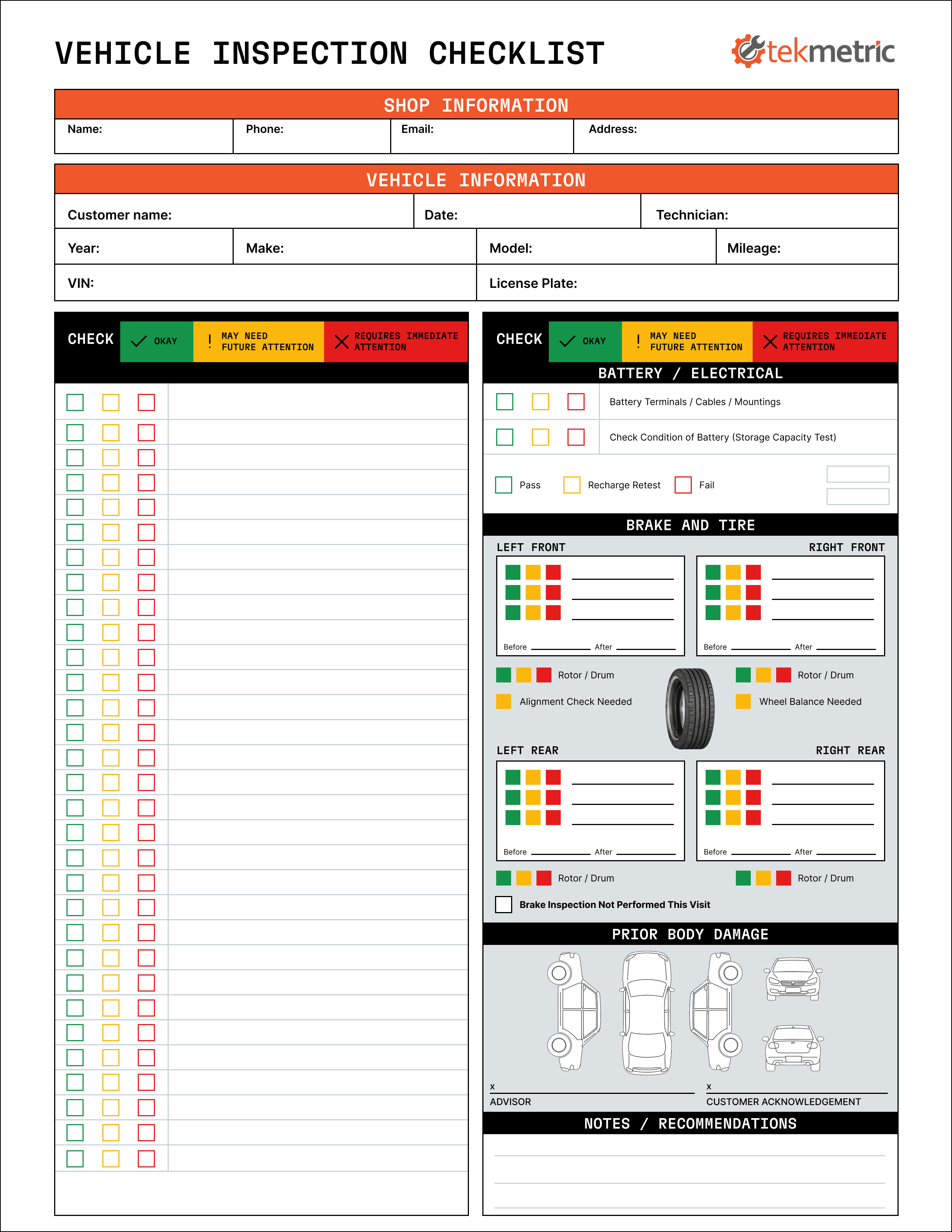
Printable vehicle inspection checklist (PDF)

Free Download: Download our comprehensive vehicle inspection checklist (PDF) to use in your shop.

Vehicle inspection checklist template.

100-Point vehicle inspection checklist

A full inspection covers every system that affects safety, drivability, and reliability. The comprehensive 100-point checklist below gives your technicians a strong baseline they can follow on every repair order.

Vehicle intake

  1. Log the VIN and license plate to confirm the vehicle's identity and match past service records.
  2. Record odometer reading in and out.
  3. Note customer-reported concerns and the reason for the visit.
  4. Document the fuel level at drop-off.
  5. Check for open safety recalls tied to the VIN.
  6. Gather customer contact information.

Do you like free resources? Download our free automotive repair work order template to use in your shop.

Exterior condition

  1. Check the body for dents, scratches, and any signs of damage.
  2. Inspect the bumpers front and rear for cracks, loose mounts, or impact marks.
  3. Confirm the license plate is secure, legible, and properly mounted.
  4. Note any rust, paint issues, or trim damage.
  5. Inspect fenders, rocker panels, and body panel alignment.
  6. Inspect glass, windshield, and mirrors for chips, cracks, or pitting.
  7. Check door handles, hinges, and weather stripping.
  8. Inspect child safety locks.
  9. Inspect the trailer hitch.

Lights and electrical

  1. Headlights on low and high beam.
  2. Taillights and brake lights.
  3. Turn signals front and rear.
  4. Hazard flashers.
  5. License plate lights and dashboard illumination.
  6. Reverse lights, fog lights, and daytime running lights.
  7. Interior dome, map, and courtesy lights.
  8. Any warning light that's illuminated on the dashboard. A check engine light, ABS warning, or airbag indicator tells you where to focus diagnostic time.
  9. Battery voltage, terminals, and charge/discharge load test.
  10. Alternator output and starter draw.
  11. Ignition switch and accelerator pedal function.
  12. Horn operation.

Tires and wheels

  1. Check tire pressure on all four tires plus the spare.
  2. Measure tire tread depth.
  3. Check for uneven wear patterns that can point to alignment or suspension issues.
  4. Inspect sidewalls for cracks, bulges, or embedded objects.
  5. Check valve stems and caps for leaks or damage.
  6. Review the tire DOT date code for age.
  7. Verify wheel condition, lug nut torque, and hub cap security.
  8. Check the spare tire, jack, lug wrench, and locking wheel lock key.
  9. Confirm the tire pressure monitoring system (TPMS) is functioning.

Brake system

  1. Check brake pads for thickness and wear patterns.
  2. Inspect rotors for scoring, warping, or excessive wear.
  3. Examine brake drums and shoes, if equipped.
  4. Check brake calipers for sticking, leaks, or damaged boots.
  5. Check brake fluid level and condition at the master cylinder.
  6. Examine brake lines and hoses for cracks or leaks.
  7. Test parking brake function and adjustment.
  8. Evaluate overall brake pedal feel, travel, and pulsation.
  9. Verify ABS sensors, wiring, and warning light operation.

Steering and suspension

  1. Inspect the steering wheel for play and responsiveness.
  2. Check steering column and intermediate shaft for looseness.
  3. Check power steering fluid level and condition.
  4. Examine tie rods and ball joints for wear.
  5. Check struts for leaks or damage.
  6. Inspect shock absorbers for proper dampening and leaks.
  7. Check CV boots and axle shafts.
  8. Inspect wheel bearings for noise or excessive play.
  9. Inspect sway bar links, bushings, and control arms.
  10. Look for uneven ride height or sagging that can indicate a failing spring.

Under the hood

  1. Check the battery capacity.
  1. Check engine oil level and condition.
  2. Check the oil filter for leaks and proper seating.
  3. Inspect transmission fluid.
  4. Check coolant level, condition, and the cooling system for leaks.
  5. Inspect brake fluid, power steering fluid, and washer fluid reservoirs.
  6. Inspect the battery, cables, and hold-down hardware.
  7. Examine the serpentine belt and any drive belts for cracks, glazing, or fraying.
  8. Check all hoses for soft spots, swelling, bulges, or leaks.
  9. Inspect the engine air filter and cabin air filter.
  10. Check the fuel filter, if serviceable.
  11. Inspect the PCV valve and evaporative emissions components.
  12. Check the radiator and condenser fins for debris or damage.
  13. Check engine and transmission mounts.
  14. Look for oil leaks at the valve cover, oil pan, and gaskets.
  15. Test the spark plugs and ignition components.
  16. Inspect air intake.
  17. Inspect fuses.

Under the car

  1. Check the exhaust system for leaks, rust, and damaged hangers.
  2. Inspect the muffler, resonator, and heat shields.
  3. Inspect fuel system components, lines, and the fuel tank for leaks or corrosion.
  4. Look at the transmission and differential housings for leaks.
  5. Check the oil pan and drain plug for seepage or stripped threads.
  6. Examine the frame, subframe, and undercarriage for rust or impact damage.
  7. Check emissions-related components like the catalytic converter and oxygen sensors.
  8. Inspect the driveshaft, U-joints, and center support bearings.
  9. Verify skid plates and underbody shielding are secure.
  10. Scan the ground under the vehicle for any fluid drips or leaks.

Interior and safety equipment

  1. Test seat belts for retraction, fraying, and buckle function.
  2. Confirm airbag and supplemental restraint indicators clear properly.
  3. Inspect windshield wipers and wiper blades for streaking or splitting.
  4. Test washer fluid spray on the windshield and rear glass, if equipped.
  5. Inspect interior warning lights.
  6. Check AC, heat, and all fan speeds.
  7. Test front and rear defrosters.
  8. Inspect infotainment displays and systems.
  9. Test door locks, power windows, and the key fob.
  10. Inspect driver-assist systems, backup camera, and parking sensors.
  11. Inspect lane departure systems.

Road test

  1. Confirm smooth engine start and stable idle.
  2. Evaluate transmission shift quality and clutch engagement, if manual.
  3. Test braking response, pedal feel, and stopping distance.
  4. Listen and feel for suspension noise, vibration, or harshness.
  5. Check cruise control and driver-assist system operation.
  6. Note any dashboard warning indicator, abnormal smoke from the exhaust, or unusual vibration that appears during the drive.

What are digital vehicle inspections (DVIs)?

Paper inspection checklists worked for decades, but they come with real costs: illegible handwriting, lost sheets, no documentation, and frustrating back-and-forth among the technician, service advisor, and customer.

Digital Vehicle Inspections change that. With Tekmetric, your technicians perform the inspection on a tablet or phone, attach photos and videos of anything that needs attention, and send a vehicle health report straight to the customer's phone.

Here's what that looks like in practice: A technician notices worn brake pads on a 2019 Toyota Highlander. Instead of writing a note the customer may not understand, the technician snaps a photo of the worn pad next to a new one, records a short video, and marks the task red for immediate attention. The service advisor builds the estimate and texts it to the customer. Whether they're an in-store customer in the waiting room or at work across town, the customer approves the job with a digital signature.

Tired of piles of paper inspections? Upgrade your shop with digital vehicle inspections. Send inspections to the customer for approval with the visual proof needed to close the deal.

Why car inspections matter

Every car owner is counting on your team to catch what they can't see. A consistent inspection process gives your technicians a repeatable way to do exactly that on every repair order, every time.

Inspections also drive revenue. When you document a vehicle's condition clearly with photos and notes, customers understand exactly what their car needs and why. They approve more of the work they genuinely need when they can see the evidence.

Build customer trust with digital vehicle inspections

A great inspection process isn't about checking boxes. It's about giving every vehicle owner a clear, honest picture of their car's condition so they can make informed decisions about their safety and their budget. When your shop pairs a thorough inspection process with a digital tool like Tekmetric's DVI, you give your team the speed and consistency they need and your customers the transparency they want.

Your next inspection starts with the right checklist. Download the free 100-point vehicle inspection checklist or upgrade to digital vehicle inspections.

Free Vehicle Inspection Checklist (Printable PDF)

April 22, 2026

Read time: 3 min

read more

When it comes to efficiency in an auto repair shop, a technician’s expertise and performance are paramount. The service advisor might be the face who interacts directly with vehicle owners, but technicians are the eyes and ears – the “pistons” – that run the whole system. As a technician, your ability to complete your day-to-day jobs efficiently and effectively is crucial to the shop’s overall performance.

Using data can help you maximize your own profitability as well as the shop’s. From identifying the problem to performing the diagnosis and completing the repair, data can significantly elevate your performance. Simply put, when you accurately and comprehensively leverage the data available through a system like Tekmetric at every step of a repair, you are going to perform more efficiently – to the benefit of the shop and your own career.

Concern: Ensure accuracy with data to identify the problem

When a vehicle is brought in with an initial concern, data can help you better respond to the customer’s needs communicated by the service advisor. By intentionally reviewing the data collected by the service advisor, you can better understand the reason the customer has brought the vehicle in for repair and ensure your diagnosis can uncover the true cause of the problem.

With Tekmetric, your job board and all the data it includes is your key to success. In fact, you can consider it your “digital clipboard,” as it includes all the details you need in one place. The job board shows approved estimates as well as completed work – so it’s your window into how efficiently you are addressing customer concerns, bottlenecks in the repair process and more. This tool enables you to follow up on questions or additional details so your service advisor can communicate with the customer. This in turn drives efficiency within the shop as you can ensure the customer’s concern is addressed promptly and correctly.

‍Cause: Utilize digital tools to make the correct diagnosis

Once a problem has been identified, you can also leverage data via digital vehicle inspections (DVIs) to document diagnoses and show the exact cause of the problem. This includes making thorough notes, including photos and videos and showcasing other issues you find that could need additional repairs. By leveraging digital tools to complete thorough inspections, you can become a diagnostic wizard, solving problems faster and more efficiently. This not only translates to happier customers who get their cars back sooner, but also lets you sell more work, boosting your productivity and earning potential.

The most important part of the digital vehicle inspection is clear photos and videos. By including the right number of photos in your inspection, you can educate your customer on their vehicle’s performance. However, be sure not to overwhelm the customer with information. Tekmetric has found that 6-8 photos on average is the sweet spot, although this may change with your customer base. 

A detailed DVI complete with photos allows the customer to review and approve the jobs they need the most, while planning for repairs that may come up in the future. As a result, you can educate the customer on the cause of their concern, share additional details if needed and simplify the communication process for you and the service advisor – ultimately increasing the average repair order (ARO).

Correction: Control the tempo of the shop’s workflow during repairs

Now that you have identified the problem, it’s time to complete the repair. As you work through your repair list, you can also use key metrics and information available on your job board to ensure you – and the shop overall – are working efficiently. For example, you can follow up with your service advisor on jobs you have inspected but are not approved for repairs. This helps drive the shop’s efficiency, so you can complete the work and get the car out of the shop to move onto the next one.

The other important aspect of the repair phase is collaborating with other technicians to better leverage each technician’s unique strengths and weaknesses. For example, if your specialty is brake replacements, you can work with your team to ensure you work on brake-related repairs. This helps streamline those repairs to you – the expert – so you can complete them faster and at a higher quality. In turn, the shop streamlines its overall processes, leading to more profit for the shop and for you.

Technicians are a critical part of a shop’s operations – but your role is not just limited to the actual repair. You can become even better in your role by using data throughout the customer experience: from the initial problem and diagnosis until the customer walks out with a fixed vehicle. In fact, utilizing data from the minute the customer walks into the shop leads to better diagnoses and more successful repairs. Learning how to use data correctly can help you perform at a higher level, ultimately increasing the profitability of the shop and growing your own paycheck.

‍