Maximizing Auto Repair Shop Customer Service: A Guide to Selling Maintenance Work
Training service advisors how to properly sell maintenance work can create more loyal customers.
Drivers typically come in with an expectation of what's wrong with their car, which can make it tricky to sell maintenance work. Drivers might think you're trying to squeeze more money out of them, or may simply have a set budget in their mind and don’t plan on spending extra.
In reality, you're simply trying to go above and beyond and provide them the best service possible. So how do you show that, and which tools will help you transform the way you sell maintenance?
Here’s how to build customer trust while staying true to your auto repair shop’s mission of providing optimal maintenance recommendations.
Why Selling Maintenance Work Can Be a Challenge for Auto Repair Shop Customer Service
According to a survey conducted by AAA, 76% of U.S. drivers said that recommending unnecessary services was the top reason they do not trust auto repair shops. The survey also points out that ⅔ of U.S. drivers have managed to find an auto repair shop that they trust. Whether it’s an independent auto repair shop, or a chain repair shop, trust needs to be at the forefront of the customer experience.
Service advisors may be hesitant to sell maintenance work and only focus on the problem at hand because they don’t want to come off as pushy. But not recommending maintenance work can be a disservice to customers who deserve to know about any and all issues with their vehicle, not just the ones they’ve noticed themselves.
Add a Maintenance-Focused Inspection and Sales Process to Your Auto Repair Shop Customer Service Routine
When it comes to selling routine vehicle maintenance work, it’s important to remember that routine check ups will make a big difference on customer’s cars. Similar to the human body, cars are complex systems. Just like the body has a heart, nervous system, and organs, cars have the engine, the vehicle bus, and the control unit. If one problem is ignored, that could lead to more issues, possibly more serious than the last. For example, if a driver puts off replacing their brakes, it could damage the car’s rotors, which in turn, could lead to loss of braking power. This gets us back to one of the most important benefits of selling maintenance work: it helps your customers stay safe and get as many miles out of their car as possible.
Benefits to Selling Maintenance Work
Regular maintenance makes your customers’ lives easier. It prevents your customers from ending up on the side of the road and prolongs their vehicles’ lifespans.
Customers save money. Maintenance work can prevent car issues from getting out-of-hand, which may lead to spending more on larger repairs in the future. And who doesn’t want to address maintenance work before it becomes a much larger expense?
Providing maintenance inspections helps shops sell more work, which usually means higher ROs and a more profitable repair shop. Also, because maintenance work helps your customers’ vehicles last longer, they’re less likely to buy a new car, which they’ll probably get repaired at the dealership during the first few years.
Maintenance inspections help you queue up more work for the future. Even if they decline the maintenance work, you now have a relationship. You can track those declined jobs, and the service advisor and technician can save time figuring out what all might be wrong with the vehicle and resell that work.
Customers trust you more. When you provide reliable insights into your customer’s vehicles, your like their go-to car whisperer—a trustworthy person who reminds them to check stuff out on their vehicle before anything bad happens
Maintenance by Mileage
Shop owners, we recommend training your service advisors to check customer mileage at each visit and tracking it in your shop's auto repair shop customer service notes. By keeping track of customer mileage on each vehicle, you’ll be able to recommend maintenance work based on how many miles it has been since their last visit.
Mileage
Recommended Car Maintenance
Every 3,000 - 7,000 Miles
Replace oil and oil filters, inspect various fluid levels and wipers, check tires and lights
Every 15,000 miles
Replace air filter
Every 20,000 miles
Inspect battery and coolant levels
Every 30,000 miless
Replace power steering fluid, inspect coolant levels, brake pads, and suspension components, check radiator hoses and HVAC system
Every 35,000 miless
Inspect and replace the battery
Every 40,000 miless
Replace spark plugs and wires, inspect ignition system and suspension
Every 60,000 miless
Replace brake pads and fluid, inspect radiator hoses, timing belt, HVAC system, suspension components, and tires, check coolant levels, and power steering fluid levels
Mileage aside, a thorough digital vehicle inspection of all vehicle’s essential components should be performed regularly.
With so many different aspects of running an independent auto repair shop, the teams that keeps cars moving through your bays and repair orders flowing through your workflow function best when they run like a cohesive unit.
Just think about your favorite sports team. The players share a common goal, whether it be scoring a touchdown or hitting a home run, and they encourage each other to always perform at their best.
But there’s usually one person on the team who everyone looks to for guidance and inspiration: the team captain. Every player in the auto repair industry is important—from the technicians to the parts managers. But service writers are like the team captain. They keep everyone on track.
If you’re ready to learn about a challenging but rewarding career where no two days are the same, you’re in the right place.
Selecting the right business name for your auto repair shop can be a challenging task. Your business name will be the first impression your potential customers have of your shop and will determine how memorable your shop will be. Use the ideas below to brainstorm the perfect name for your auto repair business.
Creative auto repair shop names
On The Road Again Repairs
NextGear Auto Service
Check Engine Repairs
Torque of the Town
The Engine Room
Chrome & Steel Auto Care
Axle & Alloy Repair Co.
Peak Performance Garage
Smooth Ride Mechanics
Driven Dynamics
Velocity Auto Shop
ClearPath Automotive
Tek-Tip: Struggling to find the perfect shop name? Tekmetric offers a free automotive shop name generator to help you create the perfect business name.
Funny automotive repair shop names
The Brake-Up Shop
Motor Mouth Mechanics
Hit & Run Body Shop
Exhausted Mechanics
Hot Wife Automotive A/C Repair
Don’t Tread On Me Auto
The Laughing Lugnuts Auto Repair
Wheel Be Alright Auto Repairs
Motor Mouth LLC
Rust in Peace Repairs
Tek-Tip: Have you thought about how you will market your new business? Learn more about Tekmetric Marketing for all automotive marketing needs including websites, CRM, online reviews, and more.
Cool mechanic shop names
The Car Whisperers LLC
RoadReady Mechanics
StreetSmart Garage
GearShift Garage
Velocity Motors
Gearhead Garage
The Repair Authority
PitStop Pros
Full Throttle Repair
Trackside Garage
Unique and catchy names
Car Medic Garage
Nuts & Bolts Car Mechanics
Unleaded Car Repair
Honest Engine Repair
Auto Barn Car Care
Iron Horse Garage
Blue Ridge Auto Works
RevSync Mechanics
The Auto Vault
Summit Auto Haven
Rust & Revive Repair
Simple auto shop name ideas
Car Surgeons
The Car Guys
Engine Experts
Quick Fix Automotive Repairs
The Brake Brothers
One Stop Auto Shop
Auto Solutions Inc.
Pit Stop Garage
Turbo Tires & More
Wrench Wizards
Service-Specific shop names
Brake Check Repairs
Oil Be Back Automotive Repairs
Vivid Vehicle Body Shop
1 Hour Heat and A/C Auto Repairs
Battery Solutions LLC
Actually Discounted Tires
Renew Collision Center
30min Oil Change Shop
Restored Right Auto Body Shop
Mobile mechanic business names
Repair on Wheels
Roaming Automotive Repairs
One Stop Repair Shop
One Call Repairs
Wheels On The Way
(Insert last name) Mobile Mechanic
The Leaky Gasket Mobile Repair
1 Hour Mobile Mechanic
24/7 Mobile Mechanic
How to select the right auto repair shop name
Once you have your list of potential shop names narrowed down, it is time to do a final round of research to make sure your name is legal, optimized and ready to launch. Check out our final 6 tips and tricks below.
1. Legal checks
Before you can launch your new automotive shop name, you should check for Trademarks by visiting the US Patent and Trademark Website. Simply search your pending business name to see if it is taken or if you can proceed.
Search engine optimization for auto repair shops is an important avenue for driving brand awareness and new customers. To maximize your new business name, aim to include common keywords like “automotive”, “repair”, and “shop”. Also, try to use local terms like “Houston” to help search engines know where your services are located. Lastly, check to see if any competitors are using a similar name and determine if your name will be unique enough.
GoDaddy can check if your new automotive repair shop name is available to use. You will also be able to see how much the domain name will cost and whether it would be cheaper to use a variation of your business name.
4. KISS
Keeping your new shop name simple will help you in the long run. Potential customers will find it easier to remember (and share via word of mouth) if you keep it short and simple. Plus, shorter business names are easier to fit on business cards, advertisements, and social media.
5. Marketing
Looking down the road, your new business name should fit within your overall automotive marketing strategy. Are you planning to use a certain logo or color scheme? Make sure your name fits the theme you are aiming for and attracts your target audience. If you plan to use social media marketing, check to see if your business name is available as a social handle.
6. Set the tone
Your name is likely your first impression with your customers. Once you are ready to launch, give it one more review to make sure it conveys the right brand identity and message. Lastly, have a friend or colleague offer feedback on your business name and see how it resonates with them.
7. Automotive business name generator
Tekmetric has developed a free AI-powered mechanic shop name generator tool to help you brainstorm new business name ideas. Our tool can also help you check for domain availability and provide logo design concepts.
Closing Thoughts
Finding the right name for your business is a daunting task and we hope this guide has helped you brainstorm new business name ideas and narrow down your list. We recommend taking the extra time to make the right choice up front so you don’t have to rebrand down the road. As always, there is wisdom to asking for feedback from your community. Select your top 5 names and ask for help picking the best shop name for your business.
In the ever-evolving automotive industry, staying ahead of the curve means constantly learning and growing. For automotive service technicians, certifications aren’t just credentials—they’re powerful tools that open doors to better job opportunities, increased pay, and credibility with customers and employers alike.
Whether you're just starting out or already working in auto repair, understanding the most common types of mechanic certification can help you create a successful, long-lasting career. This guide will break down the most recognized certifications, how to attain them, and why they matter for every auto mechanic who wants to stand out.
Types of mechanic certifications
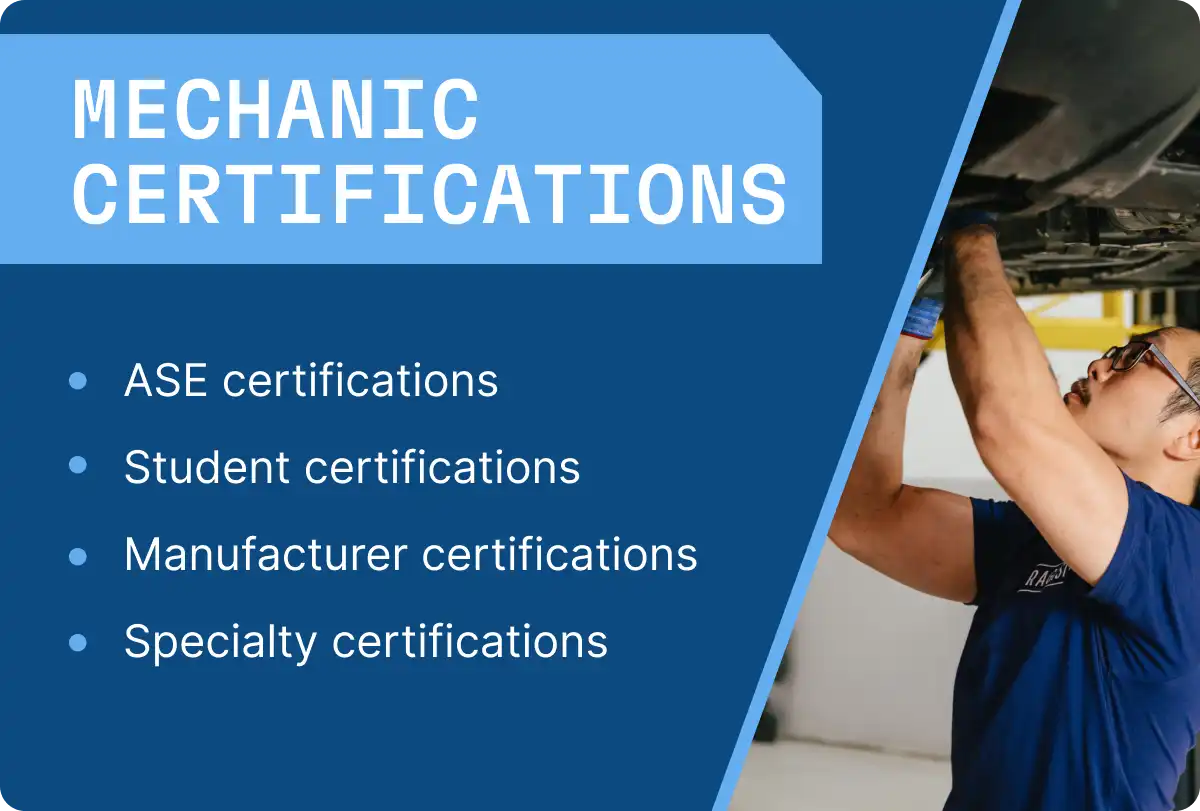
Mechanic certifications come in many forms, each tailored to different specializations and career goals. The most common types include:
1. ASE Certifications
Issued by the National Institute for Automotive Service Excellence (ASE), these certifications are the gold standard for automotive mechanics. They cover a wide range of specialties, from engine repair to electronic systems and air conditioning.
ASE certification is considered the most prestigious and widely accepted credential in the automotive world.
More about ASE
Founded in 1972, the National Institute for Automotive Service Excellence sets the benchmark for automotive service technicians. ASE offers over 50 different certification tests in categories like:
Engine Repair
Brake Systems
Air Conditioning and Heating
Suspension and Steering
Electrical/Electronic Systems
Engine Performance
Manual and Automatic Transmission/Transaxle
Light Truck and Diesel Engines
Master technicians
There’s also a separate path for master technician status, which is achieved by passing all certifications in the required testing areas for that series. For example, technicians certified in tests A1 through A8 are Master automobile technicians.
Master technician status is not for life. You must keep each one of those certifications current to maintain master technician status. If you lose master technician status due to the lapse of one or more required certifications, it can be reinstated by taking and passing the recertification tests.
How long does it take to become ASE certified?
To become ASE certified, expect to spend anywhere from 1–3 years, depending on your work experience and whether you’re currently enrolled in training programs. Each certification test typically takes 1 to 2 hours to complete and can be scheduled at a local test center.
Being ASE certified shows you’ve mastered the skills needed for the job. It’s a badge of excellence recognized by employers, repair shops, and even customers looking for reliable service.
2. Student certifications
Geared toward high school and post-secondary students in automotive technology programs, these ASE certifications offer a head start in proving foundational knowledge.
What are student certifications?
Student certifications validate entry-level knowledge in core areas of vehicle repair and maintenance. These don’t require work experience and serve as a stepping stone to full ASE status.
Programs approved by the ASE Education Foundation often include student certification exams as part of their curriculum. These are excellent options for students at auto mechanic schools or in a community college training program.
Student certifications are valid for two years and help you build confidence before entering the workforce as an entry-level technician.
3. Manufacturer certifications
These certifications are specific to vehicle manufacturers and offered by companies like Ford, Toyota, GM, and others. Often, auto technicians working in dealerships will pursue these to show mastery of brand-specific systems.
For repair technicians who want to specialize in a particular brand, manufacturer certifications are essential.
Manufacturer training programs
Toyota T-TEN
Ford ASSET
GM ASEP
Honda PACT
BMW STEP
These accredited programs often partner with dealerships to offer real-world, hands-on experience while you earn your credential. These programs can take anywhere from 12 to 24 months and typically require completion of automotive technology coursework alongside on-the-job work experience at a brand-affiliated repair center.
Why they matter
Manufacturer-certified auto technicians often have a faster path to high-paying roles within dealership networks and brand-specific repair shops. These certifications also prepare you to service increasingly complex vehicle systems, especially as brands continue to innovate with hybrid and electric vehicles.
4. Specialty certifications
You’ll also find credentials related to diesel engines, heavy truck systems, collision repair, and even hybrid/electric vehicles.
Each of these certification types plays a unique role in an automotive technician’s career path, and in many cases, earning more than one will make you significantly more marketable in repair shops and beyond.
Depending on your interests, you may also want to pursue:
A/C Refrigerant Certification - Necessary if you want to be able to to buy refrigerant and work on air conditioning service.
Diesel Mechanics Certification – Focused on diesel engines used in commercial fleets and heavy truck applications.
Collision Repair Certification – Great for auto mechanics looking to work in body shops.
Hybrid/Electric Vehicle Certification – A growing field with high demand.
Each of these certifications typically requires completion of a specialized training course and a passing score on certification exams. These programs may be part of a broader certificate program or offered as a standalone credential.
Tek-Tip: Another way to get ahead as a young technician is to be experienced with auto repair shop software so your employer doesn't have to teach you how to use their system.
Benefits of mechanic certifications
Getting certified is one of the most direct ways to turn your hands-on experience into a long-term career asset. Mechanic certifications do more than look good on a resume—they deliver real-world advantages. Here are some of the benefits of completing automotive certifications:
Increased Pay: Certified mechanics typically earn higher wages. According to the Bureau of Labor Statistics (BLS), certified automotive mechanics can earn higher hourly rates, especially in competitive markets.
Job Security: The more certifications you have, the more valuable you are to auto repair businesses.
Professional Credibility: Certification demonstrates a commitment to quality and standards, building trust with customers and employers.
Career Advancement: Certified automotive service technicians are more likely to advance to roles such as shop foreman, master technician, or service manager.
Mobility: Certifications make it easier to move between different types of employers—whether that’s independent repair shops, starting a mobile mechanic business, dealerships, or specialty service centers.
What does the certification process look like?
Most mechanic certifications follow a similar pathway but always refer to the specific instructions for your program.
Step 1: Enroll
Start by enrolling in an automotive technology program. These are offered by community colleges, trade schools, and accredited auto mechanic schools. Many programs are supported by the ASE Education Foundation, ensuring alignment with real-world industry standards.
Look for certificate programs or associate degrees that offer hands-on training. Financial aid is often available for eligible students.
Step 2: Gain work experience
Work experience is critical for most certifications. For ASE certification, for example, you need at least two years of on-the-job experience—or one year plus a diploma from an accredited program. You’ll need to show that you’ve worked on everything from brake systems and axles to manual drive train repairs and electrical systems.
Step 3: Pass certification tests
Most mechanic certifications require passing written or computer-based certification exams. These are typically held at a certified test center. The exams cover a variety of topics depending on the specialty, including engine performance, electronic systems, and automatic transmission repair.
Tek-Tip: Some auto shops/employers will pay your test fees for you.
Step 4: Maintain certification
Many certifications require recertification every five years. Staying current ensures you’re up to date with the latest automotive repair techniques, tools, and systems.
Final thoughts
Becoming a certified mechanic takes dedication, but the payoff is worth it. From better job prospects to increased credibility, mechanic certifications help you build a successful, respected career in automotive repair.
Invest in your future. Get trained, get certified, and become a leader in the ever-growing world of automotive repair.




.svg)



.svg)

.svg)
.svg)
.svg)
.svg)
.svg)
.svg)