
How to Use Real-Time and Evergreen Data to Grow Your Shop

Sunil Patel

|

July 25, 2024

|

Read time: 3 min

In today’s auto repair industry, data can play a key role in a shop’s ability to repair a vehicle more efficiently and accurately. Traditionally, repair information was documented informally, often by hand on paper. Today, this information can be captured and processed electronically, leading to a significant acceleration of the repair process – and a more positive customer experience. 

The transformative power of data extends beyond streamlining individual repairs. In fact, by strategically analyzing your shop’s data over time, you can also use the information to grow your shop. However, to maximize the impact of data, it’s important to know what kind of data is most effective to use in your shop. Some of the more evergreen data – performance over time – is useful in your long-term strategy, while others, such as real-time performance metrics, are more helpful in making short-term tweaks to promote better performance. In this blog, we’ll discuss how you can distinguish between evergreen and real-time data and where you can use both to grow your shop.

Understanding Real-Time vs. Evergreen Data

Before you can decide how to use data, it’s important to understand the difference between evergreen data and real-time data. Real-time data is live data that is available as soon as it is generated. It allows you to manage your shop and respond to situations instantaneously as they happen. On the other hand, evergreen data is used in hindsight, after a timeframe has ended. Most shops use this type of data to reflect after the repairs are complete.

Both forms of data have their uses. Real-time data allows you to respond to situations as they happen in a way that helps support your business. Evergreen data helps you track long-term trends and their effects on your shop. With Tekmetric, you can leverage both types to keep your shop running smoothly. When you leverage data strategically in all forms, you can optimize your shop’s operations and processes, create an excellent customer experience and prime your business for growth.

Stay Ahead of the Curve with Real-Time Data

Real-time data enables immediate visibility into what is happening with your shop at any given time. From inventory to customer communication to repair progress, you can review different buckets within your shop and respond as the day progresses. This capability allows you to make decisions on the fly without having to wait until the end of the day, week or month to know which parts need to be ordered or how many repairs you have completed. Strategically, real-time data can be used for short-term decisions that have long-term effects, ultimately becoming an integral piece to growing the shop’s bottom line.

Examples of how you can use real-time data might include:

  • Track daily progress with the shop dashboard:  Reviewing this in real-time allows you to respond to potential bottlenecks or problems that arise throughout the day. For example, if you see $15,000 in work pending approval before lunchtime, you can encourage your service writers to conduct follow-up calls to get approval and begin the work.
  • Send out rainy-day coupons: Business tends to slow down on rainy days. However, if you experience this, you can respond in real-time by sending a rainy-day coupon incentivizing customers to come in for quick-turn work, like oil changes. 
  • Monitor multiple shop locations with Tekmetric Multi-Shop: Multi-Shop can show you the performance of each shop at any time, from any location – so you can make decisions that support the strengths of all your locations. For example, you might move a car from a very busy, overrun location to another, slower location. Make sure you return the vehicle to the original location for easy customer pickup to maintain your customer experience. This maximizes workflow between high and low volume locations.

Analyze, Determine and Predict Trends with Evergreen Data

In addition to real-time data, you can leverage evergreen data by analyzing trends and your shop’s data for predictive forecasting. One of evergreen data’s biggest advantages is that it captures a period of time without the need for constant refreshing. This can help you review your shop’s performance over longer periods – year-over-year, month-to-month or quarterly – so you can implement long-term solutions to promote growth.

Examples of using evergreen data include:

  • Create more business with declined jobs: When you want to influence cash flow for the coming weeks or months, you can follow up on previously declined jobs, such as an oil change or tire rotation. This customer-centric approach can not only build your customer relationships, but also drive business during a slow month.
  • Create value with Shared Customer History: You can share your customer’s history across multiple locations, bringing extra value through this evergreen data. For example, if a customer asks when they had their last oil change, your service advisor will be able to pull that information within seconds – no matter which location the customer last visited.
  • Create custom financial reports to track shop performance: Tekmetric’s financial reports give you the power and flexibility to create a report that tracks what’s important to you, without any extra noise, and make decisions based on past performance. For example, you can utilize the Time Period Configuration feature to compare data from the previous year or another custom time period, identifying bottlenecks and adjusting your strategy accordingly.
  • Track month-over-month trends with comparative reporting: Pay attention to the trends that occur each month in comparison to the same time frame in previous years. This will allow you to spot trends and respond accordingly, such as preparing for a particularly busy season or implementing strategies to create more work in a slower season.

The Price of Ignoring Data

Time is money. Evergreen and real-time data allow you to manage your shop’s time and resources in the most efficient manner to generate profit while providing an excellent customer experience. To grow your shop, ensure you are using both forms of data to your advantage. Combining evergreen data’s longevity with real-time data can lead you to a multi-faceted business strategy, creating a customer-centric approach that ultimately generates more cash flow, profit and growth.
👉 Ready to grow your automotive business? [Book a personalized Tekmetric Demo Here]

FAQ

More articles

If you're running an auto repair shop, investing in a car lift is essential. A high-quality vehicle lift makes it easier to work on cars, increases efficiency, and ensures safety. But how much does it actually cost to install a car lift? That depends on the type of lift, installation costs, and other factors such as weight capacity and safety features. Let’s break it all down so you can pick the best automotive lift for your needs.

Do you need a car lift?

Car lifts are essential in auto repair shops because they provide mechanics with better access to a vehicle’s undercarriage, making inspections, repairs, and maintenance tasks safer, more efficient, and more comfortable. Unlike floor jacks, lifts offer a stable and elevated workspace, reducing the risk of injuries and improving workflow.

With a car lift, technicians can quickly perform tasks such as oil changes, brake repairs, exhaust system work, and suspension adjustments without having to crawl under the vehicle. This efficiency leads to faster turnaround times and higher shop productivity.

Additionally, lifts help maximize shop space by allowing vertical storage for vehicles, which is especially useful in high-volume repair shops. Overall, car hoists are a fundamental investment for any auto repair shop looking to enhance efficiency, safety, and the quality of service provided to customers.

Types of car lifts and their costs

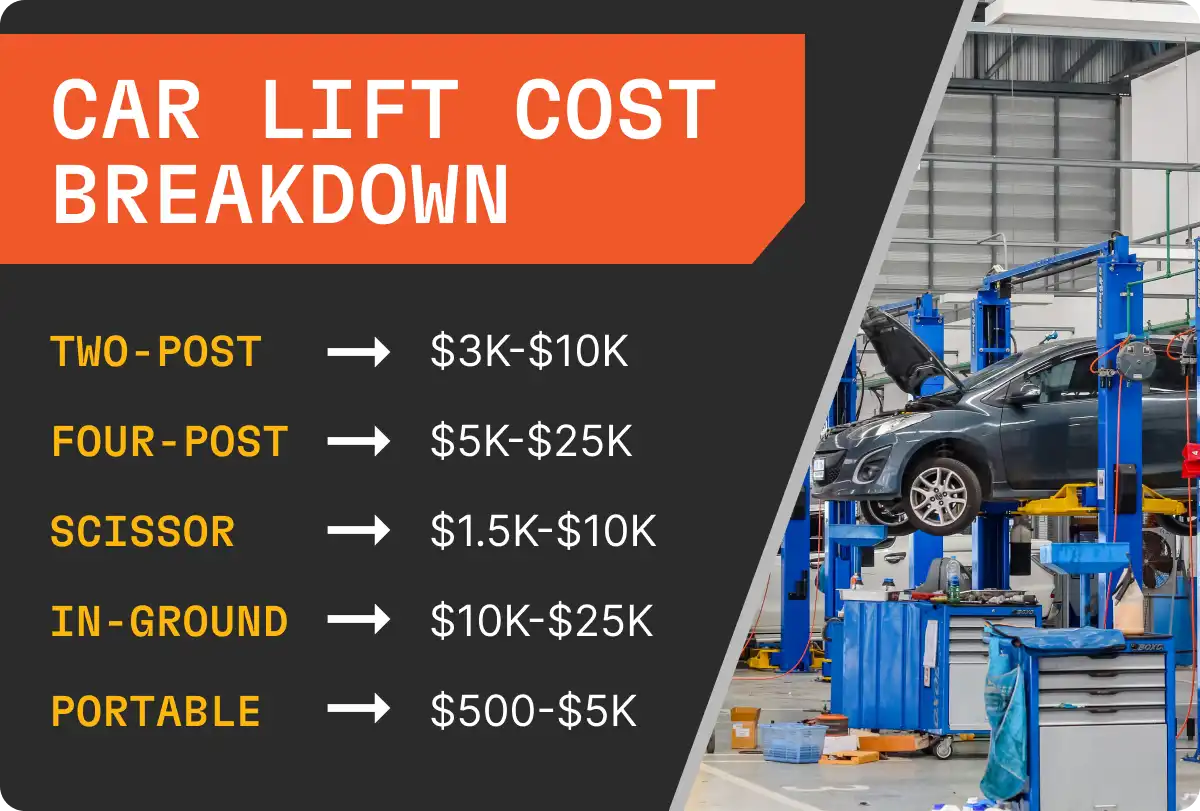
Each type of lift has its pros and cons. Some lifts are better for oil change shops and some are better for tire or repair shops. In general, car lifts can cost between $1,000 and $20,000 depending on brand, lift capacity, lift height, and features. Here’s a comprehensive look at the most common lift options for your shop.

An image comparing the cost of car lift types.

Two-Post car lifts

A two-post car lift is one of the most popular choices for auto repair shops. They are popular because they take up less space and can be affordable depending on features. Make sure to plan out your shop layout as these lifts are permanent and cannot be easily moved. These hoists come in asymmetric and symmetric configurations, allowing flexibility based on vehicle type.

  • Price: $3,000 - $10,000
  • Best For: General repair shops working on SUVs and smaller cars.
  • Lift capacity: 5,000 - 10,000 lbs.
  • Popular brands: BendPak, Rotary, Tuxedo.
  • Advantages: High lifting capacity while saving space for smaller shops.

Four-Post lifts

A four-post lift provides greater stability and weight capacity, making it ideal for heavier vehicles. If your shop works on a lot of trucks or heavy-duty vehicles, the four-post lift might be the best lift for you. Tire and brake shops should avoid these lifts as the tires sit on the lift making it difficult to work on these areas.

  • Price: $5,000 - $25,000
  • Best For: Dealerships and professional shops.
  • Lift capacity: 7,000 - 14,000 lbs.
  • Popular brands: BendPak, Titan, Tuxedo, Rotary.
  • Advantages: Heavier lifting capacity for larger vehicles.

Scissor lifts

If saving space is your top priority, the scissor lift may be your best option. They are almost invisible when not in use and lie flat on the ground to optimize garage space. Double check the lift capacity and height to make sure it can accommodate the types of vehicles you work on.

  • Price: $1,500 - $10,000
  • Best For: Quick repair shops where space is limited.
  • Lift capacity: 5,000 - 15,000 lbs.
  • Brands: QuickJack, BendPak, MaxJax
  • Advantages: Compact and cheaper.

In-Ground lifts

In-ground car lifts are a great choice for shops that work on heavier vehicles and want to save space. These lifts are the perfect balance of the space saving capabilities of a scissor lift while also providing optimal strength for large vehicles.

  • Price: $10,000 - $25,000
  • Best For: Repair shops and dealerships.
  • Lift capacity: 5,000 - 20,000 lbs.
  • Brands: BendPak, Rotary, Atlas
  • Advantages: Compact while also offering enough muscle.

Portable car lifts

If your shop layout frequently changes or you are a mobile mechanic, a portable lift may be the best option. These lifts can be easily moved around a garage or taken to a job site and are often the cheapest option. However, they can be less reliable and don’t provide the same level of strength as a stationary lift.

  • Price: $500 - $5,000
  • Best For: Home garages, mobile mechanics, DIY enthusiasts.
  • Lift capacity: 5,000 - 10,000 lbs.
  • Brands: QuickJack, MaxJax
  • Advantages: Affordable, compact, mobile.

Installation prices for car lifts

Installing a vehicle lift is not just about purchasing the unit. You also need to consider the installation costs, which can vary depending on the type of lift and garage setup. Here are the main factors affecting installation costs:

1. Concrete requirements

Most lifts, especially two-post car lifts and four-post lifts, require a thick concrete base. If your floor isn’t thick enough, you may need reinforcement, which adds to the cost.

2. Electrical setup

Lifts need power, and if your garage isn’t wired for it, you’ll need an electrician.

3. Air compressors & accessories

Some lifts require compressors and additional balancer tools for operation.

4. Professional installation

Hiring a pro ensures the lift is ALI-certified and meets safety regulations.

Choosing the right car lift for your auto repair shop

Each type of lift comes with its own advantages, making it important to choose the right one based on your needs. Here are some things to consider when making your decision:

  • How big is your shop?
  • Which repair services do you offer?
  • What is your budget?
  • Does the lift offer a warranty?
  • Will you garage layout change over time?
  • How important is a car lift warranty to you?
  • How heavy will the vehicles you work on be?
  • What is the average review rating of the lift?
  • How easy or hard is the lift to install?
  • How much will the maintenance cost?

Final thoughts

Installing a vehicle lift in your auto repair shop is a smart investment. Whether you choose a two-post car lift, scissor lifts, or portable lift, knowing the lift cost and installation costs upfront can help you budget wisely. Whatever you choose, ensure it’s ALI-certified for safety and performance. Lastly, don’t forget about regular maintenance and safety inspections to ensure your lift continues to run for many years.

How Much Does a Car Lift Cost + Installation Prices

March 21, 2025

Read time: 3 min

read more

He and Sunil Patel started Tekmetric in 2016, and today, it’s become the preferred auto tech software in the auto repair industry.

Prasanth’s success prompted Authority Magazine to contact him for an interview on the formula for scaling success.

Below are just a few excerpts of Prasanth’s interview with Ken Babcock (CEO of Tango), along with bonus content for any entrepreneur seeking to scale their business.

Scaling with People

Let’s look at each component.

The Right People.

First, you have to have the team that serves your company the best.

At Tekmetric, we learned this the hard way. We had a phenomenal idea — but our first team wasn’t comprised of exactly all the people we needed.

And that meant we failed in the first round. It was disappointing, but we learned a valuable lesson, and the next round, we hired people based on the talents we knew we needed. It was the right move, and it set us in the right direction toward success. In fact, many of the team members from this second group are still with us today.

Tekmetric’s People Today: The Best Support in the Industry

Today, Tekmetric has a growing team of people working in various departments, such as customer support, sales, product development, and human resources.

Walk into our Houston headquarters, and you’ll see people from all backgrounds catching up on their week, discussing the next product update, or talking about the future of our company over a cup of coffee.

A large portion of our team works remotely. We have employees across the United States, including: </p><ul>

  • Cleveland, OH
  • Washington, DC
  • Denver, CO
  • San Diego, CA

But no matter where our team members are, one of the big things they have in common is that they’re passionate about providing Tekmetric’s customers with the best experience and support possible.

Our support team in particular is easy to get in touch with.

Customers don’t have to spend hours listening to annoying “waiting” music on the phone or anxiously sitting in front of their computers for a response to a support ticket.

The Tekmetric support team acts to get questions answered quickly and any issues resolved fast.

After all, auto tech software needs to move at the pace of the auto repair industry—fast—and support is an important part of that process.

Sound like you would fit in? Join us!

Scaling with Direction

You also have to know the direction you’re going.

Having the idea is great; getting it right as you grow is vital. You may not have the details fully fleshed out, but you must know what you want to do and the tools you need to get there.

I’ve always said, if you have a goal in mind, and you don’t know how to get there, then you’re doing something right.

If you do know how to get there, you’re not thinking big enough. Think long and hard about what you want your business to look like.

Once you figure out those initial steps and orient yourself in the right direction, you can think ahead to challenges like growing and scaling.

Tekmetric’s Direction Today: Driving the Auto Repair Industry Into the Future

The Tekmetric team keeps a close eye on what’s happening in the auto repair industry so that we can stay one step ahead when it comes to driving the auto repair industry into the future.

For example, Tekmetric listened to its customers’ desires for a true two-way texting feature, which enables shops and their customers to communicate more seamlessly than ever before.

Tekmetric also frequently adds to its list of integrations with industry-leading tools so that shop owners can set up workflows that work best for them.

And Tekmetric listens to what shop owners, technicians, and service advisors are saying, taking their feedback and suggestions into account.

We know that we cannot do this on our own, and respect the contributions of people throughout the industry.

The Successful Auto Tech Software Scaling Formula

May 25, 2022

Read time: 3 min

read more

The Tekmetric Shop Index allows auto repair shops to benchmark themselves against thousands of Tekmetric shops nationwide


Most shop owners have a feel for how their business is doing. They know the slow weeks, the strong months, and whether the bays stayed full. What they often don't have is a good way to compare those numbers against anyone else.

That gap is where opportunity hides — and it's exactly what the Tekmetric Shop Index is built to close.

The Tekmetric Shop Index is a free benchmarking tool that lets you enter your shop's key metrics and instantly see how you stack up against more than 10,000 auto repair shops nationwide. No Tekmetric account is required. No commitments either. It's just an honest look at where your shop stands on the four numbers that matter most.

Top-performing shops track these metrics religiously — and they know exactly where they stand relative to the industry. Here's what each one means, why it matters, and how your numbers compare.

➡ Try the Tekmetric Shop Index →

1. Average Repair Order (ARO)

ARO is the average dollar amount of each repair order — total revenue divided by the number of cars you serviced. It's one of the most direct measures of how well your shop is selling and completing work.

A low ARO isn't always a bad sign on its own. But if your car count is healthy and your ARO is lagging, you could be leaving approved work on the table, underquoting, or missing opportunities to present needed repairs. A high ARO, on the other hand, means customers are approving more of the work their vehicles need.

ARO is also the metric most directly tied to your digital vehicle inspection process. Shops that complete digital vehicle inspections (DVIs) consistently — and share them with customers — tend to see higher approval rates and stronger AROs.

"I like the ease and the ability to be more transparent with my customers with detailed inspections and photos."  — Verified Tekmetric User, G2

➡ See how your ARO compares →

2. Car Count

Car count measures how many vehicles you service in a given period. It's the volume side of the revenue equation. ARO tells you how much you make per car; car count tells you how many cars you're making it on.

Both numbers matter. You can have a strong ARO and still struggle to grow revenue if car count is stagnant. And you can have a strong car count but a weak ARO if jobs aren't being sold thoroughly. Top shops keep an eye on both.

Car count breaks down further into new customers and returning customers — a distinction that matters when you're trying to understand whether your growth is coming from acquisition or retention.

"Customers can review inspection results, check estimates, and approve repairs with just a click. Everything is integrated, making our workflow way smoother than before."  — Verified Tekmetric User, G2

➡ See how your car count compares →

3. Parts Margin

Parts margin is the percentage of profit you're earning on the parts you sell. It's calculated as (retail price minus cost) divided by retail price.

This one is easy to overlook, especially if your shop has been using the same parts pricing for years. But small differences in parts margin have a compounding effect across hundreds of repair orders. If your parts pricing isn't keeping up with cost increases from your suppliers, your margin erodes quietly.

Top shops use tiered parts matrices that automatically adjust markup based on part cost ranges, protecting margin without requiring manual pricing decisions on every job.

"We were stuck at a certain level. … Once we made the switch, it just opened doors — payments, parts ordering, inventory — it all became more streamlined."  — Tim Lanier, Lanier Auto Group, Tekmetric Customer

➡ See how your parts margin compares →

4. Effective Labor Rate

Effective labor rate is the actual dollar amount your shop earns per labor hour — not your posted rate, but what you actually collect after discounts, flat-rate work, and packaged pricing.

A shop might post a $140/hour labor rate but collect significantly less per hour because of how jobs are built, discounted, or packaged. Tracking effective labor rate surfaces that gap and gives you something concrete to address.

This metric also helps you evaluate how well your labor matrix is working or whether you need one.

"I value its cloud-based agility and the way its real-time shop management board eliminates the bottleneck at the service desk … handling parts tracking and labor margins seamlessly."  — Verified Tekmetric User, G2

➡ See how your effective labor rate compares →

So Where Does Your Shop Stand?

These four metrics are the foundation of shop performance analysis. But knowing what they are is only half of it. The other half is knowing how your numbers compare — not to a theoretical ideal, but to real shops in the real industry.

That's what the Tekmetric Shop Index is built to show you. It's a free benchmarking tool that lets you enter your shop's numbers and instantly see how you compare to shops across the country on ARO, car count, parts margin, and effective labor rate. No Tekmetric account is required.

"With the implementation of Tekmetric we have seen a dramatic increase in business and positive feedback from customers."  — Verified Shop Owner using Tekmetric, G2

You can't improve what you don't measure. And you can't prioritize improvements without knowing where the gaps actually are.

Takeaways

  • ARO measures revenue per vehicle. Strong shops track it and act on it.
  • Car count captures volume. Both new and returning customers matter.
  • Parts margin erodes quietly if you're not tracking it against your costs.
  • Effective labor rate reveals the gap between your posted rate and what you actually collect.
  • Benchmarking against real industry data turns these numbers into a roadmap.

See how your shop compares. The Tekmetric Shop Index is free, takes less than two minutes, and doesn't require a Tekmetric account.

,➡ Benchmark Your Shop Now →

‍