Four Ways to Maximize Your Shop’s Data

Taylor Fuqua

|

May 17, 2024

|

Read time: 3 min

One of the most important parts of building a thriving auto repair shop in today’s industry is knowing how to interpret your shop’s data well – and often. Understanding how to leverage and report on your data can help you transform your business overnight through informed decision-making, financial health monitoring and strategic planning. Large corporations invest in tools to provide them with business intelligence to grow their bottom line and it should be no different when it comes to running your auto repair shop.

Through data analytics and predictive reporting, organizations can gain a deeper understanding of market trends, customer behavior and emerging opportunities. Integrating these capabilities into running your business can be quite intimidating. Fortunately, Tekmetric’s shop management system provides the tools you need to run reports, monitor your shop’s performance, and make strategic decisions that promote increased efficiency and profitability. Read on to discover how you can leverage data to enhance efficiency, improve customer engagement, identify growth opportunities, and drive profitability in your shop.

1. Identify Business Objectives

Identifying a clear target of what you’re looking to achieve in your business is the most important starting point when it comes to measuring performance and success. To effectively leverage data for your business, start by clearly defining your goals. Identify what you aim to achieve, whether it's improving customer satisfaction, increasing sales or optimizing operations to save you time or even looking to expand your auto repair shop to a new location. 

Once your goals are set, establish specific Key Performance Indicators (KPIs) to measure your progress. This step is crucial to ensuring you are able to evaluate progress clearly and objectively. Once you’re able to track your performance accurately and measure success, you can now move onto formulating a data-driven strategy to reach your business objectives.

2. Analyze Data & Establish Baselines

For an auto repair shop, analyzing data begins with collecting detailed information about various aspects of the business, such as customer demographics, parts usage, Digital Vehicle Inspection (DVI) metrics, technician efficiency, as well as sales trends. This analysis helps in understanding the current performance levels, pinpointing areas for improvement, and optimizing resource allocation. For example, with Tekmetric’s real-time insights you can quickly identify repair orders by status and identify bottlenecks before they occur in your shop.

Establishing baselines involves setting standard performance metrics against which future performance can be measured. By using historical data, the shop can determine average repair order (ARO), parts margins by vendor and employee efficiency. These baselines serve as benchmarks for evaluating progress and identifying deviations that require attention.‍

3. Make Data-Driven Decisions

An auto repair shop can make data-driven decisions by leveraging data insights to inform its business strategies and decisions. Tekmetric built its reporting suite with a focus on helping shops identify key areas for growth and opportunities for innovation. For example, thorough and efficient digital vehicle inspections can strongly enhance your customer experience by building trust and transparency.

At Tekmetric, we've discovered that shops sending eight to twelve photos to customers on over 50% of their repair orders achieve a higher average repair order (ARO) compared to those that don't. By measuring DVI quality through metrics like photo quantity, you can increase your ARO while building trust and transparency with vehicle owners. Leveraging Tekmetric's reporting tools, you can identify your own trends and implement a growth strategy driven by data-backed decision making.

4. Monitor and Review Progress Regularly

To ensure ongoing success, an auto repair shop should prioritize monitoring and regular review of its operations. This entails creating regular reports to track Key Performance Indicators (KPIs) and measure the impact of data-driven decisions. By consistently monitoring performance metrics, the shop can stay proactive in addressing challenges and capitalizing on opportunities.

It's crucial for auto repair shops to remain agile in their approach. Tekmetric’s reporting enables its users to be prepared to pivot and make quick decisions based on real-time data and insights. As the automotive industry evolves and customer needs change, shops must adapt their strategies accordingly. By staying agile, the shop can swiftly respond to market shifts, customer preferences, and emerging trends, ensuring its continued relevance and competitiveness in the industry.


👉 Ready to grow your automotive business? [Book a personalized Tekmetric Demo Here]

FAQ

More articles

Almost 1,000 shop owners, service advisors, and technicians gathered in Houston for Tektonic 2026, Tekmetric's first industry conference. Over two days at the Marriott Marquis, attendees packed breakout rooms, traded hard-earned lessons, and heard from operators, coaches, and industry leaders who have built and scaled shops of their own.

The Question That Started It All

Tekmetric CEO and Founder Sunil Patel opened Tektonic 2026 with a question he has been asking since he was writing service tickets and mopping floors at his former Houston shop, Motorwerks of Houston: "Why does it have to be so hard? Why does it have to feel like we're fighting a war on 12 fronts?"

That question, he told the room, is the reason Tekmetric exists.

Standing in front of shop owners, service advisors, and technicians who understand that question on a cellular level, Patel walked through how much harder running a repair shop has become. Vehicles are packed with software, sensors, and calibration systems that require entirely new toolsets. Customer expectations have been shaped by on-demand everything. Technician shortages continue to press on shops across the country. And OEM data restrictions are making it harder for independent shops to do the work they were built to do.

But Patel didn't stop at the challenge. He laid out four pillars he believes the industry needs to move forward: stop celebrating burnout as a badge of honor, build genuine trust with customers and teams, invest in an ecosystem of great partners and vendors, and embrace technology that serves shops rather than extracts from them.

He closed with a simple ask for everyone in the room: be curious, be open, be generous with what you know, and be present. 

"I want you to take something away from here," he said. "Something that will get you to be 1% better than you were."

That set the tone for everything that followed.

Top Takeaways

Process Consistency Wins on the Hard Days

Busy days don't create problems. They expose them. The best shops build their standard operating process before the chaos starts.

  • Call the day before. A preappointment call to review service history and flag overdue maintenance turns intake from reactive to planned and primes customers to say yes before they walk in the door.
  • Speed is your biggest sales tool. Every hour between drop-off and delivering an estimate costs roughly 10% in approval rates. Get findings to customers fast.
  • Set the next promise, not the finish line. Never promise a completion time you can't guarantee. Promise the next specific update and deliver it on time, every time.
  • The in-store customer is the highest-priority repair order in the building. Every other car can wait. The person sitting in your lobby cannot.
  • Improve one thing at a time. Pick one process to fix, measure it, and build accountability before moving to the next. Trying to fix everything at once fixes nothing.

Speed Closes More Jobs Than Salesmanship

Closing rates drop sharply with every hour that passes between drop-off and the customer call. A customer who has been waiting since 8 a.m. has had time to read every one-star review and talk themselves out of approving the work.

  • Get inspection results to customers within 30 minutes of dispatch. That's the speed zone. Everything else in the shop is secondary until that call is made.
  • In-store customers get findings in 15 minutes or less. The customer is sitting right there. Use it.
  • Relative priority is your daily compass. At any moment, the most important thing is moving the car that's furthest behind in the process. Not the loudest customer. Not the most expensive ticket. The earliest step.
  • Two daily goals. Full stop. Every technician runs at least eight billable hours. The shop hits its gross profit target. Nail both and everything else follows.

You Don't Have a Technician Shortage. You Have a Culture Problem.

The technician pipeline isn't as broken as it seems. What's broken is how many shops make it hard to stay.

  • Rethink flat rate. Hybrid pay models that combine a solid base with performance incentives align your team's goals with the shop's goals and they're far more attractive to the next generation coming into the trade.
  • Answer two questions before you do anything else. Why would a technician work here? Why would a customer come back? If you hesitate on either, start there.
  • Recognition is the highest-ROI leadership move you have. Research cited at the conference found that team members become disengaged because they don't feel seen. Fix that before you invest in anything else.
  • AI won't replace hospitality. Technology can handle administrative weight, but the trust a service advisor builds with a customer at the counter is irreplaceable. Invest in that skill set.
    ‍
P.J. Leslie, Tekmetric's head of mid-market and enterprise sales, moderates a panel during Tektonic 2026 in which multishop owners break down the real strategies behind expansion: buying shops, building shops, systemizing operations, integrating teams, protecting culture, and planning for eventual exit or partnership.

Growing to Multiple Locations Takes More Than Money

Every multishop operator on the stage agreed: you're never fully ready, and that's fine. What matters is being profitable, having the right people, and expecting the unexpected.

  • Profitable and cash-positive before you move. When you make a mistake at location two—and you will—you need a healthy location to cover it.
  • You're ready when your shop doesn't need you. Build your bench before you open the next door. The manager for location two should already be in your building today.
  • Start your exit plan on day one. Almost no one in the room at one of Tektonic’s breakout sessions had a clear exit strategy. Don't leave money on the table because you never thought through how the story ends—whether that means selling, transitioning, or building for long-term cash flow.

Leadership Is the Ceiling on Everything Else

Your shop will never outperform your leadership. What you tolerate becomes your standard. How you show up on Monday morning sets the emotional temperature for everyone around you.

  • Know your triggers before they know you. Name what sets you off. Once you can spot it, you can stop it before it damages a relationship.
  • Pause for three seconds. Before you respond to anything that's gotten under your skin, stop. Three seconds is the difference between a reaction and a response.
  • Hear less. Listen more. After someone finishes speaking, let the silence sit. People almost always have more to say and the second thing is usually the real thing.
  • Walk into hard conversations knowing how you want them to end. Start with the outcome in mind, not the grievance.
    ‍
Tekmetric Chief Product Officer Jared Haleck breaks down Tekmetric's new products at Tektonic 2026. The new products include Tekmetric digital ads, Smart DVI, and Tekmetric phones.

Product Announcements at Tektonic 2026

The closing session belonged to the Tekmetric product team. Drawing on data from more than 15,000 shops on the platform, Tekmetric President and COO Lauren Langston and Chief Product Officer Jared Haleck built the roadmap around key areas where winning shops consistently outperform the rest: car count, average repair order (ARO), driver experience, and cycle time.

Here's a look at what’s coming:

Tekmetric Digital Ads: AI-powered advertising on Google Maps and Search, built for the moment a driver has a problem and is ready to act. It connects directly to Tekmetric so you can see the gross profit behind every dollar of ad spend, not just clicks.

Smart DVI: Technicians walk the vehicle, narrate what they see, and Smart DVI builds the customer-ready inspection report automatically—findings organized, images annotated, and jobs pre-suggested for the estimate. Less time typing. More time turning wrenches.

Tekmetric Phones: Customer details, open repair orders, and communication history surface the moment an inbound call rings. No more looking it up while someone's waiting. A future capability in development will transcribe calls in real time and auto-populate appointment notes.

See You in 2027

Tektonic 2026 was Tekmetric's first industry conference, and it delivered on the promise Sunil Patel made from the stage: a room full of shop owners, service advisors, and technicians who showed up to get better.

The through-line across every session was the same. The shops that win are the ones that build systems, invest in their people, and keep getting 1% better. Not all at once. One thing at a time.

Registration for Tektonic 2027 is already open. We hope to see you there.

‍

In today's fast-paced digital world, connecting with your customers isn't just about turning wrenches; it's about building relationships. For the automotive industry, email marketing can be a powerful marketing tool.

A well-executed email marketing strategy can transform your auto repair business, driving new customers through your doors and fostering customer loyalty among your existing clients.

What is Email Marketing?

At its core, email marketing is a form of digital communication that enables businesses to send messages directly to a group of people via email. Think of it as a personalized billboard delivered straight to your customer's inbox.

Unlike broad social media blasts or expensive Google ads, email marketing offers a unique opportunity to tailor your message to specific segments of your email list, making your communications more relevant and impactful. It's a key component of any effective automotive repair marketing plan.

Why Auto Repair Shops Should Use Email Marketing

Many auto shop owners might wonder if email marketing is truly worth the effort. The answer is a resounding "yes!" In an industry built on trust and relationships, email marketing serves as an invaluable tool for nurturing customer relationships. Here are some of the top benefits of email marketing:

1. Cost-effective

Email marketing is very cost-effective. Compared to traditional advertising methods, the return on investment (ROI) for email marketing is often significantly higher. You're reaching a targeted audience that has already shown some interest in your services, whether by providing their email address at your shop or through an online signup.

2. Top of mind

Email marketing will keep your auto repair shop top of mind. Your customers have busy lives, and car maintenance often slips their minds until a problem arises. Regular, helpful emails ensure that when they do need service, your shop is the first one they think of. This is crucial for customer retention.

3. Customer Retention

By staying in touch, you remind existing customers about upcoming service needs and show appreciation for their business. This proactive approach significantly boosts customer retention and encourages repeat visits.

4. Measurable Results

Unlike some traditional marketing, email marketing provides detailed analytics. You can track open rates, click-through rates, and ultimately, how many appointments were booked as a result of your email marketing campaigns. This allows shop owners to refine their marketing strategy for maximum effectiveness.

5. Direct communication

Finally, email marketing provides a direct line of communication. You can share important updates, special offers, maintenance tips, and build a sense of community with your customer base. This personal touch is something that a general advertisement simply cannot replicate.

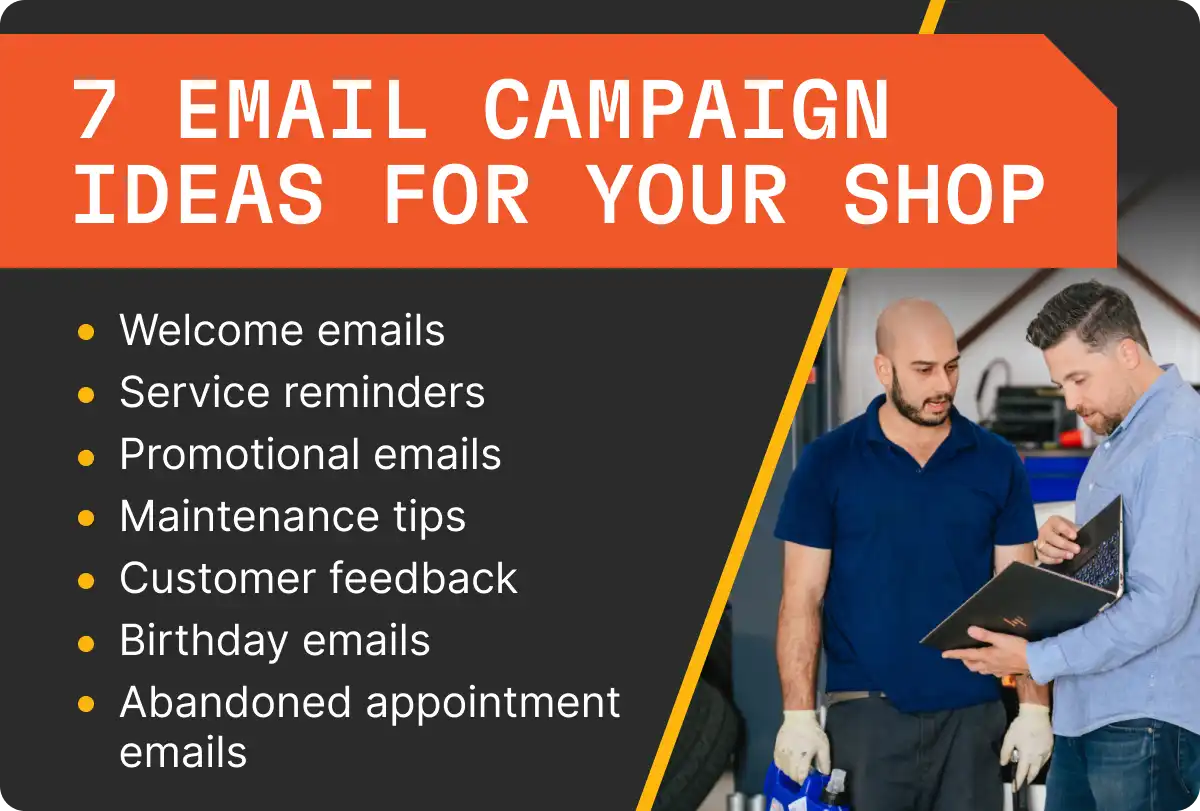
Seven email marketing campaign ideas for auto repair shops.

Email Marketing Campaign Ideas

To maximize your marketing efforts, it's essential to diversify the types of emails you send. Here are some of the most effective email marketing campaigns for automotive repair shops:

Welcome Emails

When a new customer provides their email address, send a warm welcome email. This is your chance to introduce your shop, highlight your unique selling propositions, and perhaps offer a small discount on their first service. This initial contact sets the tone for future customer relationships.

Welcome email template

Auto repair shop welcome email template example.

Service Reminders

These are arguably the most crucial emails for an auto repair shop. Based on a customer's service history (which can be managed efficiently through a good CRM system), send automated service reminders for scheduled maintenance like an oil change, tire rotations, or brake inspections. Make it easy for them to book an appointment with a clear call to action.

Service reminder email template

Automotive service reminder example email.

Promotional Emails/Special Offers

Announce discounts, seasonal promotions (e.g., winter tire specials, summer AC checks), or bundled services. Use compelling subject lines to grab attention and always include a strong call to action (or CTAs).

Promotional email template

Promotional email template for mechanic shops.

Maintenance Tips and Educational Content

Share valuable information like "5 Ways to Extend the Life of Your Tires," "Understanding Your Dashboard Warning Lights," or "Why Regular Oil Change is Crucial." This positions your shop as an expert and provides genuine value to your customer base.

Maintenance tip email template

Maintenance tip email template example.

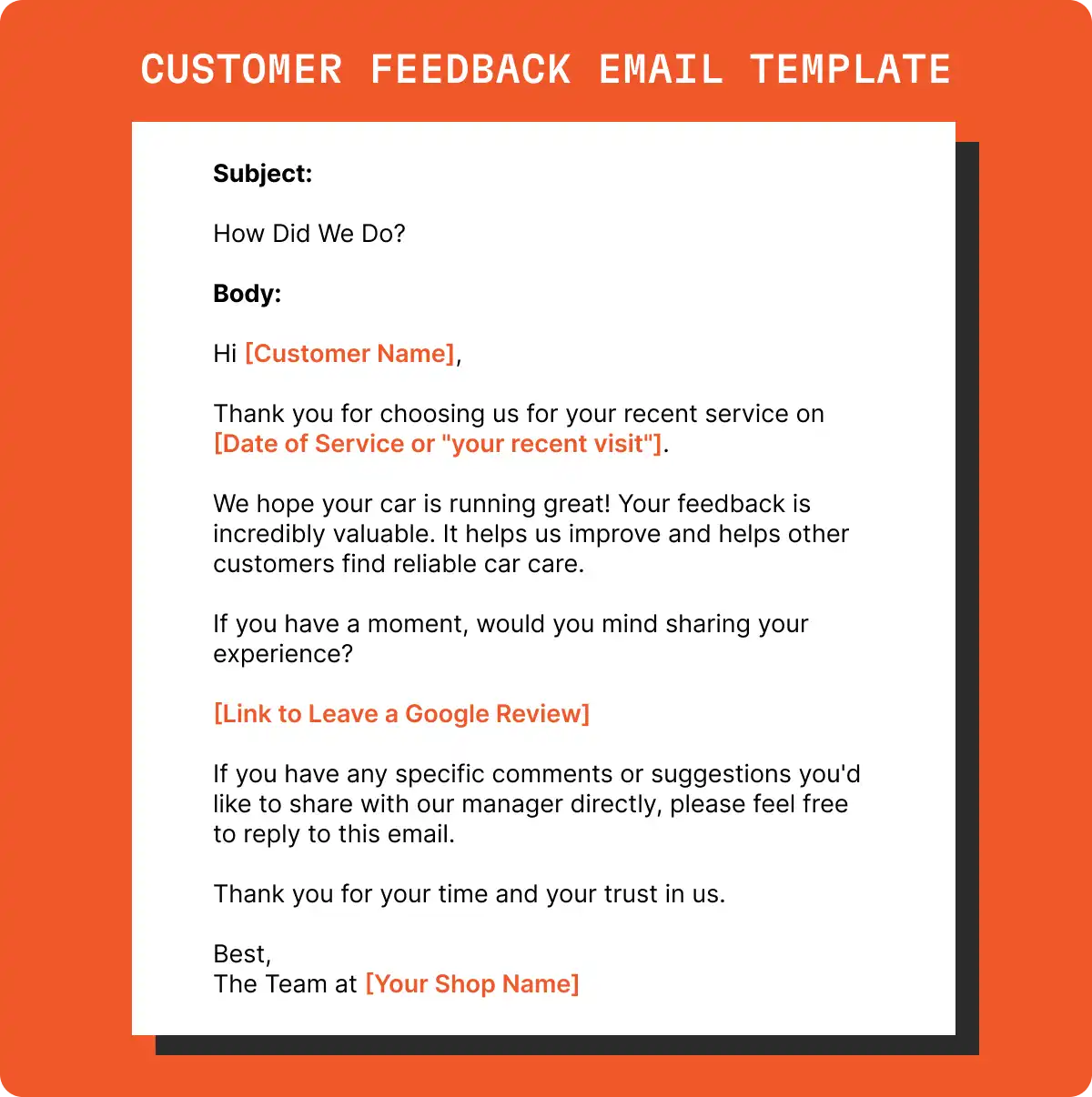
Customer Feedback/Review Requests

After a service, send a follow-up email requesting feedback or a review. Positive testimonials are incredibly powerful for attracting new business. Link directly to your Google My Business page or other review platforms.

Customer feedback email template

Customer feedback email template.

Birthday/Anniversary/Holiday Emails

A small, personalized gesture like a birthday greeting, perhaps with a minor discount, can significantly boost customer loyalty.

Birthday email template

Birthday email template for auto repair shop.

Abandoned Appointment Emails

If your shop offers online appointment scheduling and a customer starts but doesn't complete the booking process, an automated email reminding them to finish can recapture lost potential customers.

Abandoned appointment email template

Abandoned appointment email template.

Automotive Email Marketing Strategies

Now that we've covered the what and why, let's dive into the how. Implementing these best practices will ensure your email marketing strategy yields optimal results for your auto repair shop:

  • Segmentation is Key: Not all customers are the same. Segment your email list based on factors like vehicle make and model, last service date, service history, or demographics. This allows you to send highly targeted and relevant messages, improving open rates and conversion rates.
  • Craft Compelling Subject Lines: Your subject lines are the gatekeepers to your emails. Make them concise, intriguing, and benefit-oriented. Examples: "Time for Your Oil Change?", "Exclusive Discount Just For You!", "Protect Your Car This Winter."
  • Personalization Goes a Long Way: Always address customers by their first name. Reference their vehicle type or past service if possible. Automation can make this surprisingly easy, especially with a good CRM or shop management system.
  • Clear Call to Actions (CTAs): Every email should have a single, clear call to action. Whether it's "Schedule Your Appointment Now," "Claim Your Discount," or "Read Our Latest Blog," make it obvious what you want the recipient to do. Use prominent buttons or hyperlinked text.
  • Mobile Responsiveness is Non-Negotiable: A vast majority of people check their emails on their smartphones. Ensure your emails are designed to look great and function perfectly on all mobile devices. Test your templates before sending.
  • Automate Where Possible: Utilize automation tools to send welcome email sequences, service reminders, birthday greetings, and follow-up emails after a service. This saves time and ensures consistent communication without manual effort. Many CRM systems and email marketing platforms offer robust automation features.
  • Provide Value Beyond Promotions: While special offers are great, don't make every email a sales pitch. Offer genuine value through maintenance tips, car repair advice, and educational content. This builds trust and positions your auto repair shop as a helpful resource.
  • Optimize Send Times: Experiment with different days and times to see when your email list is most engaged. Tools within email marketing platforms can often provide insights into optimal send times based on your audience's behavior.
  • Integrate with Other Marketing Efforts: Your email marketing strategy shouldn't exist in a vacuum. Cross-promote your email list on your website, social media channels, and in your physical shop.
  • Monitor Performance: Regularly review your open rates, click-through rates, and conversion rates. A/B test different subject lines, CTAs, and content to continually improve your email marketing campaigns. This data-driven approach is crucial for success in the automotive industry.
  • Don’t overdue it: Nobody likes receiving 30 emails in one day, so make sure your email cadence is reasonable and not overwhelming to your audience. Always provide an “unsubscribe” option in your emails in case they no longer want to receive emails from you.

Final thoughts

In conclusion, for any auto repair shop looking to thrive in today's competitive landscape, a well-executed email marketing strategy is no longer optional – it's essential. By consistently delivering valuable content, timely reminders, and exclusive offers, you can build a highly engaged customer base, boost customer loyalty, and ensure your auto repair business remains successful for years to come.

Start building your email list today, embrace automation, and watch your marketing ideas turn into tangible results. Your customers and your bottom line will thank you.

Auto repair shops generally calculate the cost of their repairs with numerous factors that contribute to the entire process. 

This includes the cost of parts and any necessary upcharges for the shop to generate a profit, as well as the cost of labor.

In this guide, we will help your independent auto repair shop learn how to maximize your profit margin specifically on your shop's labor rate.

Want to learn more? Check out our latest Auto Repair Industry Index! We cover everything from overall industry health to unique shop settings for Tekmetric users to get the most value out of the work they already do!

No items found.
Maximize Your Auto Repair Shop's Labor Profit Margin

January 15, 2024

Read time: 3 min

read more