Your auto parts inventory management system should match the operational pace of your shop, and the system shouldn’t be so complex or time-consuming that it takes time away from hours better spent repairing cars.
Running a more efficient shop will lead to a better experience for customers, more clarity in the repair process, and ultimately more approved repairs. That means more money for your shop!
Still using pen and paper to keep track of your shop's parts inventory? Let's help you find a better way with a modern, cloud-based shop management system.
Managing Inventory with Pen and Paper
We hear it all the time: if it ain't broke, don't fix it! And sure, that might be true for your favorite recliner, but when it comes to running your shop like a well-oiled machine, there's some big room for improvement. Especially if you're relying on pen and paper.
And we get it, pen and paper requires very little training, can be completed offline, it's pretty cheap, and most importantly it's the way it’s always been done.
In reality, pen and paper records may seem inexpensive at first, but costs quickly add up:
The process is generally slow and requires managers to flip through multiple pages in a notebook or keep a long log of everything. If you need to audit a purchase, you'll be digging through pages manually.
Paper records are easily destroyed, lost, and damaged, and creating copies is a time-consuming task in and of itself.
Hand-writing! We all know it takes a nurse to read a doctor's handwriting, but what about a technician's or a shop owner's? Chances are, someone else might have a hard time reading your records. It might sound silly, but it’s a simple issue that can lead to huge problems.
Your shop has a lot of moving parts -- no pun intended. Tracking repair orders, contacting customers, and completing digital vehicle inspections, everything is so much easier with the right tools for the job. Especially when we're talking about tracking your shop's parts inventory.
Instead of hoping you wrote it down right or even at all, wouldn’t it be easier to track such items with a digital database?
Going digital, but not quite modern
We sometimes hear that shops have upgraded away from the really old school pen and paper methods to shop management tools the generally rely on spreadsheets
Spreadsheets are essentially very simplistic databases, and understandably, plenty of shops have been using spreadsheets for decades. Programs like Excel are a clear upgrade from a humble, physically maintained auto parts inventory management records system.
But ultimately, spreadsheets aren’t built with auto parts inventory management in mind or with auto workers in mind. It can be difficult to set up your own spreadsheet system, and there’s always the risk of human error or simply losing spreadsheets stored on a personal computer.
That's where a modern cloud-based system comes in.
Modern Parts and Inventory Management with Shop Management Software
Shop management software can be automated and comes with pre-created templates and tables ready for the user to fill in.
With auto parts inventory management software, service writers don’t have to invent their own templates as they would with a spreadsheet records system, and the software does much of the record-keeping for them. Shop management systems like Tekmetric have portals specifically dedicated to parts inventory management.
If your old parts management system has your shop stuttering like a rusted-out pickup running on empty, systems like Tekmetric may be the perfect solution to get your team on track with an intuitive auto parts inventory management system built for teams just like yours.
Tekmetric lets you put together and track your parts orders, store information about vendors, monitor parts sales performance over time, and even put together and save special parts lists for jobs your shop completes on a regular basis
Upgrade Your Shop's Inventory Management
Maybe your team conducts a yearly deep dive into its inventory but only supplements this with brief monthly bookkeeping reviews and weekly maintenance checks. Or maybe your shop moves enough stock that staying on top of auto parts inventory management requires fastidious, day-to-day monitoring
In the former scenario, it is easy for stock problems to creep up on shop owners without anyone noticing for some time. For shops carrying more parts and conducting more frequent monitoring, the greatest challenge may be sorting a massive volume of parts.
Whether you run a shop that sells a lot of stock parts or makes more profit on labor, the one consistent way to gain control over the pace of parts inventory management is to use a program like Tekmetric.
A shop management software worth its salt centralizes information about what you have on your shelves and lets you update records fast.
The holidays are a special time of year when we make memories with the family, give thanks, and spread joy. However, with social distancing guidelines still in effect, this holiday season will look a little different. Because this year has been challenging for many people, it’s more important than ever to stay positive and spread cheer to past, current, and prospective customers.
Making people feel warm and fuzzy this holiday season will get them to remember you, leading to more business immediately or at some point in the future. And even if not every person you positively impact comes to your shop, it’s okay! You’re still paying it forward to your community, which bolsters your shop’s reputation and can lead to more referrals down the road.
Here are ten ways you can connect with guests this holiday season.
As a shop owner, you aren't just selling a car repair; you are selling expertise, specialized equipment, and peace of mind. If your rates are too low, you’ll struggle to keep the lights on. If they’re too high without the value to back them up, customers may opt for a competitor.
In this guide, we’ll walk through exactly how to find that "sweet spot" for your labor rate so you can build a sustainable, profitable shop.
How much should a mechanic charge per hour?
Mechanic shops should charge a labor rate that is competitive in their area, covers their overhead costs (rent, utilities, employees, etc.), and allows them to maintain a healthy profit margin (40-70%) to run the shop. Whether you are an independent shop or a large dealership, your labor rate and parts markup are your primary vehicles for maintaining profitability.
Key terms to know
Before we dive into the math, we need to understand these concepts.
Loaded labor rate: is the true cost of an employee, including their hourly wage, taxes, benefits, and insurance.
Hourly labor rate pricing: is the "posted" rate—the number your customers see on the repair estimate. It is the flat dollar amount you charge per billable hour.
Flat-Rate pricing: is a system where a specific repair is assigned a predetermined amount of time (e.g., a water pump replacement is "booked" at 3.4 hours). The customer pays for 3.4 hours regardless of whether the auto mechanic finishes in two hours or five.
Effective labor rate (ELR): is the real-world number that matters. It’s calculated by taking your total labor sales and dividing them by the actual hours your technicians worked.
How to set your automotive shop labor rate (step by step)
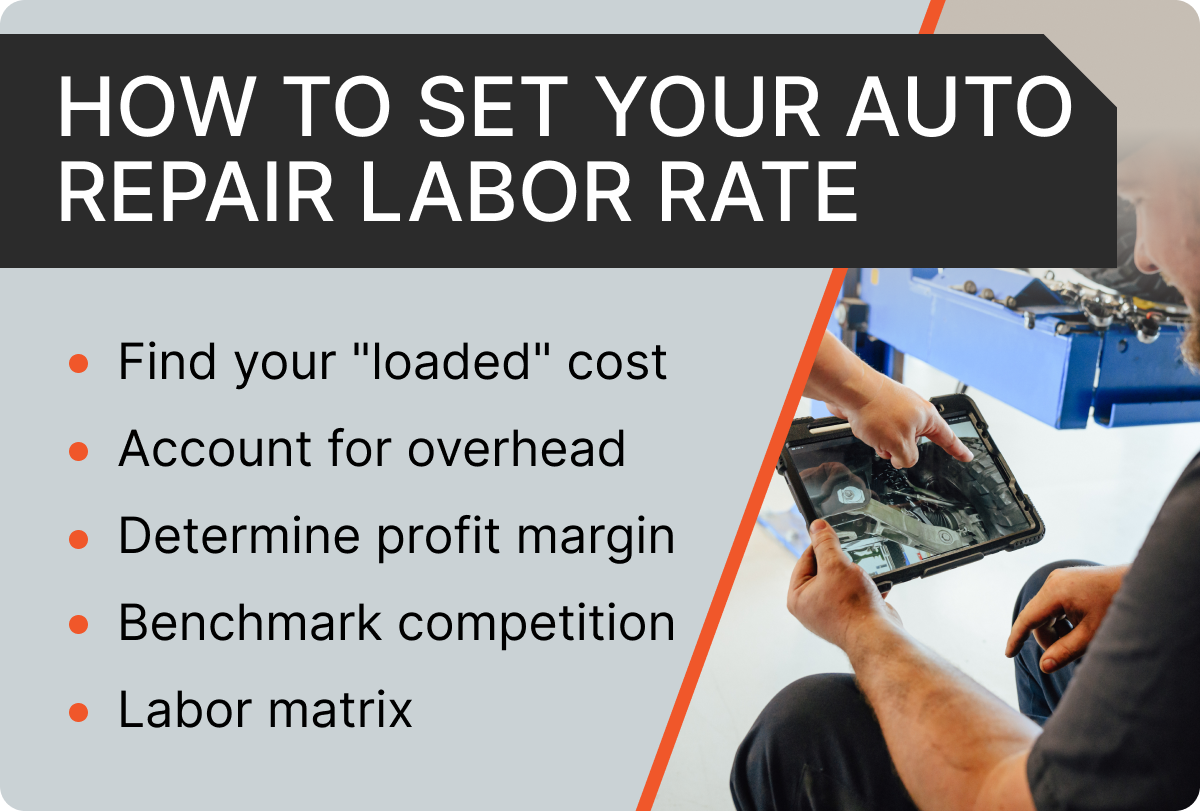
Setting your rate shouldn't be a guessing game based on what the guy down the street is charging. It should be a data-driven decision. Here is a step-by-step approach to finding your labor rate.
Step 1: Calculate your "loaded" labor cost
First, determine exactly what it costs you to pay an employee. This isn't just their hourly wage. You should include:
Wages and overtime.
Payroll taxes.
Benefits (Health insurance, 401k).
Workers' comp and liability insurance.
Training and certifications.
Any other benefits you provide employees.
Divide this total annual cost by the number of billable hours that the employee produces in a year. This is your "loaded" cost and does not include any profit margin.
Step 2: Account for overhead
Your labor revenue needs to cover more than just the employee. It must also cover the overhead costs of running an auto repair business:
In the automotive industry, labor profit margins vary greatly, but most shops aim for 40-70%. If your loaded cost for a technician is $45 per hour and you want a 65% profit margin, your base mechanic labor rate should be at least $128 per hour.
Step 4: Benchmark against your competition
While your internal numbers should be your primary focus, you shouldn’t ignore the local market. If your labor rate is $128 per hour but every other independent shop in your town is at $100, you need to either justify your value through superior service or find ways to reduce your overhead. Make sure you benchmark against competitors of similar size, services offered, and geographically nearby.
Step 5: Implement a labor matrix
Not every repair order is the same. Many successful shops use a labor guide combined with a labor matrix that slightly increases the rate for more complex jobs or diagnostic work. Shops that perform more specialized repairs or focus on specialty vehicles should heavily consider implementing a labor matrix.
Which factors impact labor rates?
Your rate shouldn't be static. Several external and internal factors will influence how much you can—and should—charge for car repair services.
Location: A higher cost of living in cities like California or New York necessitates higher labor rates compared to rural towns. Your technicians need to earn enough to live nearby.
Shop type: A general auto repair shop usually has lower rates than a specialty Euro shop or a heavy-duty diesel facility. Specialization requires more expensive tools and higher-paid talent.
Certifications: If your team holds advanced ASE certifications or factory training, you provide more value. Customers are often willing to pay more for a repair estimate from a shop they trust to do it right the first time.
Warranty: If you offer a service warranty, you are taking on more risk and can charge more for the peace of mind.
5 Ways Tekmetric can help your shop be more profitable
Tekmetric can help you be more profitable by providing the features and reporting you need to make better business decisions. Tekmetric shops average a 65% labor profit margin by utilizing modern features that help you build trust with your customers and keep them coming back year after year.
Custom labor matrix: Tekmetric allows you to set up labor matrices that automatically adjust your mechanic labor rate. This ensures you don’t undercharge for difficult work.
Real-Time reports: Stop waiting until the end of the month to see if you made money. Tekmetric gives shop owners a real-time look at their gross profit, plus many other helpful metrics.
Measuring effective labor rate: As we discussed, your posted rate isn't always what you take home. Tekmetric tracks your ELR automatically, showing you exactly where "leaks" (like excessive discounting or slow techs) are happening.
Digital Vehicle Inspections (DVI): Higher rates are easier to justify when you can show the customer exactly why they need the work. Tekmetric’s DVIs build trust and increase customer satisfaction, making the price conversation much smoother.
Technician efficiency: By tracking technician efficiency and productivity within the platform, you can see which members of your team are hitting their goals and which employees might need more coaching.
Final thoughts
Setting your labor rate requires constant attention to your local market, your internal costs, and the evolving complexity of car repair. By following these steps, you’ll ensure that your shop doesn't just keep cars running—it keeps your business thriving. If you have questions about Tekmetric or how we can help your shop be more profitable, book your free demo today.
He and Sunil Patel started Tekmetric in 2016, and today, it’s become the preferred auto tech software in the auto repair industry.
Prasanth’s success prompted Authority Magazine to contact him for an interview on the formula for scaling success.
Below are just a few excerpts of Prasanth’s interview with Ken Babcock (CEO of Tango), along with bonus content for any entrepreneur seeking to scale their business.
Scaling with People
Let’s look at each component.
The Right People.
First, you have to have the team that serves your company the best.
At Tekmetric, we learned this the hard way. We had a phenomenal idea — but our first team wasn’t comprised of exactly all the people we needed.
And that meant we failed in the first round. It was disappointing, but we learned a valuable lesson, and the next round, we hired people based on the talents we knew we needed. It was the right move, and it set us in the right direction toward success. In fact, many of the team members from this second group are still with us today.
Tekmetric’s People Today: The Best Support in the Industry
Today, Tekmetric has a growing team of people working in various departments, such as customer support, sales, product development, and human resources.
Walk into our Houston headquarters, and you’ll see people from all backgrounds catching up on their week, discussing the next product update, or talking about the future of our company over a cup of coffee.
A large portion of our team works remotely. We have employees across the United States, including: </p><ul>
Cleveland, OH
Washington, DC
Denver, CO
San Diego, CA
But no matter where our team members are, one of the big things they have in common is that they’re passionate about providing Tekmetric’s customers with the best experience and support possible.
Our support team in particular is easy to get in touch with.
Customers don’t have to spend hours listening to annoying “waiting” music on the phone or anxiously sitting in front of their computers for a response to a support ticket.
The Tekmetric support team acts to get questions answered quickly and any issues resolved fast.
After all, auto tech software needs to move at the pace of the auto repair industry—fast—and support is an important part of that process.
Having the idea is great; getting it right as you grow is vital. You may not have the details fully fleshed out, but you must know what you want to do and the tools you need to get there.
I’ve always said, if you have a goal in mind, and you don’t know how to get there, then you’re doing something right.
If you do know how to get there, you’re not thinking big enough. Think long and hard about what you want your business to look like.
Once you figure out those initial steps and orient yourself in the right direction, you can think ahead to challenges like growing and scaling.
Tekmetric’s Direction Today: Driving the Auto Repair Industry Into the Future
The Tekmetric team keeps a close eye on what’s happening in the auto repair industry so that we can stay one step ahead when it comes to driving the auto repair industry into the future.
For example, Tekmetric listened to its customers’ desires for a true two-way texting feature, which enables shops and their customers to communicate more seamlessly than ever before.
Tekmetric also frequently adds to its list of integrations with industry-leading tools so that shop owners can set up workflows that work best for them.
And Tekmetric listens to what shop owners, technicians, and service advisors are saying, taking their feedback and suggestions into account.
We know that we cannot do this on our own, and respect the contributions of people throughout the industry.






.svg)



.svg)

.svg)
.svg)
.svg)
.svg)
.svg)
.svg)