When you think about the most exciting aspects of being in the auto repair industry, it’s unlikely that the invoice and estimating process comes to mind. Drafting up invoices and getting approval on estimates can be a tedious process when all your team wants to do is get things rolling with the repair! And if you have a small team, it might be tough to find someone who can squeeze in the time to create an estimate and invoice for every single repair.
However, the auto repair invoice and estimating process is one of the most important parts of your business. By fine-tuning it, you can keep better track of repairs and sell more work, increasing your shop’s ARO.
Here are five main reasons why you should fine-tune your shop’s auto repair invoice and estimating process.
1. Meet Any Relevant Compliance Standards
Depending on which state you’re operating your auto repair business in, you might be legally required to give customers an estimate before the technician begins working on the car and an invoice when the work is completed. Some states with a variation of this law include California, North Carolina, and Washington.
No matter which state you’re in, it’s a good idea to brush up on the latest applicable laws to make sure that your shop is in compliance. When you’re managing your team and growing your business, the last thing you want to deal with is a legal hurdle.
2. Provide Better Customer Service
Legal compliance aside, fine-tuning your auto repair invoice and estimating process helps you provide better customer service.
Think about it this way: when you go shopping, you want to see the price tag on an item before deciding to make a purchase. For your customers, getting an estimate is akin to seeing the “price tag” on an item before committing to a purchase. When customers get an estimate from you, they’ll feel more at ease and secure with getting a repair from your shop. In addition, they’ll know that you care about their experience and will be impressed by your team’s professionalism.
When a service advisor sends a customer an estimate, both parties are essentially signing off on a contract, stating that they understand the nature of the repair work to be performed and the cost. If a repair doesn’t go as planned or the cost is higher than expected, the customer will hold your shop accountable. Likewise, once the customer receives the invoice, if they walk back on a repair they signed off on or don’t pay, you can hold them accountable.
3. Minimize Chargebacks and Loss of Money
A major benefit of that increased accountability is that you’ll minimize chargebacks, and your shop will lose less money.
Imagine that you don’t have a refined repair invoice and estimate process in place. Your customer might have fuzzy expectations going into the repair. Then, once it’s time to pay, they gawk at the price—they didn’t think it would be that much. They might argue back-and-forth with the service advisor, and you might get dragged into the argument. Finally, things settle down, and the customer pays. You think everything is okay. But a few days later, you see: a chargeback!
Suddenly, you have a new headache on your hands that you need to solve to ensure that your team is compensated for their hard work and that your shop doesn’t take a financial loss.
By providing each customer with an estimate and invoice, you’re showing them exactly what to expect. They will have transparency into the repair process and aren’t surprised when it’s time to pay. As a result, you avoid wasting your valuable time and energy on chargebacks and safeguard your shop from financial loss.
4. Use Declined Jobs to Keep Better Records for Future Repairs
A fine-tuned auto repair invoice and estimating process not only safeguards your shop from chargebacks and financial loss but also helps your shop upsell work in the future. Any repairs your customers decline on an estimate can be sold back to them at a later time.
When a service advisor gives a customer an estimate, there’s a chance that they may not approve every listed job, especially the non-urgent repairs. They might decide to come back to your shop in a few months, once the repair is necessary. However, customers might forget to do so, and your team might, too. But with a structured invoice and estimate process in place, service advisors can keep track of declined jobs. From there, when the time rolls around for those turned-down repairs, the service advisor can notify the customer.
5. Increase Your Shop’s ARO
A transparent, effective auto repair estimate process starts with a digital vehicle inspection (DVI). When a service advisor sends a customer a DVI, the customer will be able to look at the attached photos and videos of their vehicle, as well as the proposed repairs and the urgency of those repairs.
Because the customer will see exactly what’s wrong with their vehicle, they’ll be more likely to sign off on all the work, rather than just what they think they need. The photos and videos paint a clearer picture of the necessity of each repair. As a result, you’ll sell more work per individual ticket, and your shop’s ARO will increase.
How to Fine-Tune Your Auto Repair Invoice and Estimating Process
While paper invoices and estimates might work in the short term, they’re not sustainable—and we’re not just talking about the environment. An ever-expanding paper trail means that service advisors will have to hunt down individual estimates in messy file folders, customers might misplace their estimates, and more.
A shop management system like Tekmetric can streamline your auto repair invoice and estimating process.
With Tekmetric, a service advisor can create a repair order and dispatch it to a technician to run an inspection. Once the technician conducts the inspection, the service advisor can send the customer a DVI, which will outline the exact repairs their vehicle will need. From there, the customer can approve or decline individual line items on the repair order, directly from their phone.
In order to prevent sticker-shock, Tekmetric separates the inspection and estimate sections. When customers open the DVI, they will first see the photos, videos, and other repair details. Once they scroll down, they’ll see the pricing.
When customers finish clicking through the estimate, designating the jobs they approve and decline, the shop has the go-ahead to start the repair. There’s a digital record of exactly what the customer approved, so when it’s time to pay, there are no surprises—and the customer drives off happy, leaves a good review, and refers your shop to their family and friends.
When customers walk into your auto repair shop, they’re trusting you and your team with the health of their vehicle, one of their most expensive assets.
They’re coming in with a problem or set of problems and expect your team to effectively fix those problems in a reasonable time frame.
And modern expectations for customer service have shifted as our technology has evolved. Customers don't want to have to find time for a phone call when they can just get texted updates about their repairs, and digital tools make it easier for shops to build transparency in their process.
Modern auto repair shop software not only makes it easy but lays the foundation for a modern customer experience at every step.
Offering a Modern Auto Repair Shop Customer Experience Starts with a Modern Shop Management System
We're big advocates of modernizing your auto repair shop, and we don't necessarily mean replacing all your racks, updating all your compressors, and swapping out your alignment rack. Sure those might help, but we get those can be really big investments.
That's why we're focused on the behind-the-scenes operations of your shop, the overall management and flow of repair orders. Modern shop management software enables owners, managers, service advisors, and technicians to gain visibility into, and control over, their individual part of the process with specific functions:
Cloud-based shop management
Real-time control
Digital Vehicle Inspections
Built-In Payment Processing
Digital Shop Communications
Efficient Parts and Inventory Management
While all of these directly work to modernize your shop operations, they also work to modernize your shop experience for customers.
When your shop is using Digital Vehicle Inspections instead of paper printouts, you're not only making it easier for your technicians and service advisors to communicate and collaborate, but you're also modernizing how your shop interacts with customers, by emailing or texting results and approval requests.
Almost 1,000 shop owners, service advisors, and technicians gathered in Houston for Tektonic 2026, Tekmetric's first industry conference. Over two days at the Marriott Marquis, attendees packed breakout rooms, traded hard-earned lessons, and heard from operators, coaches, and industry leaders who have built and scaled shops of their own.
The Question That Started It All
Tekmetric CEO and Founder Sunil Patel opened Tektonic 2026 with a question he has been asking since he was writing service tickets and mopping floors at his former Houston shop, Motorwerks of Houston: "Why does it have to be so hard? Why does it have to feel like we're fighting a war on 12 fronts?"
That question, he told the room, is the reason Tekmetric exists.
Standing in front of shop owners, service advisors, and technicians who understand that question on a cellular level, Patel walked through how much harder running a repair shop has become. Vehicles are packed with software, sensors, and calibration systems that require entirely new toolsets. Customer expectations have been shaped by on-demand everything. Technician shortages continue to press on shops across the country. And OEM data restrictions are making it harder for independent shops to do the work they were built to do.
But Patel didn't stop at the challenge. He laid out four pillars he believes the industry needs to move forward: stop celebrating burnout as a badge of honor, build genuine trust with customers and teams, invest in an ecosystem of great partners and vendors, and embrace technology that serves shops rather than extracts from them.
He closed with a simple ask for everyone in the room: be curious, be open, be generous with what you know, and be present.
"I want you to take something away from here," he said. "Something that will get you to be 1% better than you were."
That set the tone for everything that followed.
Top Takeaways
Process Consistency Wins on the Hard Days
Busy days don't create problems. They expose them. The best shops build their standard operating process before the chaos starts.
Call the day before. A preappointment call to review service history and flag overdue maintenance turns intake from reactive to planned and primes customers to say yes before they walk in the door.
Speed is your biggest sales tool. Every hour between drop-off and delivering an estimate costs roughly 10% in approval rates. Get findings to customers fast.
Set the next promise, not the finish line. Never promise a completion time you can't guarantee. Promise the next specific update and deliver it on time, every time.
The in-store customer is the highest-priority repair order in the building. Every other car can wait. The person sitting in your lobby cannot.
Improve one thing at a time. Pick one process to fix, measure it, and build accountability before moving to the next. Trying to fix everything at once fixes nothing.
Speed Closes More Jobs Than Salesmanship
Closing rates drop sharply with every hour that passes between drop-off and the customer call. A customer who has been waiting since 8 a.m. has had time to read every one-star review and talk themselves out of approving the work.
Get inspection results to customers within 30 minutes of dispatch. That's the speed zone. Everything else in the shop is secondary until that call is made.
In-store customers get findings in 15 minutes or less. The customer is sitting right there. Use it.
Relative priority is your daily compass. At any moment, the most important thing is moving the car that's furthest behind in the process. Not the loudest customer. Not the most expensive ticket. The earliest step.
Two daily goals. Full stop. Every technician runs at least eight billable hours. The shop hits its gross profit target. Nail both and everything else follows.
You Don't Have a Technician Shortage. You Have a Culture Problem.
The technician pipeline isn't as broken as it seems. What's broken is how many shops make it hard to stay.
Rethink flat rate. Hybrid pay models that combine a solid base with performance incentives align your team's goals with the shop's goals and they're far more attractive to the next generation coming into the trade.
Answer two questions before you do anything else. Why would a technician work here? Why would a customer come back? If you hesitate on either, start there.
Recognition is the highest-ROI leadership move you have. Research cited at the conference found that team members become disengaged because they don't feel seen. Fix that before you invest in anything else.
AI won't replace hospitality. Technology can handle administrative weight, but the trust a service advisor builds with a customer at the counter is irreplaceable. Invest in that skill set.
P.J. Leslie, Tekmetric's head of mid-market and enterprise sales, moderates a panel during Tektonic 2026 in which multishop owners break down the real strategies behind expansion: buying shops, building shops, systemizing operations, integrating teams, protecting culture, and planning for eventual exit or partnership.
Growing to Multiple Locations Takes More Than Money
Every multishop operator on the stage agreed: you're never fully ready, and that's fine. What matters is being profitable, having the right people, and expecting the unexpected.
Profitable and cash-positive before you move. When you make a mistake at location two—and you will—you need a healthy location to cover it.
You're ready when your shop doesn't need you. Build your bench before you open the next door. The manager for location two should already be in your building today.
Start your exit plan on day one. Almost no one in the room at one of Tektonic’s breakout sessions had a clear exit strategy. Don't leave money on the table because you never thought through how the story ends—whether that means selling, transitioning, or building for long-term cash flow.
Leadership Is the Ceiling on Everything Else
Your shop will never outperform your leadership. What you tolerate becomes your standard. How you show up on Monday morning sets the emotional temperature for everyone around you.
Know your triggers before they know you. Name what sets you off. Once you can spot it, you can stop it before it damages a relationship.
Pause for three seconds. Before you respond to anything that's gotten under your skin, stop. Three seconds is the difference between a reaction and a response.
Hear less. Listen more. After someone finishes speaking, let the silence sit. People almost always have more to say and the second thing is usually the real thing.
Walk into hard conversations knowing how you want them to end. Start with the outcome in mind, not the grievance.
Tekmetric Chief Product Officer Jared Haleck breaks down Tekmetric's new products at Tektonic 2026. The new products include Tekmetric digital ads, Smart DVI, and Tekmetric phones.
Product Announcements at Tektonic 2026
The closing session belonged to the Tekmetric product team. Drawing on data from more than 15,000 shops on the platform, Tekmetric President and COO Lauren Langston and Chief Product Officer Jared Haleck built the roadmap around key areas where winning shops consistently outperform the rest: car count, average repair order (ARO), driver experience, and cycle time.
Here's a look at what’s coming:
Tekmetric Digital Ads: AI-powered advertising on Google Maps and Search, built for the moment a driver has a problem and is ready to act. It connects directly to Tekmetric so you can see the gross profit behind every dollar of ad spend, not just clicks.
Smart DVI: Technicians walk the vehicle, narrate what they see, and Smart DVI builds the customer-ready inspection report automatically—findings organized, images annotated, and jobs pre-suggested for the estimate. Less time typing. More time turning wrenches.
Tekmetric Phones: Customer details, open repair orders, and communication history surface the moment an inbound call rings. No more looking it up while someone's waiting. A future capability in development will transcribe calls in real time and auto-populate appointment notes.
See You in 2027
Tektonic 2026 was Tekmetric's first industry conference, and it delivered on the promise Sunil Patel made from the stage: a room full of shop owners, service advisors, and technicians who showed up to get better.
The through-line across every session was the same. The shops that win are the ones that build systems, invest in their people, and keep getting 1% better. Not all at once. One thing at a time.
Starting a tire shop is an exciting and profitable venture, but success isn’t just about getting customers through the door—you need the right tools and equipment to provide top-quality service. Whether you're performing tire repair, wheel balancing, or alignments, investing in high-quality automotive equipment ensures efficiency, safety, and customer satisfaction.
Many new shop owners make the mistake of cutting corners when purchasing tools, only to realize later that low-quality equipment leads to slower turnaround times, safety hazards, and costly mistakes.
By the end of this guide, you’ll know exactly what’s needed to run a successful, efficient, and profitable tire shop.
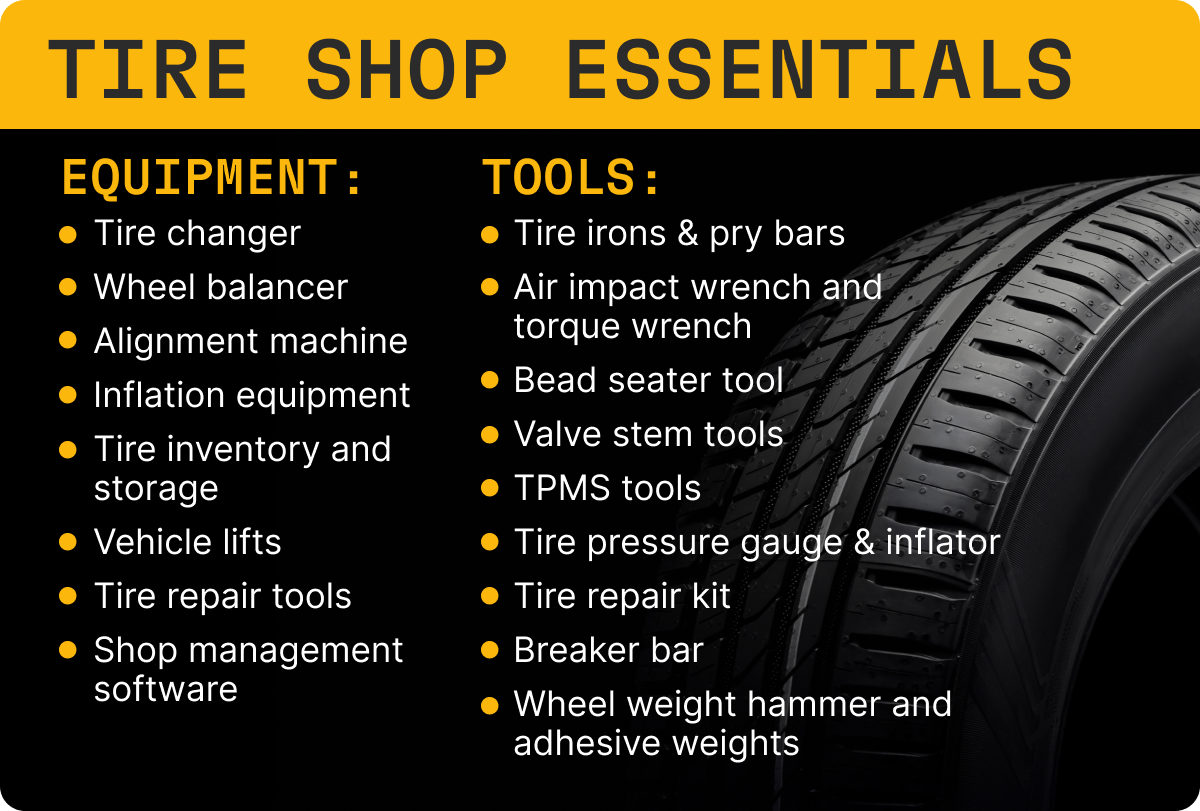
Tire shop equipment list
Beyond hand tools, your tire shop needs specialized equipment to handle tire mounting, balancing, and alignment efficiently. Here are the nine must-have machines every professional shop needs:
1. Tire changer
A tire changer is the core machine of any tire shop, allowing fast and damage-free tire mounting and removal. A high-quality automatic tire changer saves time, protects expensive alloy wheels, and enables your shop to handle a higher volume of customers efficiently.
Tire changers come in a few variations to accommodate for different tire sizes and needs. When you are ready to make a purchase, consider the price, time to train your technicians, energy usage and return on investment. Here are some of the popular choices:
Swing Arm: Affordable and easy to use, the swing arm tire changer is a popular choice. They are appropriate for tires up to 50 inches in diameter. The only drawback is you have to reset the head position every time you change tire sizes.
Tilt-Back: If you are looking for a faster option, the tilt-back may be the right choice for you. They can adjust to varying tire sizes much easier that a swing arm but they typically cost more.
Leverless: Leverless tire changers provide the most automated experience but also come at a premium price point. This tool can be exceptionally helpful if your technicians deal with larger truck tires or if you want to reduce the risk of employee injuries.
Heavy-Duty: Handling up to 90in diameter tires, this tool will be your best friend if you work on construction or heavy duty vehicles regularly. They have a high price point but it will be justifiable if you service enough large tires.
2. Wheel balancer
A wheel balancer ensures perfectly balanced tires, preventing vibrations and uneven tread wear. Investing in a wheel balancer for your auto repair shop helps you achieve precise results, improving customer satisfaction, and reducing comeback work. Wheel balancers come in a few variations:
Dynamic balancers: Using more advanced technology, dynamic balancers spin the tire to assess any variations in the tire. Once the tire is assessed, the technician can make any necessary adjustments to ensure a smooth and comfortable ride. These machines tend to be more precise but also come with a bigger price tag.
Static balancers: Static machines use a more basic measurement technology to balance tires. The basic idea is that gravity will pull the heaviest part of the tire downwards as the tire is suspended on the machine. They tend to be cheaper and take up less space but because they are stationary, the readings can be less accurate than dynamic balancers.
Bubble balancers: Bubble balancers are ideal for shops looking to save money or smaller operations that don’t service tires as often. They work by using a bubble level to check for imbalances in the tire. These machines are less reliable but they are also cheaper and take up less space.
3. Alignment machine
Alignment machines are critical to any tire repair shop because misaligned wheels can cause uneven tire wear and poor handling. A high-tech alignment machine allows your shop to offer wheel alignment services, a high-profit service that improves customer retention. Alignment machines are expensive, ranging from $10,000 to $40,000 but can provide years of service that often justify the upfront cost.
Proper tire alignment leads to improved handling, fuel efficiency, tire life, and safety. All of these benefits help your customers get the most out of their new tires which leads to better customer loyalty.
4. Inflation equipment
Many of your shop’s tools, including impact wrenches and bead seaters, rely on compressed air. A large-capacity air compressor ensures consistent air supply, keeping your operations running smoothly.
Air compressor: Air compressors provide the necessary air for many of your power tools and machines. They are also the key to proper tire inflation to make sure your tires leave the shop with the right PSI. Remember to have the right adapters needed to connect to the tire valve stem.
Tire inflators: If you are servicing enough tire volume, you may want to invest in dedicated tire inflators. They often include pressure gauges and make it a little easier than using a regular air compressor.
5. Tire inventory and storage
Finding the right balance between having enough tires in stock and crowding your shop layout can be challenging. To maximize efficiency, keep track of which tires you sell the most of and reduce inventory of seasonal tires that you only need once a year.
Heavy-duty tire storage racks allow you to store new and used tires efficiently. If your customers can see your inventory, make sure it is organized and professional looking. Lastly, ask your technicians for feedback and how you can help them be more efficient by adjusting your layout or inventory.
6. Vehicle lifts
A car lift makes tire rotations, inspections, and alignments easier and faster for your technicians. While they are expensive, they can be used for tire repairs as well as general automotive repairs. There are multiple types of lifts on the market so make sure to find the lift that works best for your shop. Consider price, size, lift speed, lift height, and load capacity.
Jack stands may be a cheaper alternative if you have a smaller budget to work with and don’t service a large volume of tires. However, they ares slower to use and may reduce effieiciencies in your shop workflow.
7. Tire repair tools
Some customers will just be looking for a quick patch or repair on their tire. Make sure you have patch and plug kits readily available so you can win easy business.
8. Tire shop software
Your tire shop isn’t just about changing tires—you need to track inventory, invoices, and customer records. A modern workstation with tire shop management software (like Tekmetric) keeps operations organized, efficient, and profitable.
9. Miscellaneous items
Waiting area: Make a good first impression by offering a comfortable waiting area with chairs, TV, and basic refreshments. Keep the climate at a comfortable temperature to make sure your customers feel at ease.
Marketing: Tekmetric makes it easy to market your business with modern marketing and CRM capabilities. Let us build your website and provide integrated online appointment scheduling to make it easy for customers to find you and book with you.
Point of sale (POS) software: Tekmetric has you covered with payment options and solutions for your customers. Provide customers with multiple ways to pay plus financing options.
Essential tools for your tire shop
Even with high-tech machinery, manual tools are essential for precise tire work. These tools allow your technicians to handle tire mounting, balancing, and repairs efficiently and safely. Here are the nine tools every tire shop needs:
1. Tire irons & pry bars
These are critical for manually mounting and demounting tires. Even with a tire changer, stubborn tires (such as off-road or low-profile tires) often require extra force. Pry bars and tire irons allow your techs to work efficiently and prevent rim damage.
2. Air impact wrench & torque wrench
Lug nut installation and removal is a daily task in any tire shop. An air impact wrench speeds up this process, while a torque wrench ensures that lug nuts are tightened to manufacturer specifications, preventing over-tightening (which can damage wheel studs) or under-tightening (which can lead to wheel detachment).
3. Bead seater tool
A bead seater blasts a strong burst of air to seat the tire bead onto the wheel, ensuring a secure and leak-free fit. This tool is especially valuable for handling low-profile, oversized, and performance tires, reducing manual effort and increasing efficiency.
4. Valve stem tools
Valve stems regulate tire pressure, and a valve stem tool kit allows for quick replacements and repairs. Properly maintaining valve stems prevents slow leaks and customer complaints, improving the overall quality of service.
5. TPMS tools
A tire pressure monitoring systems (TPMS) is an electronic system designed to monitor the air pressure inside pneumatic tires on various types of vehicles. Having the right tool can help you make sure a customers TPMS light doesn’t come on after they leave your shop. These tools can do light resets and reprogram tire positions when necessary.
6. Tire pressure gauge & inflator
Proper tire pressure improves fuel efficiency, tire lifespan, and vehicle safety. A high-quality tire pressure gauge ensures accurate readings, while an inflator allows quick and precise air adjustments, reducing customer wait times.
7. Tire repair kit
Not all punctured tires need to be replaced—some can be repaired! A tire repair kit with patches, plugs, and rubber cement lets you fix minor punctures, offering customers a cost-effective alternative to tire replacement while increasing your shop’s revenue.
8. Breaker bar
Sometimes, lug nuts are too tight for an impact wrench due to rust or excessive torque. A breaker bar provides extra leverage, making it easier to remove stuck lug nuts without damaging wheel components.
9. Wheel weight hammer & adhesive weights
Proper wheel balancing ensures a smooth ride and even tire wear. A wheel weight hammer allows your techs to install or remove clip-on weights, while adhesive weights are ideal for balancing modern alloy wheels.
Conclusion
Setting up a successful tire shop requires more than just skills—you need the right tools and equipment. If the startup cost is daunting, consider leveraging vendor/supplier relationships to help with the cost. Or, leverage a line of credit from Tekmetric Payments. By investing in high-quality tire changers, wheel balancers, and shop management software, you’ll improve efficiency, customer satisfaction, and long-term profitability. You can learn more about Tekmetric's tire shop software here.







.svg)



.svg)

.svg)
.svg)
.svg)
.svg)
.svg)
.svg)