

Inside Tektonic 2026: Breakout and General Session Sneak Peek

Sunil Patel

|

December 3, 2025

|

Read time: 3 min

A Note from Sunil: Why We Built Tektonic 2026

Over the years, I’ve had thousands of conversations with shop owners, advisors, and technicians across the country. No matter the size of the shop or how long you’ve been using Tekmetric, I keep hearing the same two things:

You want a place to learn from each other.
And you want deeper, hands-on Tekmetric training.

That’s exactly why we built Tektonic 2026.

If you’ve already found this page, you probably know the basics: three days in Houston, April 9-11, built for owners, advisors, and technicians from every kind of shop and every kind of system. Tektonic is about one thing — helping you get better results, faster, with practical education, shop-tested playbooks, and product training you can actually use.

Here’s a sneak peek at what we have in store, at what that really means for you and your team.

For Owners: Stop Profit from Slipping Through the Cracks

You already work hard. The question is whether every hour and every RO is actually paying you back.

Breakout: Unlock Hidden Profits Without Blowing Up What Already Works — Alex Saladna, CEO, WickedFile

‍Even well-run shops leak profit in the back office: unclaimed credits, fees that never get billed, vendor mistakes that never get caught. This session is about tightening all of that up without burning everything down and starting over.

You’ll walk away with:

  • Simple audits you can run regularly to spot hidden losses
  • A clear view of where profit usually disappears — and how to plug those holes
  • Ways to automate repetitive tasks so more dollars stay in the business

If you’ve ever felt like your top line looks good but the bottom line doesn’t match the grind, this one’s worth circling.

Breakout: ADAS & Required Calibrations: Protect Your Shop and Your Customers — Joel Adcock, Director of Strategic Partnerships, Revv

‍Late-model vehicles roll in, ADAS is everywhere, and the liability is real. Missed calibrations aren’t just a line item you forgot to bill — they’re a safety issue and a trust issue.

You’ll walk away with:

  • Clarity on when calibrations are required and how to identify them
  • How to bake calibrations into your SOPs and ROs so they don’t get missed
  • Practical ways to educate your team and your customers on why this matters

The goal: fix vehicles right the first time, protect your reputation, and make sure you’re charging appropriately for the work you’re already responsible for.

Breakout: Scale on Purpose, Not by Accident — Jesse Jackson & Brian Walden, Mango Automotive

‍If you’ve ever wondered how some shops jump to eight figures while you’re fighting for steady month-over-month growth, Jesse and Brian are going to walk you through the playbook they actually used.

For managers: Master the Maelstrom — Aaron Blair, Director of Operations, Alloy Automotive Partners

In the fast lane of auto service, chaos is inevitable—but profit isn’t. Aaron Blair, systems architect behind Blair and Alloy Automotive, shows how to turn daily disorder into precision workflow with tactical frameworks to control every moving part, from dispatching ROs to winning buy-in from techs and advisors.

You’ll learn how to:

  • Use systems to get ahead: Build smarter workflows with dispatch boards, SOPs, and tech scoreboards to spot bottlenecks early.
  • Maximize your day: Treat your calendar as a tool with time blocks for RO triage, tech coaching, and margin reviews.
  • Create team consistency: Rely on huddles, checklists, and incentives so every team member stays aligned and executes to standard.

Also in the owner-focused track at Tektonic:

  • Reporting Deep Dive: Making Sense of Tekmetric’s Dashboards
  • From Invoice to Insights: Using Tekmetric to Master Shop Financials
  • Love the Shop Again: Mindset Shifts to Lead, Inspire, and Grow
  • Build It and They Will Come: How to Open a Shop That Stands Out, Attracts Talent, and Builds Loyalty Fast
  • Powering Growth with Tekmetric Payments: From Faster Cash Flow to Customer Financing
  • Running MSOs: Tools and Best Practices

For Service Advisors: Turn Conversations into Trust and Revenue

Advisors are the heartbeat of the shop. When they’re trained, supported, and set up well in the system, everything feels smoother…for you and your customers.

Breakout: Is Your Advisor Making You 100K or Losing You 100K? — Greg Bunch, Chief Officer, Transformers Institute

‍Owners and advisors will both get a lot out of this one. Greg walks through how a single advisor can swing six figures either way — and what to do about it. 

You’ll walk away with:

  • A ready-to-use hiring funnel with a job ad, screening script, and one-hour audition plan
  • A 90-day onboarding and training plan with daily drills and talk tracks
  • A simple scorecard to track call conversion, ARO, and appointment close ratio

If you’ve ever hired an advisor on “gut feel” and hoped for the best, this session will give you a better way.

Breakout: High Impact Sales: The Words That Build Long-Term Customers — Sabrina Wilkerson, Business Performance Analyst, Elite Worldwide

‍Advisors, this one is built for you. Customers don’t just buy the work — they buy the way you explain it. Sabrina breaks down what to say, how to say it, and how to stay ethical and honest while still driving approvals.

You’ll walk away with:

  • Practical ways to generate higher profits through better conversations at the counter
  • Tools to build long-term trust so people come back and send their friends
  • Confidence to show up as the credible expert instead of “just another shop”

These are skills you can practice in the room and use on your very next phone call.

Breakout Bundle: Tekmetric Tools That Make Every Day at the Counter Less Chaotic

‍On top of the coaching and hiring sessions, we’re going deep on the actual tools advisors live in all day. The focus is simple: fewer dropped balls, clearer priorities, better follow-up, and a system that supports your advisors instead of slowing them down.

You’ll walk away with:

  • Cleaner workflows from first call to follow-up
  • Better visibility into which jobs to prioritize and when
  • Fewer “I thought you had it” moments between the front counter and the bay

Advisor-focused Tekmetric sessions include:

  • Tekmetric Service Workflow Deep Dive
  • Advisor Dashboard Training: Prioritizing the Right Jobs, Every Time
  • Advisor Toolkit Jam: Quotes, Smart Jobs, Templates & Follow-Up
  • Shaping the Future of Service Advisor Tools in Tekmetric

For Technicians: Build Skills, Confidence, and a Real Path Forward

Great techs want two things: the right tools and a future.

Breakout: How to Run Monster Hours — Ryan Blair, CEO and Co-Founder, Alloy Automotive Partners

As a dealer technician turned one man band shop owner, Ryan Blair averaged 500 hours a month in production. In this session, you will get a breakdown of the mindset, systems, tips, and tricks to increase your production no matter what kind of shop you are working in.

Takeaways:

  • How to play the game: maximizing the relationship with the front of house
  • The surprising math behind the things you didn't realize are holding your production back
  • Master the mindsets and beliefs to become the number one producer in your shop

Owners: this is a great session to send your high-potential techs to if you want them thinking bigger.

Breakout: Profit in the Bay: How Techs Win with DVIs and Efficiency Tracking

‍Being a great technician isn’t just about fixing cars. It’s about seeing the payoff from the work you do. In this Tekmetric training session, we’ll connect the dots between the work in the bay and the numbers on the screen.

You’ll walk away with:

  • How solid DVIs drive higher approval rates
  • How photos, notes, and videos make it easy for customers to say “yes”
  • How efficiency tracking shows your impact — on the shop and on your paycheck

The goal is to give techs a clear line of sight from “I turned this wrench” to “I made this much difference.”

Breakout: ON-TRACK with DIN Diagrams + VCDS 101 — Travis Ruiz, Technical Support Consultant, German Car Support

‍If VW/Audi work feels like it takes twice as long as it should, these sessions are for you.

You’ll walk away with:

  • Practice finding the correct wiring diagrams and navigating service info
  • A walkthrough of the VCDS interface: scans, fault codes, live data, and basic functions
  • Real-world tips for using VCDS to diagnose and fix problems faster

For techs who want to sharpen their skills on European cars, this is time well spent.

For techs who want even more time in the tools:

  • Tekmetric Mobile App Deep Dive: Workflow at Your Fingertips
  • DVI + Mobile App End-to-End Training: Photos, Video, Notes & Approvals
  • Unlocking Smarter Repairs in Tekmetric

Big-Room Moments That Shift How You Lead

On top of 50+ breakout sessions, Tektonic’s general sessions are built to stretch how you think about your business and your role in it:

  • Keynote: From Mainstreet to Millionaire — Codie Sanchez, Contrarian Thinking
    Why “boring” businesses like auto repair can be the foundation of serious wealth if you build them right — and what that means for how you think about profit, risk, and opportunity in your own shop.
  • Keynote: Entrepreneurship Simplified — Mike Michalowicz, Profit First
    Practical, straight-talking frameworks for building a healthier business: profit baked in from the start, cleaner cash flow, and systems that don’t fall apart every time you step away from the shop.
  • Keynote: Effort Matters, Character Counts — General Robert Neller, USMC (Ret.)
    What effort and character look like on high-trust teams — and how those same principles apply when you’re leading a crew through nonstop cars, parts delays, and the pressure to deliver every day.
  • Coaching Power Hour Panel: The Great Shop Coaching Showdown
    Leaders from top coaching groups tackling real shop challenges, side by side, so you can hear different approaches in one fast-paced session.
  • Shop Owner Panel: What It Really Takes to Win
    From hiring and training to navigating daily chaos, this panel pulls back the curtain on what different types of high-performing shops are doing to scale, stay profitable, and keep both teams and customers thriving. You’ll hear real talk and real strategies from leaders who are living it every day, not just talking theory from a stage.

Three days in those rooms can change how you lead for the rest of the year.

Bring Your Whole Shop to Houston

Tektonic is built for your whole team:

  • Owners getting clear on growth, profit, and where the business is really headed
  • Advisors sharpening the conversations that build trust and drive revenue
  • Technicians building skills, confidence, and a real path forward in their careers

It’s every shop, every role, under one roof, with zero gatekeeping. Wherever your shop is today — overwhelmed, growing, rebuilding, thriving — Tektonic delivers clarity, community, and practical tools to get to your next result.

Learn more about Tektonic 2026 and register your team HERE.
👉 Ready to grow your automotive business? [Book a personalized Tekmetric Demo Here]

FAQ

More articles

Ever wonder how you could make your auto repair shop website rank in Google for “Mechanic near me” or “Best auto repair shop”? Look no further, this guide will walk you through everything you need to know about search engine optimization for automotive repair shops.

Search engines play a large role in today’s buyer journey and the auto repair shop industry is no different. Shop owners are recognizing this and starting to emphasize SEO (search engine optimization) as part of their overall digital marketing strategy.

Auto Repair SEO 101

SEO for automotive repair shops is a marketing tactic designed to influence how your website ranks in Google and other search engines. When done correctly, SEO efforts can create more website traffic and ultimately, generate more customers for your auto repair shop.

However, search traffic is becoming more competitive and other shops are likely aiming for the same keywords as you are. Utilize this guide to see how you can improve your website traffic and search engine rankings for your auto shop.

Tek-Tip: Curious how you rank for important keywords? Simply open an incognito tab and search for keywords you want to rank for. Incognito tabs remove location and search history bias from your search.

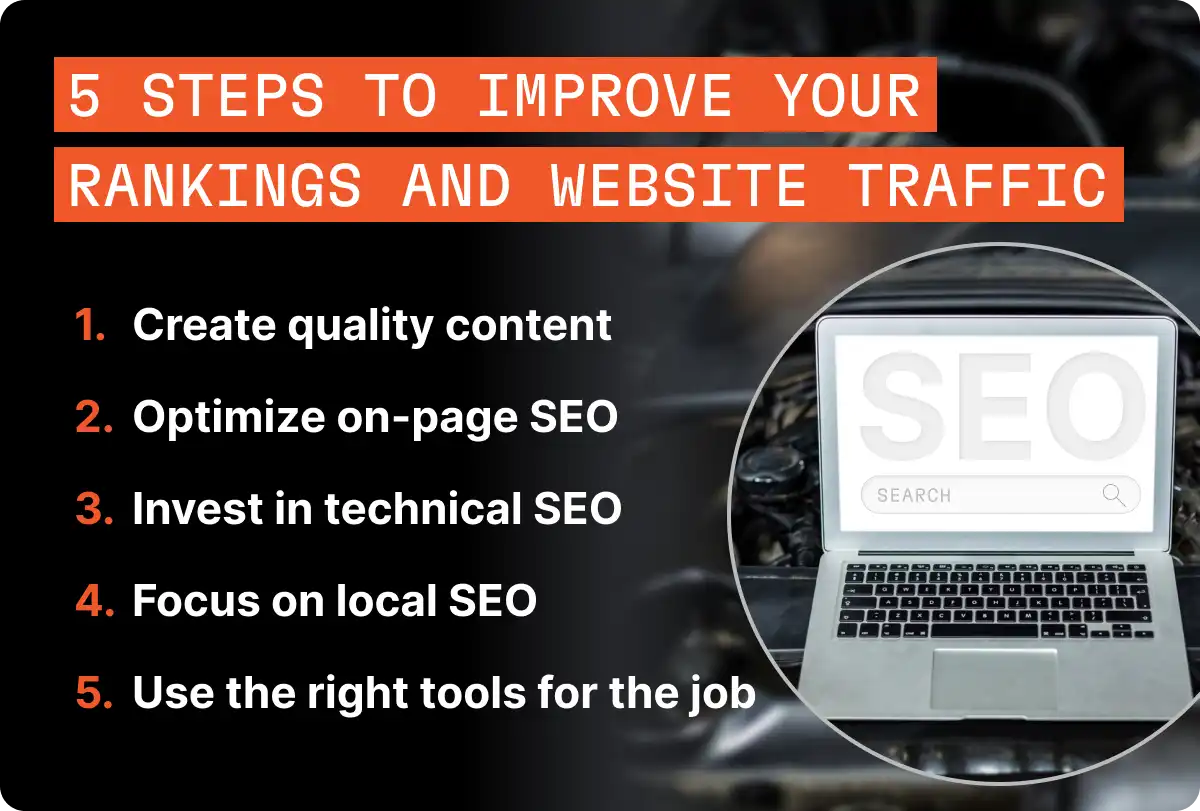
Image showing 5 steps to better SEO for auto repair shops.

Why is SEO important for Auto Repair Shops?

More traffic equals more customers

Search traffic is high-intent traffic which means that people who are searching for “mechanic near me” and similar queries are indicating that they are ready to make a decision. Social media and other traffic forms may bring in traffic but rarely are they ready to make a decision that day. Capturing more search traffic almost always leads to more conversions. Think about it, when you start looking for a service where do you start your search?

Brand awareness

Even if the customer is not ready to make a decision that day, being visible for relevant keywords is important (and free) brand awareness. Ranking well will help your shop stay top of mind for future automotive repair needs and build your online presence. Just like we remember a billboard or business logo weeks later, being visible in search engine results leads to better brand awareness and online visibility.

Cost effective

Unlike Google Ads, SEO efforts are free if you do them in-house. All you need to get started is this guide + a few YouTube videos and you can make a big difference in your website traffic and online conversions.

Local search

Search engines can use mobile device locations to help match customers with a shop that is nearby. Part of this guide will walk you through how you can indicate to Google where your auto repair shop is located and capitalize on local search traffic.

5 Steps to Improve your Rankings and Website Traffic

1. Quality content

Helpful content: Google loves fresh content and companies who regularly publish helpful content. Strategize what type of content will resonate with your audience and don’t be afraid to test new ideas. Consider removing or updating out-of-date content that is no longer relevant for your audience.

Content calendar: Creating a content calendar for your shop can help you strategize which topics you want to cover each month and who will be responsible for the project timeline.

2. On-page SEO

URLs: Did you know that Google uses the words in your url to help understand what your content is about? Avoid generic URLs like www.Yourshopname.com/blog/23trk and start using keyword-rich URLs like www.Yourshopname.com/blog/houston-tire-store. A simple optimization that can lead to better rankings.

Keyword research: Organic search is no longer about stuffing your content with every keyword you can find but keywords still play a part in how Google ranks content. Keywords are the terms searchers type into Google like “Tire shop near me” or “Brake service shop in Houston”. Other common auto repair keywords include “auto repair shop near me”, “best mechanic in (insert city)”, or "(insert service type) near me”.

You can use a free tool like Google Search Console (more info on tools later on) to explore which keywords you are ranking for and strategize how you can include those terms in your content/website. You will also want to research keywords that you do not currently rank for but want to in the future. Don’t forget to look at competitors and see what they are ranking for to help you locate your target keywords and form your overall strategy.

Internal linking: If you think of the internet as a spider web, each piece of content has internal and external links that help connect related content. These internal links help search engines crawl your website and find all the other content your website has to offer. Aim for at least one internal link in each article you write.

Meta Descriptions: As the name suggests, meta descriptions inform readers on what they can expect your content to cover. This is a great place to highlight keywords you think searchers might use to find your content.

Avoid click-bait strategies but try to make your meta description attractive and keyword dense. This will lead to better click-through-rates and better rankings. Aim to use 150 characters or less in your meta description so Google doesn’t cut it off.

Meta Titles: Think of a meta title as the headline or title tag for your content. This is a great place to showcase what your content offers and what it covers. You also want to feature your top priority keyword in the title to make sure Google (and users) know that it matches what they are searching for.

A picture showing how title and meta description tags appear in Google search.

3. Technical SEO

Tek-Tip: Warning: this section is more technical and may require the assistance of a website professional. We recommend Shopgenie to help with all of your website/SEO needs.

Page speed: Search engines have started to prioritize websites that provide a better user experience and part of that is having fast page speed. You can test your website speed using this free tool. Some quick ways to improve your page speed would be to minimize image file sizes and reduce the number of third-party scripts you have on your website. You may need to contact a website developer if you want to make bigger adjustments to your website.

Link building: Search engines use backlinks as a way to identify which websites are trustworthy and authoritative. For example, if your website has a link from Forbes pointing to your blog article, it indicates that your blog has value. The more links you can gather (especially from high-quality websites) the more reasons search engines have to believe your website has value.

SEO and PR agencies can help you build your link profile. You can also contact other websites directly and do manual outreach. The best practice is to create content that people want to link to and the links will accumulate naturally. Content that typically performs well for link-building in the automotive industry includes how-to videos, guides, and tutorials.

Mobile friendly/UX: Have you ever been frustrated by a website on your phone that you can’t use because the buttons are too close together or it loads slowly? With the majority of your target audience using their phones to search for services, your SEO strategy needs to include a user and mobile-friendly website design.

Sitemaps: A sitemap is a file that you can add to your website to help guide search engine crawlers to your content. Think of it as a crawler roadmap for your website. This file can be useful if you don’t want certain parts of your website crawled or if you recently added new content and want it to be crawled quickly.

4. Local SEO

Google My Business: Google My Business (GMB) is a free Google business profile that showcases your company, services, contact info, logo, and more. An easy way to improve your local SEO is to keep this platform up-to-date with your contact information, website, and hours of operation. If a potential customer searches “auto repair shop near me” your GMB listing indicates to Google if you service that area and helps you rank for their search.

Bonus tip: Make it easy for customers to leave reviews on your GMB profile as extra proof that you run a quality automotive repair shop. Some auto shops add a QR code on the front desk or on receipts directing customers on how to leave reviews. Make sure to respond to negative and positive reviews with professionalism. First impressions matter; potential clients often research reviews before selecting a shop.

Directories: Directories are popular aggregation review platforms like Yelp, Consumer Reports, BBB, and Yellow Pages. Claiming your business profiles and updating them with your relevant information can help some potential clients find your auto repair business. Make sure your phone number, address and website are all up to date within each directory.

Location pages: Adding your address and directions to your website can help search engines understand where you are located and aid in pairing you with appropriate local queries. Another tactic is to make sure your website content mentions your city to further boost this effort.

5. SEO tools

Paid tools: There is no shortage of SEO software/tools to help you upgrade your auto repair SEO strategy. These tools typically have a free version but they are limited in functionality and you will need to upgrade if you have larger websites. Some of the top options include Ahrefs, Semrush, and seoClarity.

Free tools: If you have a smaller website you may be able to get by with these free tools. Some of the top free SEO tools include Google Search Console, PageSpeed Insights, and free versions of Ahrefs and Semrush.

Tracking/monitoring: After making updates to your website and overall SEO strategy it is important to track your progress and KPIs like clicks, traffic, impressions, CTR and others that may be relevant to your auto repair business. You can build free tracking dashboards in Google Analytics or Google Looker Studio.

Bonus tip: Google and other search engines regularly update their algorithms so keep an eye out for volatility during these updates.

How long does it take for search engine optimization to work?

While some SEO tactics will start working immediately, larger and more consistent progress will be seen within 3-6 months if implemented correctly. Typically, this progress is seen as part of a “snowball” effect where multiple small optimizations will snowball into larger results over time.

Ranking on the first page of Google can take time but it often depends on how many competitors are in your area. All worthwhile marketing strategies take time and SEO is no different.

Final thoughts

Search engine optimization is an important tactic to drive more traffic and customers for your auto repair business. Keep in mind that SEO is one of many marketing tactics and should be part of a larger marketing strategy. To be successful in automotive shop marketing you will also need to explore other channels like social media, email, paid advertising, and traditional marketing.

Auto Repair SEO: The Complete Guide for 2026

March 18, 2025

Read time: 3 min

read more

If you’re an automotive shop owner or service advisor looking to upgrade your system, you’ve likely encountered the name Tekmetric. Like any smart shopper, you are looking for a free trial of Tekmetric before you purchase. Below, you can find a few options to test drive Tekmetric for free.

Option 1: Free Tekmetric Trial

To access your free Tekmetric self-guided trial, you can use this link here. It will walk you through the key parts of the Tekmetric software, customer experience, estimate building, customer approvals, digital vehicle inspections, and more. Afterwards, you can book a demo to chat with our sales team and start the onboarding process.

Option 2: Personalized Demo with Tekmetric

If you prefer to chat with a Tekmetric employee, you can book a demo here and ask any questions you have. We will show you how Tekmetric can maximize your efficiency, improve your customer experience, and boost sales. We will also talk about your shop's needs, goals for your business, and what gives your shop a competitive edge.

Option 3: Case Studies and Customer Reviews

We think our customers are the best sales team. So, we have provided our customer success stories, real customer reviews, and G2 rankings to aid in your decision-making process. This is a great place to see the ROI Tekmetric can provide for your shop.

Tek-Tip: Ask ChatGPT or Gemini for a summary of Tekmetric and how it could be a fit for your business.

‍
Final thoughts

Whichever option you pick, we hope you will give Tekmetric a try. Built by a former shop owner, Tekmetric understands the importance of finding the right software for your shop. Tekmetric offers month-to-month pricing options in addition to discounted annual plans to fit any budget. Unlimited users, unlimited RO's, unlimited support, no hidden fees. Are you ready to take your shop to the next level?

Tekmetric Free Trial: How to Test Drive Tekmetric Before Buying

December 2, 2025

Read time: 3 min

read more

If your customers don’t understand their estimate, their repair order, or the progress of their repair, they may become frustrated or even decide to take their vehicle somewhere else.

But when service advisors communicate effectively with customers, they’ll increase the likelihood that each customer will become a repeat customer who will refer their friends and family to your shop. In other words, clear communication with your guests can exponentially improve your profits.

Everyone at your shop has their own responsibilities, but they all need to be skilled in communicating effectively with each other and with your guests.

Your service advisors in particular need to be great at communicating with your guests because they are the ones who will set the stage for your guests’ experience at your shop.

Here are three service advisor tips for assessing and upgrading communication with your guests.